
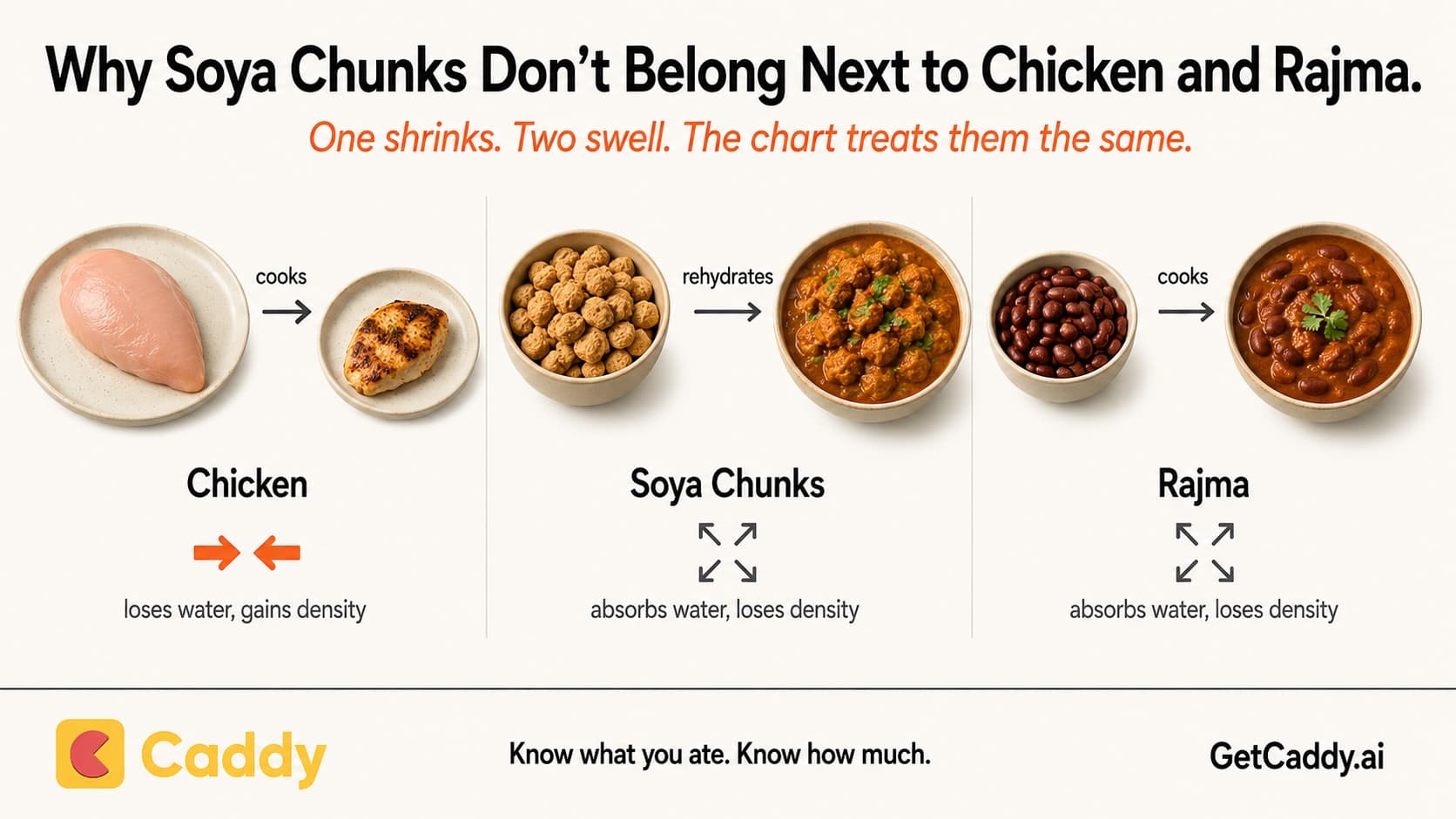
Why Soya Chunks Don't Belong Next to Chicken and Rajma (And That's Okay)
Written by Rishi Bhojnagarwala
Nutrition Reviewed by Dr. Hetal Pal, PhD in Nutrition Science
We recently came across yet another viral "Top Protein Sources" chart doing the rounds on social media. Among a list of whole protein foods like chicken, eggs, and rajma — there it was: soya chunks, usually with a headline figure of 52g of protein per 100g attached.
Here's what caught our attention. Many of the same accounts publishing these charts also publish "no supplement needed" meal plans. No whey. No protein powder. Just real food. And then soya chunks appear in the meal plan.
That's the inconsistency worth talking about. Because soya chunks are a processed protein concentrate made by an industrial process — exactly like whey. If your position is that supplements aren't necessary, soya chunks sit on the wrong side of your own line.
To be clear from the outset: there is nothing wrong with eating soya chunks. They are affordable, high in protein, and genuinely useful — especially for Indian vegetarians. This isn't an argument against them. It's an argument for knowing what you're actually eating, and for reading that 52g figure correctly.
What Soya Chunks Actually Are
Soya chunks — also sold as soy nuggets or TVP, textured vegetable protein — are not whole soybeans. They're what remains after the oil has been extracted.
The FAO's own description of the process runs roughly like this: soybeans are cleaned, cracked, dehulled, flaked, and then defatted by solvent extraction. The leftover material is ground into defatted soy flour, conditioned with steam, and forced through an extruder at 150–180°C, where heat, pressure and shear reorganise the protein into a fibrous, meat-like structure.
The starting material has to hit a tight specification: minimum 50% protein, maximum 3.5% fibre, maximum 1.5% fat.
Read that spec again. The fat is gone. The fibre is almost gone. What's left is concentrated protein in a chewy shell. That is the entire reason the number on the packet says 52g.

The Whey Parallel
Whey protein is made through a comparably technical route. Whey is separated from milk during cheese-making, then filtered, purified, and spray-dried into a powder.
Different raw material, same logic: strip away everything that isn't protein, and the protein percentage climbs.
So if soya chunks belong on a "whole foods protein" chart, whey belongs there too. Both are protein concentrates. Neither is bad. Both simply belong in a different column from eggs, dal, paneer and chicken — a point we've made before about protein bars and other convenience proteins, and one that sits at the centre of our whole-food protein hierarchy.

The 52g Problem: Raw Numbers Versus Real Plates
This is where most charts fall apart.
That 52g figure is measured on dry, raw soya chunks. Nobody eats dry soya chunks. TVP is engineered to rehydrate — it absorbs roughly three times its own weight in water. So 100g of dry chunks becomes 300–350g on the plate.
A realistic serving is about 100–125g of cooked soya chunks, and in most Indian homes that comes in a tomato-onion gravy. Strip out the gravy and you're looking at roughly 25g of dry soya in that serving. Which means about 13g of protein.
Now run the same honest arithmetic on the foods it's being compared against:
Nutrition figures from the Bon Happetee Indian food database.
Chicken looks weakest on paper at 22g and lands strongest on the plate at 34g. Soya chunks look strongest on paper at 52g and land at 13g — statistically level with rajma.
The direction of the error is worth noticing. Raw-weight comparisons don't just exaggerate soya chunks slightly. They invert the ranking entirely.
Chicken gains protein density during cooking because it loses water. Soya chunks and rajma lose protein density because they absorb it. Comparing all three at raw weight isn't a rounding error — it's comparing a food that shrinks against two foods that swell, and then reading the labels as though they mean the same thing.

Why You Can't Simply Eat More Soya
The obvious response is: fine, eat 300g of cooked soya chunks instead.
In practice, almost nobody does — and the reason loops straight back to the processing. Stripping out the fat, most of the carbohydrate and nearly all the fibre is what makes soya chunks protein-dense. It's also what makes them dense and rubbery to chew. Portion size is limited by the texture, and the texture is a direct consequence of the manufacturing.
The same process that gives you the impressive number on the packet is the process that stops you eating enough of it to reach that number.
What a Registered Dietitian Says About This
We asked Lavanya Kethamukkala, RDN, LDN, CLT, founder of Nourishing Expert LLC and a clinical dietitian with over 18 years of experience specialising in Indian and vegetarian diets, whether the processing itself changes anything nutritionally.
On whether extrusion affects protein quality compared to whole soybeans or rajma:
Yes, it does! Extrusion processing used to make soy chunks may alter protein structure and reduce digestibility, although the clinical significance is still being investigated. Soy chunks are made from defatted soy flour, meaning they don't provide the fiber and healthy fats.
As a Whole-Food, Plant-Based Dietitian navigating menopause, I include a variety of legumes—including rajma, chickpeas, and whole soy foods such as edamame, tofu, tempeh, and soybeans—3–4 times per week. I choose these foods not only for their high-quality protein, but also for their fiber, isoflavones, heart-healthy fats (in whole soybeans), resistant starch, polyphenols, vitamins, and minerals that work together to support gut, heart, metabolic, and hormonal health.
— Lavanya Kethamukkala, RDN, LDN, CLT
Her caution on digestibility is appropriately hedged, and the research supports that hedge in both directions. Soy protein scores as high as 1.0 on PDCAAS, on par with milk and egg. Extrusion can cause some lysine loss, but it also deactivates anti-nutritional factors, and high-moisture extrusion has been found to improve soy protein quality rather than reduce it. Published DIAAS values for extruded soy range from 65 to 97 across studies.
Translation: soya chunk protein is good protein. The digestibility question is unsettled and probably minor. The fibre and fat that got removed are not in dispute at all.
On whether soya chunks are functionally different from whey:
"Not all 20 grams of protein are created equal. The best protein comes packaged with fiber, healthy fats, vitamins, minerals, and protective plant compounds—not just protein alone."
Whey is an animal-derived protein that provides complete protein but lacks fiber and many of the protective phytonutrients found in whole plant foods.
Soy chunks are a convenient option, but they shouldn't become the primary source of plant protein.
— Lavanya Kethamukkala, RDN, LDN, CLT
And on the charts themselves:
"Protein grams tell you how much protein you're eating. Whole foods tell you how much nutrition you're getting."
"If two foods have the same protein, choose the one that gives you the most nutrition beyond protein."
Aim for protein that's packaged by nature—not manufactured for convenience.
— Lavanya Kethamukkala, RDN, LDN, CLT
So Should You Eat Soya Chunks?
Yes, if you want to. They're cheap, shelf-stable, complete in amino acid profile, and one of the more accessible protein options available to Indian vegetarians. For anyone struggling to close India's real protein gap — roughly 15–25g a day below requirement for most people — they are a legitimate tool.
Three things to hold onto:
Count them at serving weight, not packet weight. A bowl of soya chunk curry is about 13g of protein, not 52g. If your tracking says otherwise, your tracking is wrong.
Treat them like a supplement, because that's what they are. Useful alongside dal, rajma, curd, paneer and eggs. Not a replacement for them. As Lavanya puts it, convenient but not the primary source.
Don't build a "no supplements" identity around a supplement. If you're comfortable with soya chunks, there's no consistent reason to be scandalised by whey. Both are processed. Both are fine. What matters is what the rest of your plate looks like — which is the argument we made in detail about dal, roti and protein supplements.

Where This Actually Bites: Your Tracking
This is not an academic distinction. If you log "soya chunks, 1 bowl" and your app credits you 52g of protein, you're recording roughly four times what you ate. Do that a few times a week while genuinely trying to hit a protein target, and you will consistently fall short while your tracker tells you you're succeeding.
That's the failure mode we built Caddy to avoid. Indian food is full of these traps — foods that swell, foods that shrink, foods eaten in gravy, foods where the packet weight and the plate weight are nothing alike. Getting them right requires a database built for how Indians actually cook and eat, not one converted from Western portion assumptions. We go deeper on the mechanics in how protein absorption and utilisation actually work and on why processing itself is a poor proxy for healthiness.
Rajma is not tofu. Paneer is not cheddar. And soya chunks are not eggs — not because they're processed, but because 100g of one is not 100g of the other by the time it reaches your plate.
Not every high-protein food is equal. And not every nutrition chart deserves to go viral.
About Caddy
Caddy is a weight loss and nutrition companion built for how Indians actually eat. Instead of forcing you into a food database designed for someone else's kitchen, Caddy is powered by deep, India-first nutrition data — so logging soya chunk curry, rajma chawal or last night's dal reflects what you genuinely ate, at the weight you genuinely ate it.
Track calories, protein and fibre without overthinking. See the gaps clearly. Build habits that hold.
Clarity beats willpower. Caddy helps you see better, so you can do better.
Sources
Textured Vegetable Protein — ScienceDirect Topics, Encyclopedia of Meat Sciences
Extrusion production of textured soybean protein — Food Chemistry, 2023
Bon Happetee Indian Food Nutrition Database — protein and serving-weight figures for soya chunks, chicken, and rajma
Frequently Asked Questions
- How much protein is really in one serving of soya chunks?
- About 13g. The 52g per 100g figure printed on the packet refers to dry, uncooked chunks. Soya chunks absorb around three times their weight in water, so 100g dry becomes 300–350g cooked. A realistic serving of 100–125g cooked curry contains roughly 25g of dry soya, which works out to about 13g of protein.
- Are soya chunks better than rajma for protein?
- Not meaningfully, once you compare real servings. A serving of soya chunk curry delivers around 13g of protein and a serving of rajma curry around 12g. The gap that appears in viral charts comes from comparing dry soya chunks against dry rajma, which is not how either food is eaten.
- Are soya chunks a supplement or a whole food?
- Functionally a supplement. They are made from defatted soy flour — the material left after oil extraction — which is then extruded at high temperature into a fibrous texture. The fat and most of the fibre are removed by design. That places them in the same category as whey protein rather than alongside eggs, dal or chicken.
- Are soya chunks unhealthy because they are processed?
- No. Processing is not the problem and soya chunks are a genuinely useful protein source, particularly for vegetarians. Soy protein scores as high as 1.0 on PDCAAS, comparable to milk and egg. The issue is classification and portion maths, not safety.
- Why does chicken have more protein per serving despite a lower number per 100g?
- Because chicken loses water during cooking while soya chunks and rajma absorb it. 170g of raw chicken shrinks to about 120g cooked and still contains roughly 34g of protein. Soya chunks move in the opposite direction, which is why raw-weight comparisons reverse the true ranking.
- Can soya chunks replace whey protein?
- They can serve a similar purpose, since both are protein concentrates. The practical limit is portion size — soya chunks are chewy and dense because the fat and fibre have been stripped out, so most people cannot eat enough in one sitting to match a whey serving. Dietitians generally advise using them as one option among several rather than as a primary protein source.
Get Caddy
Your simplest way to eat smarter with Indian food
Download