
Are Protein Bars Actually Worth It? The GI Myth, the Dates Debate, and the Paneer Answer
Written by Rishi Bhojnagarwala
Medically Reviewed by Dr. Hetal Pal, PhD in Nutrition Science
India's protein bar industry has built a ₹1,000 crore marketing story on two ideas — that convenience and good nutrition are the same thing, and that dates are meaningfully better than sugar. The data disagrees with both.
The Label That Started a Conversation
Walk into any urban Indian supermarket, gym supplement store, or health food section of a modern retail chain and you will find a growing shelf of premium protein bars. The packaging is beautiful — minimal, honest-feeling, hand-lettered fonts, ingredient lists that read like a farm inventory.
And somewhere on almost every one of them, a claim that has become the defining marketing language of the category.
No Added Sugar.
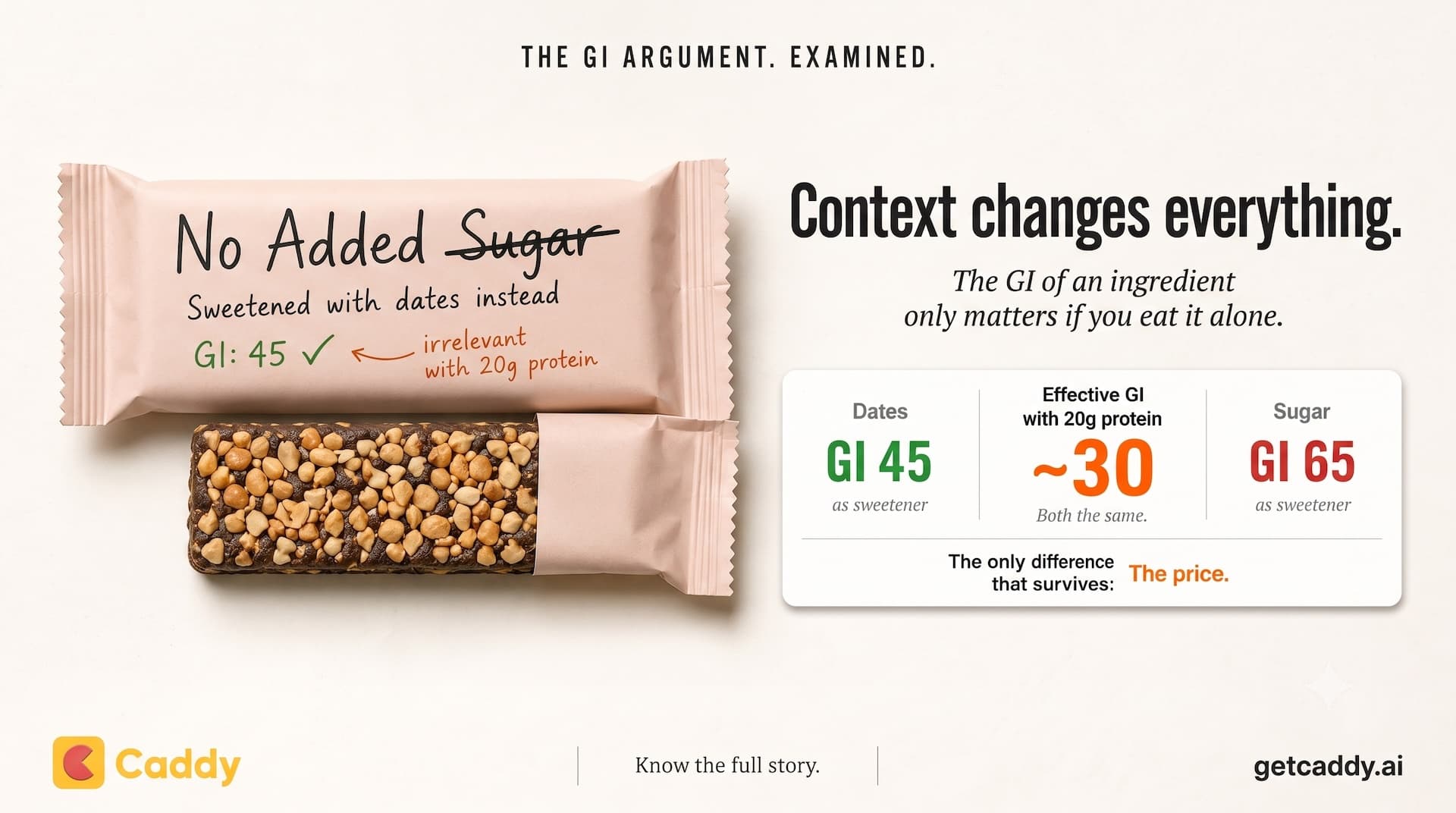
Followed, in smaller text, by the explanation: sweetened with dates instead. And often a glycaemic index comparison — dates at 45, sugar at 65 — presented as evidence that the product is healthier than the alternatives.
This claim recently attracted regulatory attention. The Food Safety and Standards Authority of India directed certain brands to remove "no added sugar" from their packaging on the grounds that dates contain sugar, and that claiming "no added sugar" while sweetening with a high-sugar fruit is misleading to consumers.
The regulatory intervention was correct. But it only addresses the surface of a marketing argument that has deeper nutritional problems — and those problems are worth understanding in full.
The GI Argument — And Why It Collapses in Context
The glycaemic index comparison between dates and sugar is the nutritional foundation of the clean label protein bar category's marketing position.
Dates: GI approximately 45. Table sugar: GI approximately 65.
Both figures are broadly accurate. The comparison, presented in isolation, suggests that choosing dates over sugar produces a meaningfully lower glycaemic response — a slower rise in blood sugar, less insulin demand, better metabolic outcomes.
This is true when you eat dates or sugar by themselves.
It is almost entirely irrelevant in a protein bar.
The glycaemic index of an individual ingredient only predicts blood glucose response when that ingredient is consumed alone. The moment you combine any carbohydrate source with protein, fat, or fibre — which every protein bar does, by definition — the GI of the final product is governed by the combination, not the individual component.
Protein is the most powerful modifier of glycaemic response in a mixed meal. It stimulates the release of hormones that slow gastric emptying, reduces the rate at which glucose enters the bloodstream, and attenuates the insulin response substantially. A food containing 15 to 20 grams of protein — which most premium protein bars do — will have a low effective glycaemic response regardless of whether the sweetener is dates, sugar, honey, or anything else.
The effective GI of a 20g protein bar, with protein suppressing the glycaemic response, is approximately 25 to 30 — regardless of which sweetener was used. The difference between the dates version and the sugar version at this effective GI level is nutritionally negligible.

There is an additional irony in the dates argument that the marketing never mentions.
Dates consumed as a standalone food — which they commonly are, as a snack or sweet — produce a more immediate glycaemic response than sugar typically does in practice. Sugar is almost never consumed alone. It travels with milk, ghee, cream, nuts, whey, or other ingredients that dramatically reduce the glycaemic load of the final product. Dates often travel alone. A bowl of dates as a snack produces a faster blood glucose response than a cup of chai with two teaspoons of sugar in full-fat milk.
The ingredient being marketed as the clean, low-GI honest alternative is, in the most common real-world consumption context, more glycaemically aggressive than the ingredient it replaced.
The GI argument was never wrong. It was just incomplete. And incomplete truth in a marketing context is its own kind of problem.
What a Protein Bar Actually Contains
Now that the sweetener debate is properly contextualised, it is worth looking honestly at what a standard premium protein bar delivers nutritionally.
A typical Indian market protein bar providing 20 grams of protein contains approximately:
Calories: 320 to 360 kcal
Carbohydrates: 18 to 25 grams
Protein: 20 grams
Fat: 15 to 22 grams
Fibre: 2 to 4 grams
The macronutrient distribution reflects a structural reality of bar manufacturing. To bind a protein bar into a bar — to give it texture, cohesion, and palatability — you need carbohydrates (grains, oats, dates, rice crisps) and fats (nuts, seeds, nut butter, coconut oil). The protein does not come alone. It cannot.
This is not a criticism of the product. It is a description of what it is. A protein bar is a high-protein, moderate-carbohydrate, high-fat snack that happens to be convenient and shelf-stable. It is a useful product in specific circumstances.
The problem is not the product. The problem is the gap between what the product is and what its marketing implies it is — a nutritionally superior choice that justifies its ₹100 to ₹150 price tag on the basis of ingredient quality and GI advantage.
When you examine that claim against the alternatives available in any Indian kitchen, the justification becomes harder to maintain.
The Paneer Comparison
100 grams of paneer — a quantity that costs approximately ₹30 to ₹40 at retail, available in every Indian home and most neighbourhood stores — delivers the following:
Calories: approximately 260 kcal
Carbohydrates: approximately 13 grams
Protein: approximately 20 grams
Fat: approximately 15 grams
Fibre: negligible
Against the protein bar at the same protein level: 80 fewer calories, 7 to 12 fewer grams of carbohydrates, comparable fat, lower glycaemic index in practice, and a cost of approximately one-quarter to one-third of the bar.
If you use low-fat paneer — widely available and similarly priced — the fat content drops to approximately 5 to 7 grams and the calorie count falls to approximately 160 to 180 kcal. At this calorie level, paneer delivers 20 grams of protein at roughly half the calories of the premium protein bar.
The preparation case is also simpler than it is often made to appear. Dice 100 grams of paneer. Heat a teaspoon of oil or ghee in a pan. Three to four minutes on each side until golden. Add chaat masala, salt, a squeeze of lemon. Total preparation time: under five minutes. No refrigeration required during consumption. Genuinely more satisfying than a bar.
The complete amino acid profile of paneer — a dairy-derived protein — is comparable to or better than most protein bar formulations, which typically blend whey, soy, or pea protein with varying amino acid completeness depending on the source.

The Cheese Alternative
Since not everyone has paneer available at every moment, cheese deserves its own analysis.
Across approximately ten common cheese varieties available in India — cheddar, processed cheese slices, mozzarella, gouda, emmental, and others — the average nutritional profile per 80 grams is approximately:
Calories: 265 to 285 kcal
Carbohydrates: 3 to 7 grams
Protein: 18 to 22 grams
Fat: 18 to 22 grams
This is a remarkably low carbohydrate count. At 5 grams of carbohydrates against 20 grams of protein, cheese has one of the lowest carbohydrate-to-protein ratios of any accessible Indian market food. The glycaemic impact is minimal regardless of any sweetener debate.
On its own, 80 grams of cheese is a relatively dense snack. Combined with a single slice of toasted bread — 75 calories, 14 grams of carbohydrates, 3 grams of protein, 1 gram of fat — the complete snack looks like this:
Total calories: approximately 350 kcal
Carbohydrates: approximately 20 grams
Protein: approximately 23 grams
Fat: approximately 20 grams
This delivers more protein than the standard protein bar, at comparable total calories, with real food satisfaction, at significantly lower cost.
The cheese on toast comparison is particularly relevant because it directly addresses the convenience argument. A slice of toasted bread with cheese takes approximately the same time to prepare as unwrapping a protein bar. It requires no special equipment beyond a toaster. It is available in most homes and offices. And it produces a more satisfying eating experience because it is real food with familiar flavour rather than a compressed nutrient delivery mechanism.
When the Protein Bar Actually Makes Sense
The protein bar is not the enemy of this argument. It is a solution to a specific problem that protein bars solve better than most alternatives.
That problem is: I need reliable, measured protein intake in a situation where I have no access to refrigeration, no time to prepare food, no kitchen, and no other options. Travel. Long commutes. Back-to-back meetings. Airport terminals. Hiking. Post-gym when there is no food available.
In these circumstances the protein bar earns its price. Shelf-stable, portable, measured, consistent — these are genuine advantages that paneer and cheese cannot match.
The issue is not the bar's existence. It is the marketing claim that the bar is nutritionally superior to real food in all circumstances — that the dates sweetener makes it a meaningful upgrade, that the GI advantage is real and relevant, that the premium price reflects nutritional value rather than convenience premium and marketing cost.
Use the bar when convenience genuinely demands it. In every other circumstance, the Indian kitchen already has better options at a fraction of the price.
The Broader Pattern
The protein bar category is one instance of a wider pattern in Indian premium health food marketing — the pattern of building brand identity around what a product does not contain rather than what it actually delivers.
No added sugar. No refined carbs. No artificial preservatives. No ingredients your grandmother cannot pronounce.
These negative claims are easy to make and difficult to challenge. They position the product as an alternative to something bad without requiring the product to demonstrate specific positive nutritional superiority. And they allow a significant price premium to be charged for an ingredient substitution — dates for sugar — that produces negligible nutritional difference in the context of a protein bar.
The regulatory intervention on "no added sugar" claims is a step toward requiring food marketing to be contextually accurate rather than technically true in isolation. The GI comparison between dates and sugar is technically accurate. In the context of a protein bar consumed as a protein source, it is not a meaningful nutritional claim.
The standard worth applying to food marketing claims is not whether the individual numbers are correct. It is whether the story those numbers are being used to tell is the complete truth.
The Practical Conclusion
Protein is not scarce in Indian food. It is abundant, accessible, affordable, and — in the form of paneer, cheese, dal, eggs, curd, and legumes — nutritionally complete in ways that many processed protein products are not.
The gap between Indian protein intake and Indian protein requirements is not a product gap. It is an awareness gap. Most Indians significantly underestimate their protein needs and significantly overestimate how much protein their current diet provides. Closing that gap requires better information — not premium products with better marketing.
Know what you eat. Know what it contains. Make decisions based on the complete number rather than the most compelling claim on the front of the package.
A ₹35 piece of roasted paneer or a slice of cheese on toast will close your protein gap as effectively as a ₹125 protein bar. It will do so with fewer carbohydrates, comparable or lower calories, and significantly more satisfaction.
That is the whole truth. All of it.
About Caddy Caddy tracks paneer, cheese, protein bars, dal, eggs, and everything in between — with one of India's most accurate food databases and real nutritional data for real Indian food. Whether you are eating a protein bar on a flight or roasted paneer at your desk, Caddy gives you the actual numbers so your decisions are based on data rather than marketing. Visit getcaddy.ai