
Processed Food Isn't the Problem. Overeating Is.
Written by Rishi Bhojnagarwala
Nutrition Reviewed by Dr. Hetal Pal, PhD in Nutrition Science
Spend a few minutes on social media and you'll see the same script repeated: avoid processed food, say no to GMOs, eat only natural. It sounds logical. Clean. Almost obvious.
Like most things in nutrition, it's not that simple.
The Real Question: What's Actually Causing Poor Health?
Step back for a second. Is it really the small share of packaged or processed food in your diet? Or is it the much larger share — the food you eat every day, often in excess?
Most real-world problems don't come from occasional chips, a protein bar, or a packaged snack. They come from overeating, excess oil and butter, oversized portions, and meals that skew heavily toward one macronutrient with nothing to balance it.
Processed Food Isn't Automatically Harmful
"Processed" has become a marketing villain, but almost everything you eat is processed in some sense: rice is milled, wheat is ground into flour, milk is pasteurised, salt is iodised. Cooking itself is a form of processing. Packaged foods simply go a step further, usually to improve shelf life, safety, or texture.

There is no strong scientific evidence that approved food additives are harmful when consumed within normal limits — we've gone through the actual chemistry and regulatory history behind the most commonly feared ones, including MSG, sodium benzoate, and xanthan gum, in detail elsewhere.
GMOs: Real Science, Not Scary Science — But Get the Example Right
Genetically modified crops are widely misunderstood, and one of the most common examples used to defend them is actually wrong, worth correcting directly: the short, high-yielding wheat varieties behind the mid-20th century Green Revolution were not genetically engineered. Norman Borlaug developed them through conventional cross-breeding, crossing tall, disease-resistant wheat with naturally short-stemmed Japanese varieties. No genetic engineering technology existed yet — that came decades later. It's still a real example of science improving crops, just not a GMO one.
India's actual, large-scale GMO story is Bt cotton, engineered to resist the bollworm pest that used to devastate cotton crops. A rigorous panel study published in PNAS found Bt adoption increased yield per acre by 24% and cotton profit among smallholders by 50%, alongside a sharp cut in insecticide use. The longer-term picture is more nuanced — later research in Nature Plants found yield gains over 20 years correlate more with fertiliser use than Bt adoption alone, though the pesticide reduction held up. On safety specifically, the U.S. National Academies of Sciences' 2016 review of over 1,000 studies found no evidence that GE crops pose different health risks than conventionally bred ones.
Without crop science — genetically engineered or conventionally bred — feeding a growing population would be significantly harder either way.
The Bigger Problem: Quantity, Not Category
Here's the uncomfortable truth: you can eat completely "clean" food and still gain weight, develop insulin resistance, or struggle with your health. The body responds to total calorie intake, nutrient balance, and consistency over time — not whether a label says "natural" or "processed."

India's Reality: It's Not the Packaged Food
In India, packaged food is a genuinely small share of what people actually eat. According to a 2024 report from the Economic Advisory Council to the Prime Minister, packaged processed food's share of rural household food expenditure rose from just 2.3% in 2011-12 to 3.2% in 2022-23 — real growth, but still a small slice of the plate. The majority of Indian meals remain home-cooked, carb-heavy, and often high in oil, which lines up with ICMR-INDIAB data showing Indians derive roughly 62% of calories from carbohydrates.
So if health issues are rising, it's worth asking honestly: are we blaming the wrong thing?

What Actually Works: Moderation and Structure
The solution isn't eliminating foods. It's building better habits: controlling portion sizes, balancing meals across protein, carbs, fibre and fat, avoiding constant overeating, and managing how often — not whether — you indulge.
In simple terms: it's not processed versus natural. It's excess versus moderation.
Where Most People Struggle
Even once people understand this, execution is genuinely hard — portion sizes are unclear, Indian meals are complex mixed dishes, and most nutrition apps were never built to understand them.
How Caddy Helps You Eat Smarter
One score, clear guidance. Every meal gets a score from 0-10. Score 8 means you're on track to lose weight — no calorie math, no confusion.
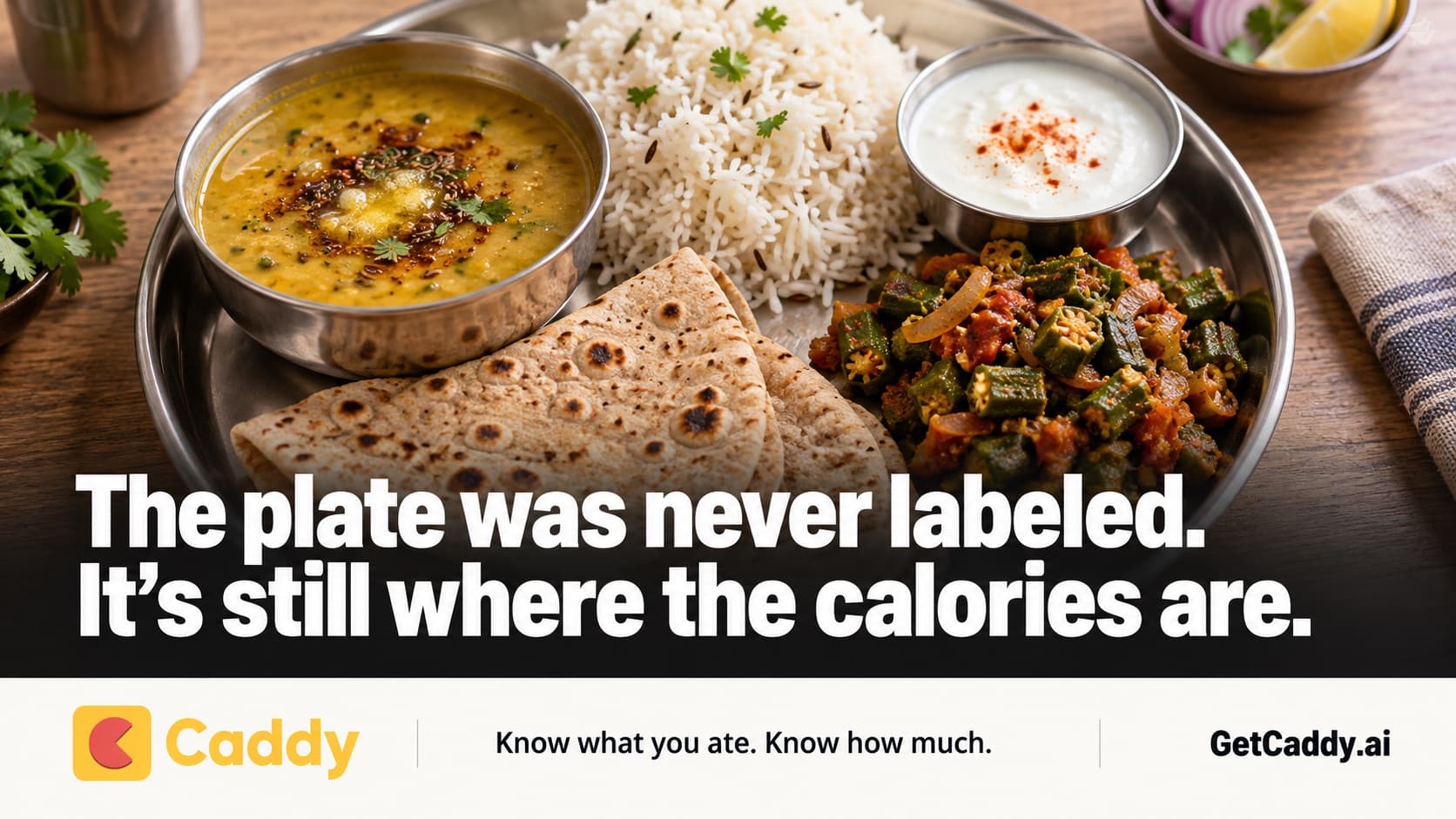
Built for Indian food. Caddy understands dal in a katori, roti-sabzi-thali combinations, and real Indian portions — powered by the Bon Happetee database, not a generic Western food list.
Real-time meal feedback. Caddy tells you what's missing from a meal and what to adjust next, rather than just logging a number.
Portion awareness without obsession. Instead of strict dieting, Caddy helps you eat the same food you already enjoy — just with better awareness of how much.

The Simple Rule
Processed food isn't the villain it's made out to be, and "natural" food isn't automatically healthy. What matters is how much you eat, how often, how well your meals are structured, and how consistent you are over time.
Eat everything. Just eat it right.
Know what you ate. Know how much.
Score 8. Lose weight. That's it.
Sources
MSG, E211, E415: The Real Source Behind "Scary" Additives — Caddy
Kathage, J. & Qaim, M. Economic impacts and impact dynamics of Bt cotton in India — PNAS, 2012
Long-term impacts of Bt cotton in India — Nature Plants, 2020
Comprehensive Nutrition Report — Economic Advisory Council to the Prime Minister, 2024
Frequently Asked Questions
- Is processed food actually bad for weight loss?
- Not inherently. Most foods are processed to some degree — even milling rice or pasteurising milk counts. The evidence points to total calorie intake, portion size, and overall dietary balance as the real drivers of weight gain, not whether a food is labeled "processed."
- Are GMOs safe to eat?
- Yes, according to the scientific consensus. A comprehensive 2016 review by the U.S. National Academies of Sciences found no evidence that genetically engineered crops pose different health risks than conventionally bred ones.
- Is Green Revolution wheat a GMO?
- No — this is a common misconception. Norman Borlaug's high-yielding dwarf wheat varieties were developed through conventional cross-breeding, not genetic engineering, which didn't exist as a technology yet. India's actual major GMO crop is Bt cotton.
- How much of the Indian diet is actually packaged or processed food?
- A relatively small share. Government data shows packaged processed food made up just 2.3% to 3.2% of rural household food spending between 2011-12 and 2022-23. Most Indian meals remain home-cooked.
- If processed food isn't the main problem, what is?
- Overeating, imbalanced meals, and inconsistent portion sizes — not the specific category a food falls into. Moderation and structure matter more than whether something is "natural" or "processed."
Try Caddy
Your simplest way to eat smarter with Indian food
Download