
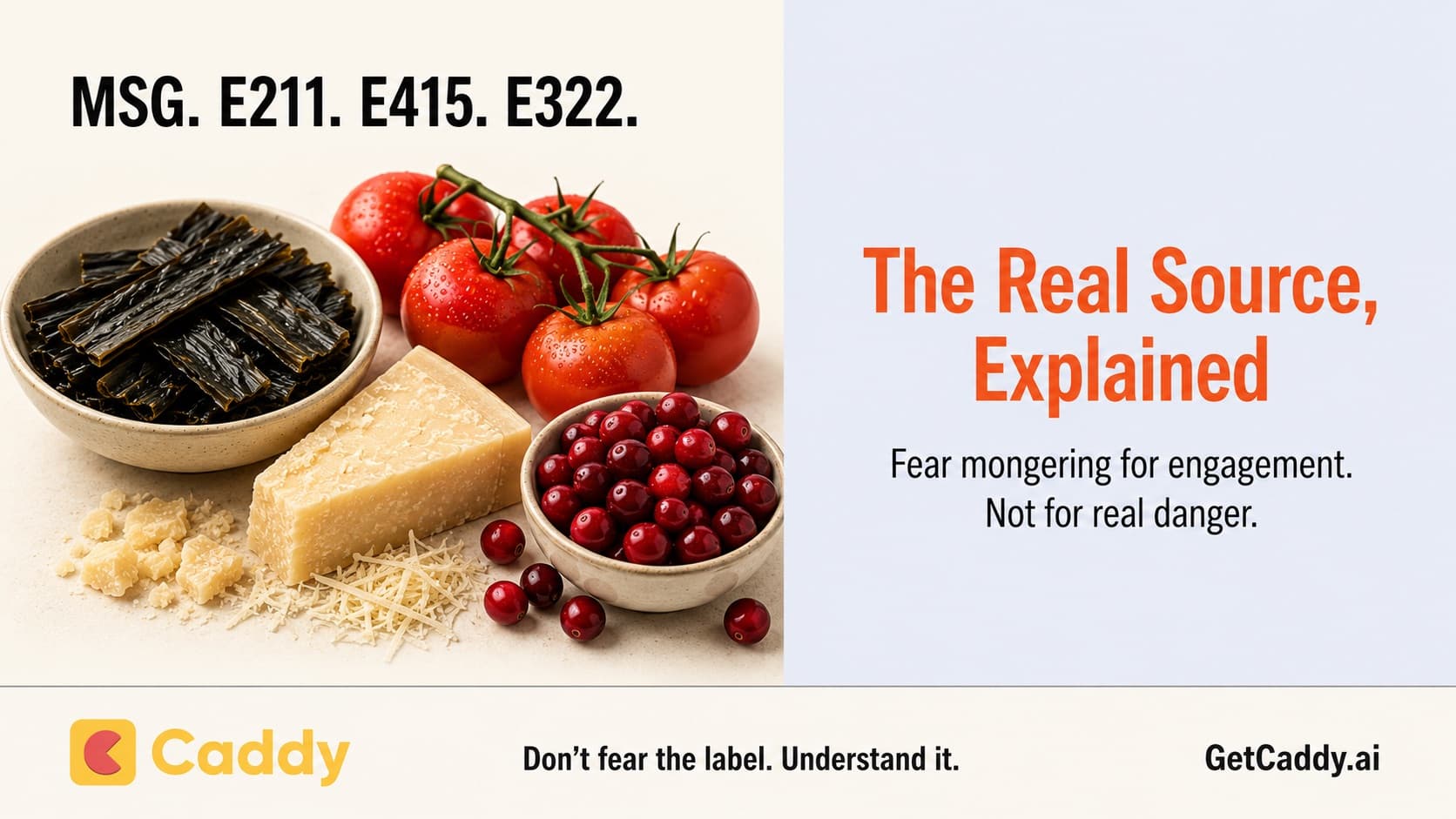
MSG, E211, E415: The Real Source Behind "Scary" Additives
Their long-standing presence is often weaponized by activists to provoke consumer anxiety and drive engagement. Here's where these ingredients actually come from.
A Pattern, Not a Coincidence
From influencers to weight-loss coaches to "clean" food founders, the modern rulebook for building an audience runs through the same move: point at a packaged food's ingredient list, land on a name or number that sounds unfamiliar, and let the silence do the rest. Fear spreads faster than facts, and pointing at packaged food ingredients has become the fastest, cheapest way to generate it.
The strategy has an underlying pattern worth naming directly: their long-standing presence in food is weaponized specifically because it's unfamiliar-sounding, not because it's actually dangerous. Here's what several of the most commonly targeted additives actually are.
What E and INS Numbers Actually Mean
Before the catalog — a quick clarification. E-numbers are Europe's standardized labeling code for approved food additives. India's FSSAI uses INS (International Numbering System) instead, part of the same global Codex Alimentarius standard — functionally identical numbers, different prefix. Neither system tells you whether something is natural or synthetic, dangerous or benign. It's a reference code, nothing more. You have to actually look at what's behind the number.

Monosodium Glutamate — E621 / INS 621
MSG has arguably the most damning origin story of any modern food fear. It was first extracted not from a laboratory, but from seaweed broth in 1908, by a Japanese chemist studying why the broth tasted so savory. Glutamate — the same compound — occurs naturally in tomatoes, parmesan cheese, mushrooms, potatoes, soy sauce, and even human breast milk.
The fear that made MSG infamous, "Chinese Restaurant Syndrome," has documented roots in anti-Asian bias rather than rigorous science — the term traces to a single 1968 letter to the New England Journal of Medicine built on personal anecdote, not a controlled study. Double-blind, placebo-controlled challenge studies have consistently found no measurable difference in symptoms between MSG and control groups. The FDA classifies it as Generally Recognized As Safe, and — tellingly — prohibits "No MSG" claims on products containing ingredients that naturally contain it, because regulators already understand the natural-versus-synthetic distinction here is meaningless.

Sodium Benzoate — E211 / INS 211
Sodium benzoate is a water-soluble preservative, effective specifically in acidic foods like ketchup and jam. Its benzoate component occurs naturally, in real concentrations, in cranberries — up to roughly 0.5% of their weight — as well as plums, prunes, and most berries. It's high enough in cranberries to function as the fruit's own built-in preservative, part of why cranberries resist spoilage without any additive at all. The FDA caps sodium benzoate at 0.1% of food weight, GRAS at that level.
Xanthan Gum — E415 / INS 415
Xanthan gum isn't synthesized from petrochemicals. It's produced through natural fermentation — bacteria (Xanthomonas campestris) breaking down sugar — the same broad category of biological process that produces yogurt, vinegar, and wine. It received FDA GRAS status in 1969, and a 2017 EFSA re-evaluation found no adverse effects even at the highest tested exposure levels.
Soy Lecithin — E322 / INS 322
Lecithin's name comes from the Greek word for egg yolk — it was originally isolated from egg yolk before soybeans became the dominant commercial source. It's naturally present in egg yolk, soybeans, sunflower seeds, and several other plant and animal foods. Industrially, it's a mechanically extracted byproduct of soybean oil processing — not a lab invention, and it's also one of the few additives permitted in organic food production in many jurisdictions.
Curcumin, Ascorbic Acid, and Citric Acid — The Everyday Ones
A few more, briefly, because the pattern holds across dozens of common codes: E100 (INS 100) is curcumin — the compound in turmeric, haldi, sitting in almost every Indian kitchen. E300 (INS 300) is ascorbic acid, better known as vitamin C. E330 (INS 330) is citric acid, naturally occurring in every lemon. None of these needed a scary number to already be trusted, whole, natural ingredients — they only became suspicious once reduced to a code on a different product's label.
It's Not Just Additives — Palm Oil Gets the Same Treatment
This pattern extends beyond additives entirely. Palm oil is routinely cancelled by "no palm oil" labels, despite having lower saturated fat and zero cholesterol compared to ghee, an ingredient that carries an almost unquestioned cultural halo. Same pattern, different target: familiarity and reputation determine the fear, not the actual nutrition data.

The Actual Business Model
Pointing at a number on a label, offering no explanation of its function, and letting silence imply danger isn't information. It's a strategy — and it's a genuinely effective one, because it converts a completely ordinary ingredient into content, and content into an audience for whatever "clean" alternative gets sold next.
This is the specific damage worth naming: consumers pay more for products with no meaningful nutritional advantage, based on fear of ingredients that, in many cases, are less exotic than the fruit already sitting in their kitchen.
How Caddy Fits Into This
We're not in the business of flagging ingredients by how unfamiliar their names sound. Caddy tracks the number that actually predicts your outcome — total calories and macros — regardless of which regulated, well-understood additive happens to be doing its job in your food.
Know what you ate. Know how much.
Score 8. Lose weight. That's it.
Sources
Frequently Asked Questions
- Is MSG actually safe to eat?
- Yes. MSG is classified as Generally Recognized As Safe by the FDA. Double-blind, placebo-controlled studies have found no consistent difference in symptoms between people given MSG and those given a placebo. It occurs naturally in foods like tomatoes, parmesan cheese, mushrooms, and human breast milk.
- What is E211 and is it dangerous?
- E211 is sodium benzoate, a preservative that occurs naturally in cranberries (up to 0.5% of their weight), plums, prunes, and most berries. It's regulated by the FDA at a maximum of 0.1% of food weight and considered safe at that level.
- Is xanthan gum a natural or synthetic ingredient?
- Xanthan gum is produced through natural fermentation — bacteria breaking down sugar — the same general category of process used to make yogurt, vinegar, and wine. It is not synthesized from petrochemicals.
- What's the difference between E-numbers and INS numbers?
- They're functionally the same system. E-numbers are used in Europe; India's FSSAI uses INS (International Numbering System) instead, based on the same global Codex Alimentarius standard. Both are simply labeling codes for approved additives, not indicators of safety or danger.
- Why do influencers and brands use ingredient numbers to create fear?
- Pointing at an unfamiliar-sounding number on a label, without explaining what it actually is, is an effective way to generate engagement and sell "clean" alternative products. The strategy relies on the number sounding scary, not on the ingredient actually being harmful — many of these ingredients, including MSG and sodium benzoate, occur naturally in common foods.
Score 8 to lose weight
Your simplest way to eat smarter with Indian food
Get Caddy