
Palm Oil vs Ghee: What the Nutrition Data Actually Shows
Written by Rishi Bhojnagarwala
Nutrition Reviewed by Dr. Hetal Pal, PhD in Nutrition Science
"No Palm Oil" labels are everywhere. Ghee gets a permanent health halo. Here's what the actual numbers say.
The Question Nobody's Actually Answered
Walk down any Indian supermarket aisle and you'll see it on pack after pack: "No Palm Oil," printed proudly, like the brand has kept out something dangerous. Meanwhile, ghee sits on the same shelf with an entirely different reputation — traditional, wholesome, grandmother-approved, beyond question.
Nobody seems to have actually compared the two on paper. So here's that comparison.
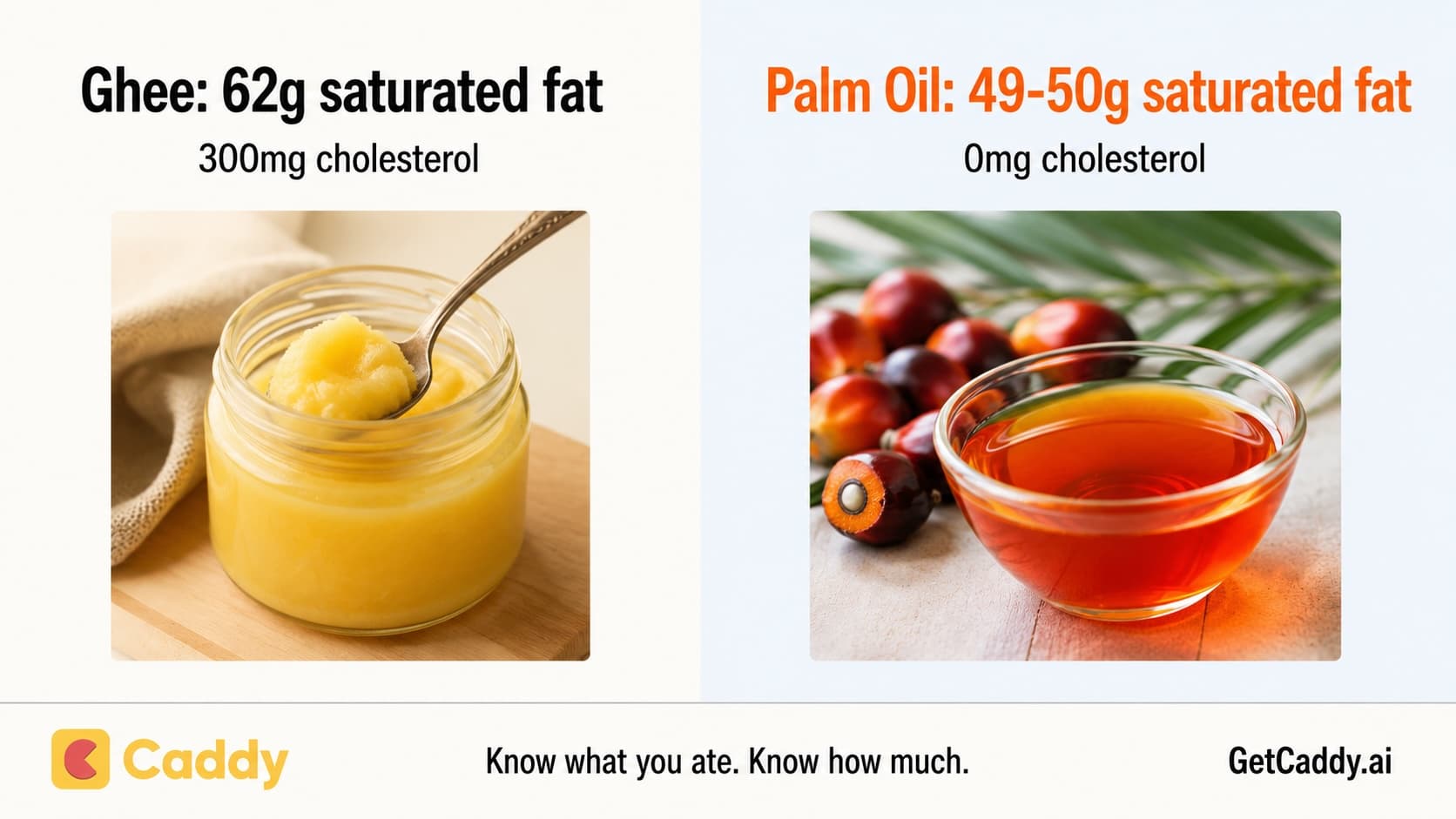
The Data, Per 100 Grams
On every metric people typically cite when they're wary of palm oil — saturated fat content, heart health implications — ghee scores worse, not better. Ghee carries roughly 25% more saturated fat than palm oil. It carries a substantial cholesterol load that palm oil, being entirely plant-derived, cannot have by definition. Palm oil also has more monounsaturated fat, more omega-6, and roughly seven times the vitamin E content of ghee.

An Important Caveat, Stated Upfront
This comparison is specifically about the health and nutrition question. Palm oil carries a separate, entirely legitimate controversy that has nothing to do with saturated fat or cholesterol: large-scale palm oil production has been linked to deforestation and habitat loss in producing regions, particularly affecting rainforest ecosystems and wildlife. That's a real concern, and a different conversation from whether palm oil is bad for your body when you eat it. This piece addresses only the health question — not the environmental one, which deserves its own scrutiny and isn't being dismissed here.

So Why Does Palm Oil Get the "Villain" Treatment?
If the nutrition numbers don't support fearing palm oil more than ghee, something else is driving the reputation gap.
The most plausible explanation: palm oil is cheap. Because it's cheap, it gets used — and reused — at a scale and frequency that other oils rarely are. Street food vendors, packaged snack manufacturers, and quick-service kitchens reuse the same oil for frying, reheating it repeatedly across a day or even multiple days, well past the point any oil should be reheated.
Repeated heating genuinely does degrade oil, producing harmful compounds and breaking down beneficial nutrients regardless of which oil is being used. But that's a process problem, not an ingredient problem. Olive oil, mustard oil, or ghee, subjected to the same repeated high-heat reuse, would degrade in largely the same way.
The Thought Experiment Worth Sitting With
If olive oil cost what palm oil costs, it's a fair bet your neighborhood samosa stall would be frying everything in extra virgin olive oil. Give that scenario ten years, and there's a reasonable chance an entirely new content genre would exist: "the dangers of olive oil," built on the exact same reused-oil argument currently aimed at palm oil.
The ingredient isn't what determines the damage. The way it's used — reused, overheated, applied to excessive quantities of fried food — is what actually matters.
The Real Pattern: Ingredient Blame, Portion Silence
This fits a broader pattern that shows up across nutrition conversations generally: it's far easier to circle a single ingredient on a label and declare it the villain than to examine total consumption, cooking method, and portion size — the factors that actually determine health outcomes in most cases.
Palm oil isn't uniquely dangerous. Fried food, eaten in excess, cooked in oil that's been reused far beyond reasonable limits, is a real concern — regardless of which oil happens to be in the fryer. Framing this as a single-ingredient problem lets the actual issue, overconsumption and poor oil-handling practices, escape scrutiny entirely.
What This Doesn't Mean
This isn't an argument that palm oil deserves the same cultural reverence ghee has, or that either oil should be consumed without limit. Both are, after all, still fat — calorically dense at roughly 884-900 kcal per 100g, and worth moderating regardless of source. It's an argument for evaluating oils based on actual nutrition data and how they're used, rather than which one has better branding or a longer cultural association with home cooking.
What a Nutrition Coach Says About This
We asked Rena Awada, Certified Nutrition Coach (PN1), founder of Healthy Fitness Meals, for a practical take on all three questions this piece raises.
Q: When Indian food safety data shows repeated frying degrades any oil similarly, why does public perception single out palm oil specifically rather than the reuse practice itself?
Rena: The "bad" status of palm oil as a quick reference to "not good for you" stems from the fact that it contains a high percentage of saturated fats and the fact that most people eat it as part of their diet when they consume processed products. In doing so, there is less focus placed on how it is prepared with respect to repeated thermal treatment. A critical aspect of oil degradation is also related to heat (with or without oxygen) and particle degradation, which are independent of the type of oil. Therefore, focusing solely on the quality of the oil used may be misleading and does not provide the whole story regarding the handling of the oil.
Q: Is there a meaningful nutritional difference between palm oil and ghee once you account for typical serving size and cooking use, rather than comparing them gram-for-gram at 100g?
Rena: Yes, but the way in which they are both portioned and consumed makes it easier to compare them. They are both types of concentrated fats; however, ghee has a higher concentration of saturated fats compared to palm oil. A single tablespoon now and then versus comparing 100 grams for nutritional purposes are two vastly different ways to look at this. When considering how these fats can be utilized on an everyday basis, I believe that you should consider your total consumption, methods of preparation, and overall diet instead of labeling one of the fats as "good" or "bad."
Q: What's the most reliable way for a home cook to tell when frying oil has been reused too many times and should be discarded?
Rena: There isn't a single foolproof way to visually identify when cooking oil has reached its end. Home cooks should look at several signs at once: if the oil has significantly changed color, thickened, is excessively frothy, smells unpleasantly of rancid products, or smokes earlier than usual — all of these mean it's time to discard it. If you can't determine what's been done with the oil previously, replace it.

How Caddy Fits Into This
This is exactly the kind of ingredient-level fear Caddy is built to cut through. Rather than sorting oils, or any food, into "good" and "bad" categories based on reputation, Caddy tracks the one thing that actually predicts your outcome: total calories and macros, regardless of which oil cooked your meal.
Score 8 means you're in a calorie deficit — true whether tonight's sabzi was cooked in palm oil, ghee, or anything else, as long as the portion and frequency make sense for your day.
Know what you ate. Know how much.
Score 8. Lose weight. That's it.
GetCaddy.ai
Sources
Frequently Asked Questions
- Is palm oil actually bad for your health?
- On the core nutrition metrics people typically worry about — saturated fat and cholesterol — palm oil compares favorably to ghee, a widely trusted cooking fat. Palm oil has less saturated fat than ghee and, being plant-derived, contains no cholesterol at all. The main legitimate concerns around palm oil relate to environmental impact from large-scale production, not direct health effects from consumption in reasonable amounts.
- How does palm oil's saturated fat compare to ghee?
- Palm oil contains roughly 49-50g of saturated fat per 100g, while ghee contains approximately 62g per 100g — about 25% more. On this specific metric, ghee is the higher-saturated-fat option of the two.
- Does palm oil contain cholesterol?
- No. Palm oil is entirely plant-derived, and cholesterol is only found in animal-derived fats. Ghee, being made from dairy, contains approximately 300mg of cholesterol per 100g. Palm oil contains 0mg.
- Why do brands advertise "No Palm Oil" on packaging?
- This is largely a marketing and perception choice rather than one grounded in comparative nutrition data. Palm oil has developed a negative reputation, partly due to environmental concerns around large-scale production and partly due to its association with heavily processed, cheaply made fried snacks — even though the oil itself, nutritionally, doesn't compare unfavorably to widely trusted alternatives like ghee.
- Is palm oil safe to cook and fry with?
- Palm oil has a smoke point of around 230°C, making it reasonably stable for high-heat cooking. Like any oil, repeated reheating and reuse — common in street food and mass snack production — degrades its quality and can produce harmful compounds. This is a risk associated with oil reuse practices generally, not something unique to palm oil specifically.
Get Caddy
Your simplest way to eat smarter with Indian food
Download