
India's Protein Crisis Is Hiding Behind the Wrong Statistic
Written by Rishi Bhojnagarwala
Medically Reviewed by Dr. Hetal Pal, PhD in Nutrition Science
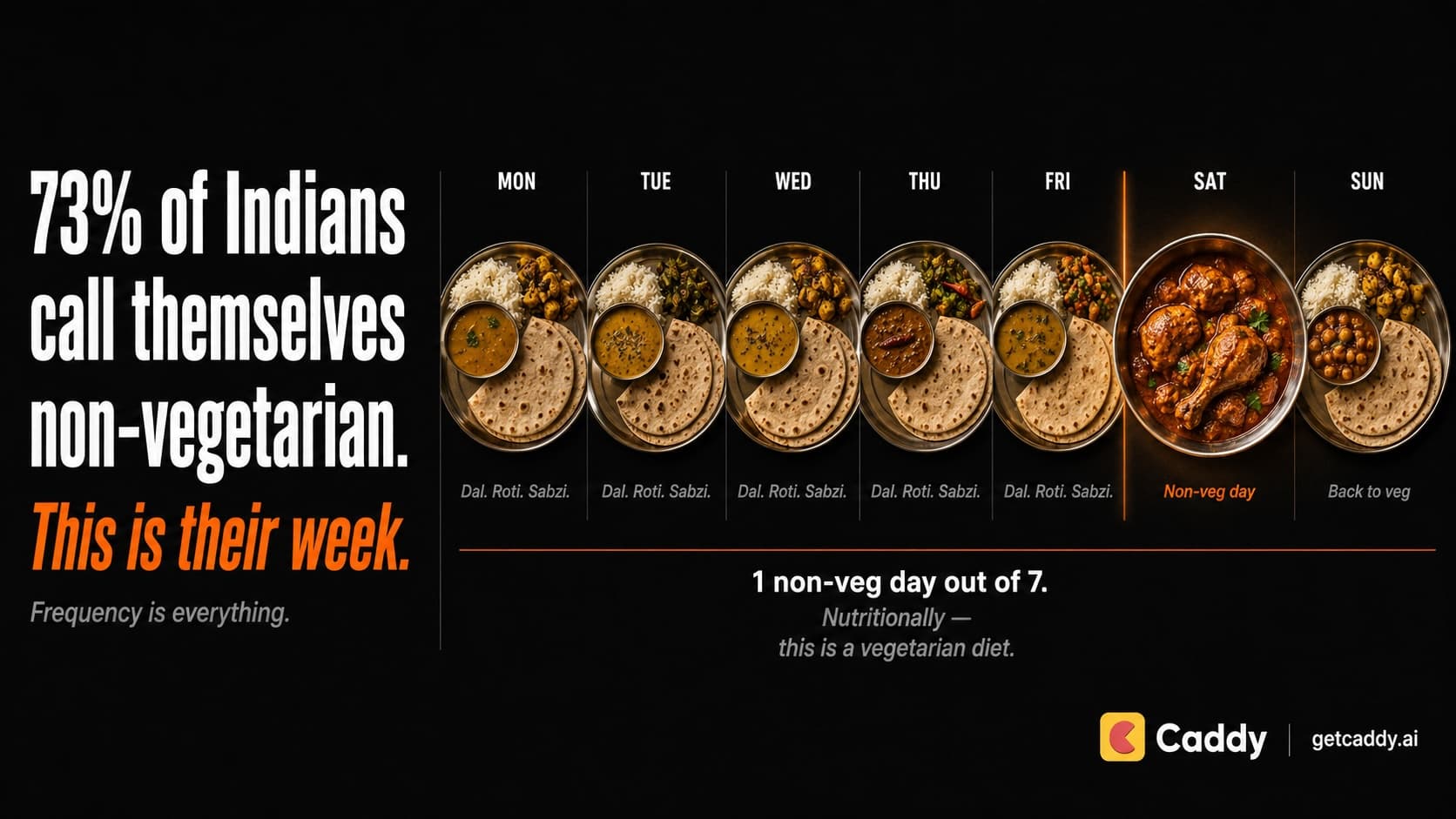
73% of Indians eat non-vegetarian food. The number is accurate. In a nutrition context, it has been actively misleading public health policy for years — and the real protein gap is far larger than the headline figures suggest.
The Number Everyone Cites
Open almost any discussion about protein deficiency in India and you will encounter the same statistic within the first few paragraphs.
Approximately 73% of Indians eat non-vegetarian food.
It appears in policy papers, nutrition debates, food industry market analysis, and public health discussions. It is used — explicitly or implicitly — to suggest that a large majority of Indians have access to regular animal protein.
The problem is that this is not what the statistic measures. And the gap between what it measures and how it is used has significant consequences for how India understands and addresses what is genuinely one of its most serious and underacknowledged public health problems.

What the 73% Actually Measures
The figure is primarily drawn from the National Family Health Survey 5 (NFHS-5, 2019-21), which recorded between 70 and 73% of the surveyed population as non-vegetarian depending on state-level aggregation methodology. Similar figures appear in NSSO household consumption surveys.
The surveys ask, in various formulations, whether the respondent or household consumes non-vegetarian food. The answer captures dietary identity and cultural practice — not consumption frequency, not weekly intake, and not the regularity with which animal protein actually appears on the plate.
In the Indian context, "non-vegetarian" is partly a cultural and religious category. It signals that the household does not observe a strictly vegetarian diet on religious or ethical grounds. A family that eats chicken on Eid, Christmas, and two or three other occasions during the year will correctly identify itself as non-vegetarian on such a survey. So will a family where one member eats eggs occasionally while the rest of the household is vegetarian.
The statistic was designed to measure dietary identity. It has been repurposed to imply dietary composition. These are different things.
The Frequency Gap
The NSSO 68th Round household consumption expenditure surveys provide a more granular picture. When frequency data is examined rather than binary dietary identity, the picture changes substantially.
Approximately 40 to 50% of self-identified non-vegetarian households report consuming any meat, poultry, or fish in a given week. The remaining portion of self-identified non-vegetarians consume these foods less frequently — monthly, on festivals and special occasions, or rarely.
When the threshold is raised to regular consumption — three or more servings per week, which is broadly the frequency at which meat consumption becomes a meaningful contributor to weekly protein intake — credible cross-referenced estimates from nutritional surveys suggest this figure is approximately 10 to 15% of the total Indian population.
This is a significant difference from 73%.
For the purpose of nutritional analysis, India is effectively a vegetarian or near-vegetarian country for the overwhelming majority of its population on the overwhelming majority of days. The primary protein sources for most Indians — regardless of their cultural self-identification — are dal, legumes, milk, curd, and dairy products.

The Real Protein Gap — And Why It Is Larger Than It Looks
This is where the analysis requires careful attention, because the commonly cited comparison between actual and recommended protein intake can appear reassuring when it is anything but.
Average per capita protein consumption in India is estimated at approximately 47 to 60 grams per day. The ICMR Recommended Dietary Allowance is 0.8 grams per kilogram of body weight. At first glance these numbers appear close — almost compatible. This appearance is misleading for three distinct reasons. Furthermore, this protein primarily comes from carb rich sources such as wheat and rice with an incomplete amino acid profile.
First: the recommended intake is calculated against outdated reference body weights.
The ICMR's 0.8g/kg recommendation uses reference body weights of 65 kilograms for the Indian reference man and 55 kilograms for the Indian reference woman. At these reference weights the minimum requirements are approximately 52 grams and 44 grams respectively — figures that do seem broadly consistent with reported average consumption.
But actual average Indian body weights — particularly in urban populations — are now significantly higher than these reference figures. NFHS-5 data indicates average urban Indian men weigh approximately 68 to 72 kilograms. Applied to actual body weights at the ICMR's own 0.8 gram threshold, the minimum protein requirement rises to 54 to 58 grams for men — already beyond what a significant portion of the population reliably consumes on a daily basis.
Second: 0.8 grams per kilogram is a deficiency prevention floor, not a health target.
The 0.8g/kg figure represents the minimum required to prevent protein deficiency in sedentary individuals — not the amount required for health, physical activity, immune function, or healthy aging. The current consensus in nutrition research has moved substantially beyond this threshold.
Most credible nutrition researchers and health organisations now recommend 1.0 to 1.2 grams per kilogram of body weight for reasonably active adults. The recommendation rises further — to 1.2 to 1.6 grams — for older adults concerned with age-related muscle loss, which is increasingly recognised as one of the most significant health risks of aging populations.
At 1.0 gram per kilogram applied to actual Indian body weights of 68 to 72 kilograms for men and 58 to 62 kilograms for women, the recommended daily protein intake is approximately 65 to 75 grams for men and 58 to 62 grams for women — an overall average of 60 to 70 grams - primarily from protein sources (with essential amino acids) such as dairy, eggs, meat.
Third: the 47 to 60 gram average conceals severe distributional skew.
Population averages in nutrition data are particularly susceptible to being misleading because food consumption is not normally distributed across a population. Urban middle-class households with access to diverse protein sources pull the average upward, while rural households, low-income urban households, and women across all demographic groups cluster near the lower end of the range.
The Right to Protein survey conducted by IMRB in 2020 — one of the most comprehensive recent assessments of Indian protein consumption — found that nine out of ten Indians consume a protein-deficient diet by any reasonable measure. This figure is more informative than the average range because it captures the distributional reality: the average of 47 to 60 grams is carried by a minority of well-nourished urban consumers masking a much more severe deficiency across the majority.
What the Real Gap Looks Like
When the comparison is made correctly — actual consumption against recommended intake based on current guidance and actual body weights — the gap is 15 to 25 grams of protein per day for the average Indian adult.
For women, for rural populations, and for older adults, the shortfall is larger.
15 to 25 grams per day does not sound dramatic until you consider what it means compounded over time. Protein is not stored by the body in the way fat and carbohydrates are. The shortfall cannot be compensated for by occasional high-protein meals. It must be met consistently, daily, across a lifetime. A sustained deficit of this magnitude over years and decades has measurable consequences for muscle mass, metabolic function, immune response, bone density, cognitive health, and the management of chronic disease.
India's protein deficiency problem is not a rounding error. It is a structural public health challenge of significant scale that has been chronically underestimated because the data most commonly cited — 73% non-vegetarian, average consumption of 47 to 60 grams — makes it look manageable when the full picture does not support that conclusion.

The Policy Error This Creates
When policymakers, nutritionists, and food industry analysts operate from the assumption that 73% of the population regularly consumes animal protein, they systematically underestimate the protein gap. They design nutrition interventions around a dietary baseline that does not reflect how most Indians actually eat on most days.
They look at a population that describes itself as largely non-vegetarian and conclude that protein deficiency cannot be the structural problem the health data suggests. The dietary identity statistic provides false reassurance that the nutritional reality does not support.
This is not a minor methodological issue. Underestimating the severity and prevalence of protein deficiency leads to underinvestment in solutions — whether those solutions are nutritional education, food fortification policy, school meal program redesign, accessible supplementation, or the inclusion of protein adequacy as a specific measurable outcome in public health programs.
The protein deficiency problem in India is real, it is large, and it is disproportionately borne by the people least able to address it through individual dietary choice — rural populations, women, low-income households, and older adults. Accurately characterising the problem is the necessary first step toward addressing it.
The Broader Principle
There is a wider point worth making about how data travels in public discourse.
Data does not become misleading only through fabrication or error. It becomes misleading through context mismatch — accurate numbers applied to questions they were never designed to answer, in frameworks that produce systematically wrong conclusions.
The 73% non-vegetarian figure is accurate and useful in its original context: understanding cultural and religious food identity in Indian households. It is a meaningful data point for anthropologists, food industry researchers, and anyone studying the social role of food in Indian life.
It is not a proxy for protein adequacy. The survey that generated it was designed to answer a different question. Using it as though it can answer the nutritional question produces the specific and consequential error we have described — the false appearance of a manageable protein gap where a serious structural deficiency actually exists.
Before a statistic is cited, the question worth asking is: what was this designed to measure, and is that actually the same thing I am trying to understand?
In the case of Indian protein nutrition, the answer is clearly no. And that mismatch has been quietly distorting the conversation — and by extension the policy response — for a long time.
What Would Actually Help
The question of how India closes a protein gap of 15 to 25 grams per day across a population of 1.4 billion is genuinely complex and genuinely important. It does not have a single answer.
For urban households with access to diverse food sources, the answer is often education and awareness — helping people understand what their actual protein intake is and where the gaps are in their existing diet. Dal, eggs, paneer, curd, and legumes can collectively provide adequate protein at accessible cost, but they need to be consumed in adequate quantities and with enough frequency to actually close the gap. Most people, including health-conscious urban Indians, significantly overestimate their daily protein intake.
For rural and low-income populations the answer involves structural interventions — food fortification, the redesign of public distribution systems to include higher-protein foods at accessible cost, and school meal programs that prioritise protein adequacy as a specific measurable outcome rather than caloric sufficiency alone.
For older adults the answer involves specific recognition that protein requirements increase with age even as appetite often decreases — a combination that makes protein deficiency among the elderly a distinct and underaddressed concern.
None of these solutions can be adequately designed or funded if the problem is understood through the lens of a statistic that suggests 73% of the population has regular access to animal protein.
Fix the context. Then design the solution.
About Caddy Caddy tracks actual protein intake for real Indians eating real Indian food — dal, roti, eggs, paneer, curd, the occasional chicken or fish. The protein gap shows up in the numbers every day. Caddy gives you one daily score so you always know where you actually stand — not where the average suggests you might be. Visit getcaddy.ai