
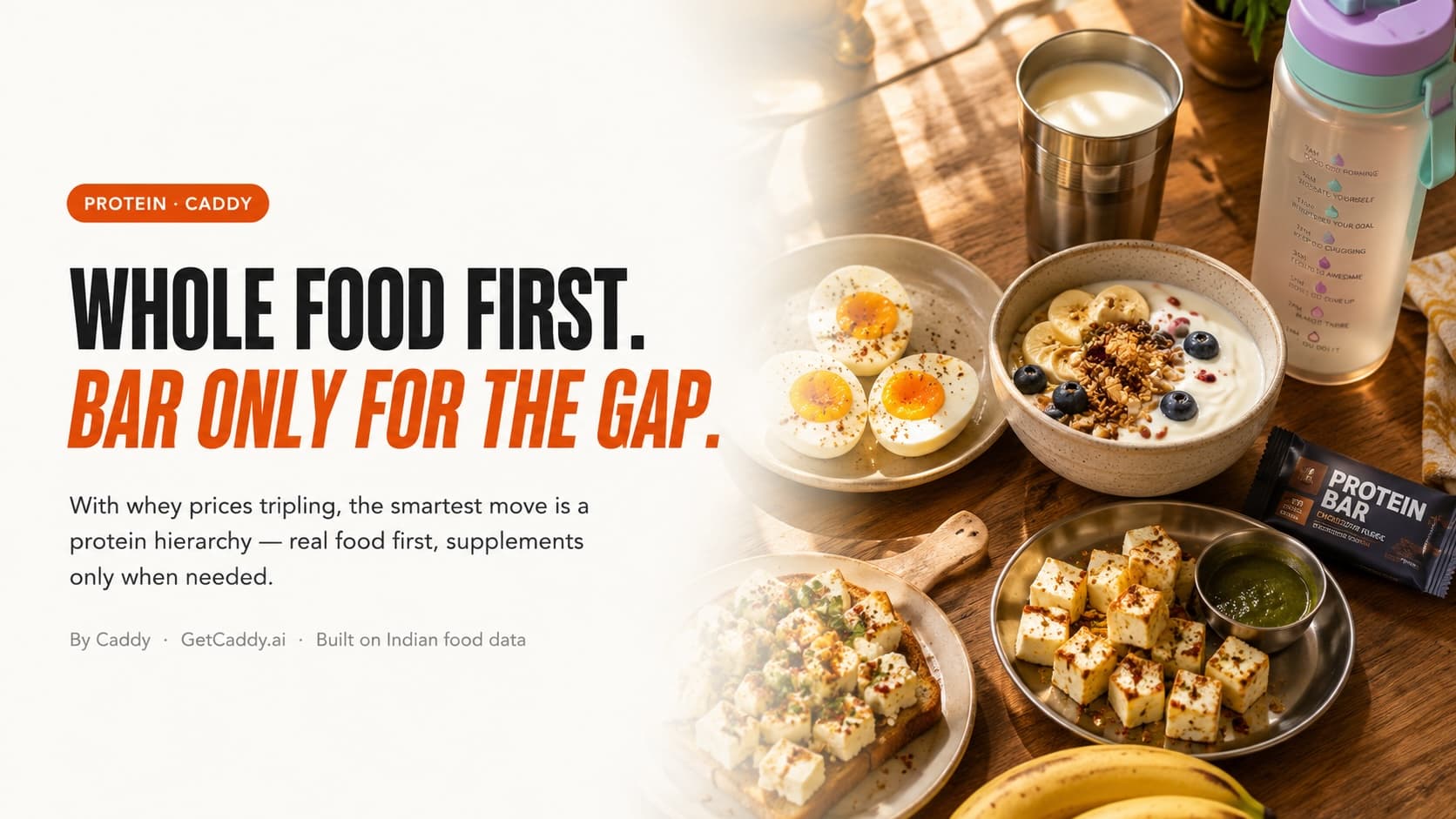
Whole Food Protein First: The Family Rule That Changed How We Think About Supplements
Written by Rishi Bhojnagarwala
Medically Reviewed by Dr. Hetal Pal, PhD in Nutrition Science
A simple hierarchy — primary, secondary, gap filler — and what happens when your family actually follows it.
The Question Nobody Asks
Most conversations about protein in Indian households go one of two ways. Either protein isn't discussed at all — it's assumed the dal and roti are handling it — or someone has started tracking and immediately reached for a supplement to hit a number on an app.
What rarely happens is the question in the middle: how much protein am I actually getting from real food today, before I open anything with a label?
This post is about that question — and the simple hierarchy one family built around it.
How It Started
My 14-year-old daughter has become genuinely health-conscious in a way that surprises me. She hydrates consistently throughout the day, watches her portions, and has started paying attention to protein — all without being pushed.
Her solution to protein was a daily protein bar. Convenient, tastes good, easy. She likes Super You. We keep them at home. Nothing wrong with that choice.
My wife and I had our own version on autopilot — whey shakes on workout days, bar if we were in a hurry. It worked well enough that we didn't examine it.
Until we did.
The question we asked was a simple one: are we eating our protein, or are we just supplementing around a gap we haven't bothered to fill with real food?
When we looked honestly, the answer was mostly the latter. Not because the food wasn't available — it was. We were just reaching for the supplement first out of habit.
Why We Decided to Change
The reasons for making whole food the priority are not complicated.
Satiety. A protein bar delivers protein efficiently but doesn't fill you up the way a meal does. Two eggs and Greek yogurt with muesli will keep you full for three hours. The same protein from a bar rarely does. The physical volume of food, the fiber, the fat, and the slower digestion of whole food all contribute to satiety signals that processed protein simply cannot replicate.
Absorption profile. Whole food protein is digested more slowly and steadily than isolated protein. This isn't a disadvantage — for most people in most situations, a sustained release of amino acids across a longer window is exactly what the body needs. Fast-absorbing whey post-workout has its place, but as a daily protein strategy, whole food wins.
Micronutrient package. An egg isn't just protein. It's choline, vitamin D, B12, selenium, and healthy fat alongside the protein. Paneer isn't just protein — it's calcium, phosphorus, and fat-soluble vitamins. Greek yogurt brings protein plus probiotics and calcium. None of this comes in a bar made primarily of protein isolate, maltitol, and flavouring.
Cost. Eggs are approximately ₹6–8 each. Two eggs provide 12–13g of high-quality complete protein. A 100g serving of paneer costs roughly ₹20–30 and provides 18–20g of protein. Compare this to a protein bar at ₹80–150 providing a similar amount of protein with significantly fewer nutritional co-benefits. At the scale of daily consumption, the difference compounds.
Separately — whey protein concentrate prices have nearly tripled globally over the last two years, and most of India's supplement-grade whey is imported. This wasn't the reason we made the change, but it's worth noting that the shift turned out to be financially sensible as well.

The Hierarchy
The framework is three tiers. Before opening a supplement, run through the first two. The supplement fills whatever gap remains.
Tier 1 — Primary Whole Food Protein
These are the foods to check for first, every day, before anything else.
Eggs — 2 eggs: approximately 12–13g of complete protein. One of the most bioavailable protein sources available at any price. Versatile across Indian cooking — bhurji, boiled, omelette, anda curry.
Paneer — 100g: approximately 18–20g of protein. Naturally fits Indian meals across breakfast, lunch, and dinner.
Greek yogurt — 150g thick: approximately 12–15g of protein. Pairs with muesli, fruit, or eaten plain. Also provides probiotics.
Chicken — 100g cooked breast: 25–30g of protein. If your household cooks chicken 2–3 times a week, this anchors protein for those days without any supplementation needed.
Cheese — 30g: 6–8g of protein. A useful addition on toast, in a wrap, or alongside eggs.
Tier 2 — Secondary Whole Food Protein
These contribute meaningful protein at lower density or with amino acid profiles best combined with other sources.
Dal — A serving of cooked dal provides 6–9g depending on variety. Toor, moong, and masoor are everyday staples that add up across the day without any effort.
Milk — A 250ml glass provides approximately 8g of protein alongside fat and calcium. Two glasses daily is a significant contribution.
Nuts and seeds — A 30g handful provides 5–7g of protein alongside healthy fats and fiber. Dense in calories, so useful as an addition.
Curd (dahi) — 100g provides 3–4g of protein. A natural part of the Indian thali that adds to the total.
Tier 3 — The Gap Filler
After running through Tiers 1 and 2, calculate what you've consumed. For a moderately active adult, the target is approximately 0.8–1.2g of protein per kg of body weight. If whole food has covered most of that, the supplement fills a small remaining gap.
A shake after a training session when a proper meal isn't immediately available. A bar when time genuinely doesn't allow for food. These are the use cases supplements were designed for — not daily defaults that quietly replace the whole food check.
What Changed at Home
My daughter now runs through the mental checklist before reaching for a bar. Eggs this morning? Greek yogurt at breakfast? Is there chicken tonight?
Most days, two of those questions resolve the protein question entirely. The bar earns its place 1–2 times a week rather than 4–5. She still enjoys it — it just isn't the default anymore.
My wife and I shifted in the same direction. The whey doesn't disappear — it closes gaps on heavy training days when food hasn't quite covered the target. Most days it stays in the cupboard.
The changes that stick are the ones that make logical sense and don't require willpower. This one does both.
Tracking It
The reason most people don't do this naturally is that they can't easily see how much protein their real food actually contains. A bar has a label. An egg bhurji doesn't.
Caddy is built for exactly this. India's only nutrition tracker with a food database built ground-up from Indian whole foods — accurate data for paneer, dal, eggs, curd, katoris and ladlefuls — not adapted from a Western database that doesn't know what's in your thali.
Log your whole food first. See what you've actually eaten. Then decide whether today needs a supplement at all.
Score 8. Lose weight. That's it.
Frequently Asked Questions
- 1. Should I get most of my protein from food or supplements?
- For most people, whole foods should be the first choice. Eggs, paneer, Greek yogurt, chicken, fish, dal, and milk provide not only protein but also vitamins, minerals, and other nutrients that protein bars and shakes don't. Supplements are best used to fill occasional gaps, not replace real meals.
- 2. Are protein bars as good as eggs or paneer?
- Protein bars can be convenient, but they aren't a substitute for whole foods. Eggs, paneer, and Greek yogurt generally provide better satiety and additional nutrients, making them a better everyday source of protein for most people.
- 3. When should I use whey protein or protein supplements?
- Protein supplements are most useful when it's difficult to meet your daily protein needs through food alone, such as after a workout or on busy days. They work best as a supplement to a balanced diet, not as the primary source of protein.
- 4. How much protein should I eat every day?
- Your protein needs depend on factors like your age, body weight, activity level, and health goals. As a general guide, many adults aiming to maintain muscle or lose weight benefit from consuming around 0.8–1.2 grams of protein per kilogram of body weight, while more active individuals may require more.
- 5. What's the easiest way to increase protein in an Indian diet?
- Start by adding protein-rich whole foods to meals you already eat. Eggs at breakfast, paneer or chicken with lunch, curd or Greek yogurt as a snack, and dal with dinner can significantly increase your daily protein intake before you need to consider supplements.
Get Caddy
Your simplest way to eat smarter with Indian food
Download