
Dal Roti Is Not Protein Deficient. Here Is What the Data Actually Shows.
Written by Rishi Bhojnagarwala
Medically Reviewed by Dr. Hetal Pal, PhD in Nutrition Science
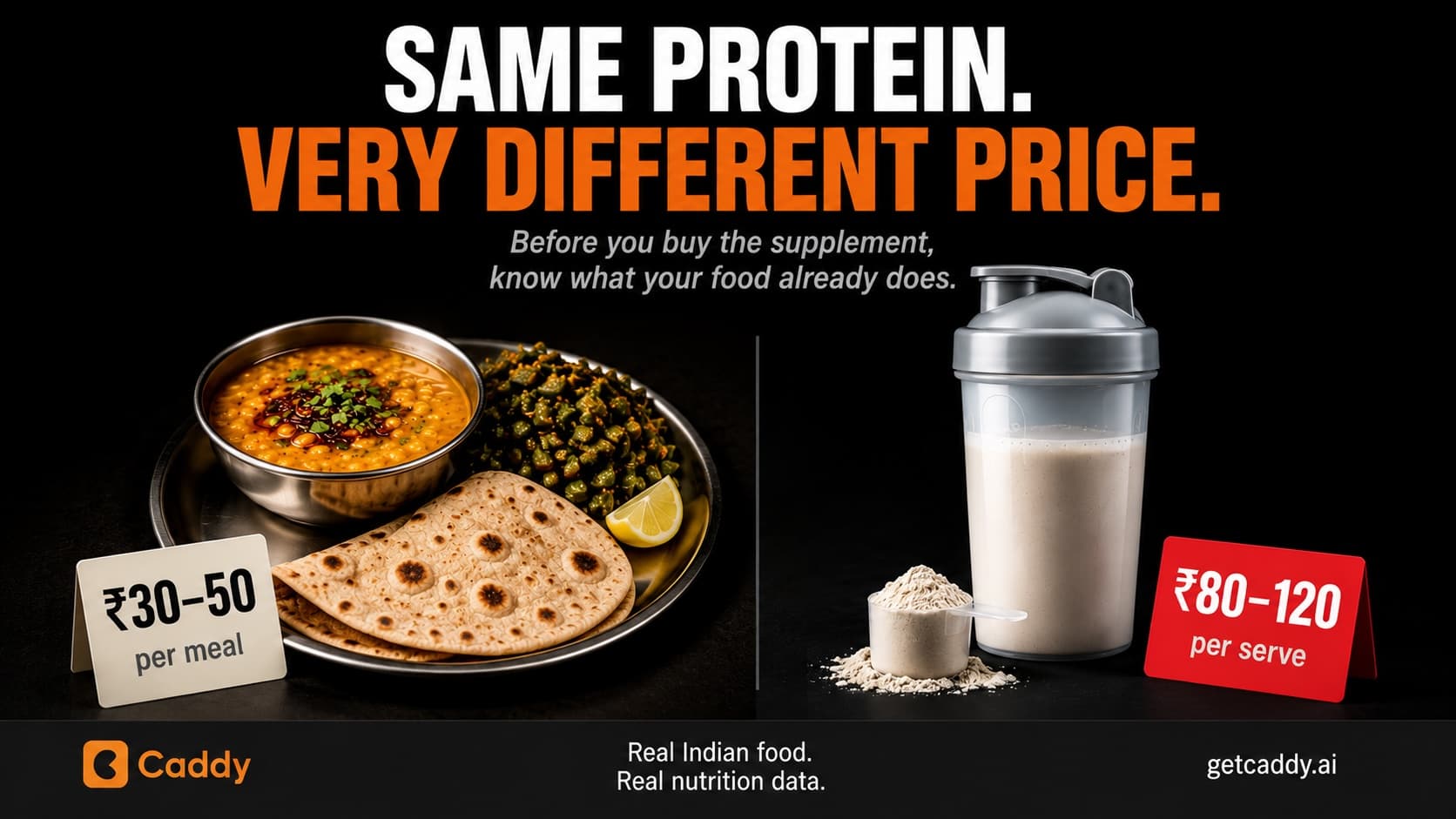
Before you buy the supplement, know what your food is already doing.
The Narrative That Needs Examining
Spend any time on Indian fitness social media and you will encounter a remarkably consistent message.
Your dal roti meal is nutritionally inadequate. Indian food is protein deficient. Unless you are adding chicken breast, whey protein, or expensive paneer to every meal, your thali is failing you nutritionally. The implication — sometimes stated, more often implied — is that the food a billion Indians have eaten for generations is somehow not good enough, and that the solution is available for purchase.
This narrative has commercial logic. Supplement companies, fitness coaches, and protein-focused food brands all benefit from Indians believing their everyday food is inadequate. The louder the inadequacy message, the larger the addressable market.
But what does the data actually say?
What a Standard Dal Roti Subji Meal Delivers
Let us start with the numbers — because the numbers are considerably more interesting than the narrative.
A standard everyday Indian meal of dal, roti, and subji — the kind that hundreds of millions of Indian families eat at lunch and dinner every day — delivers the following nutritional profile per serving:
Protein: approximately 20 grams. A large bowl of dal contributes roughly 12 grams, two rotis add approximately 6 grams, and a generous portion of vegetable subji provides 1 to 2 grams.
Total calories: approximately 400 kilocalories.
Carbohydrates: approximately 50 grams — but critically, these are low glycaemic index carbohydrates attached to significant fibre.
Fat: approximately 12 grams.
Dietary fibre: approximately 8 grams — which is roughly 25 to 30 percent of the daily recommended fibre intake for an average adult.
The macro ratio this produces — approximately 20 percent protein, 50 percent carbohydrate, 30 percent fat — is genuinely balanced for an average Indian adult going about their daily life. It is not the macro profile of an elite athlete in a caloric surplus. But for the vast majority of Indians whose health goal is not competitive bodybuilding but simply to live well and maintain a healthy weight, this ratio is nutritionally reasonable.

The Part of the Story Nobody Tells About Dal
Here is what the protein-focused narrative consistently leaves out when it dismisses dal as an inadequate protein source.
Dal is one of the lowest glycaemic index carbohydrate sources available in the Indian diet — or any diet. The combination of soluble fibre, resistant starch, and the specific carbohydrate structure of lentils and legumes means that the glucose from dal enters the bloodstream slowly and steadily, avoiding the sharp insulin spikes associated with refined carbohydrates.
This matters because when fitness content encourages Indians to reduce dal in favour of higher protein alternatives — to replace the dal with a protein shake, to skip the roti and add more chicken — it is not simply increasing protein. It is removing fibre. It is removing the low GI carbohydrate that provides sustained energy. It is removing the micronutrients — iron, folate, potassium, magnesium — that dal delivers alongside its protein.
The 8 grams of fibre in a standard dal roti meal is not a side note. It is a central nutritional feature. Gut health, blood sugar stability, satiety, and long-term metabolic health all depend on adequate fibre intake — and the average Indian who eats dal regularly is getting this benefit automatically, without thinking about it, without tracking it, and without spending anything extra.
When you replace dal with whey protein, you gain protein density. You lose almost everything else.

The Honest Protein Comparison
Let us compare dal directly with the most commonly recommended alternatives — eggs and whey protein.
Dal's protein to calorie ratio is approximately 25 to 30 percent of calories from protein. Eggs come in at approximately 30 to 35 percent. Whey protein concentrate typically delivers 70 to 80 percent of calories from protein.
On pure protein density, whey wins clearly. This is not in dispute.
But the comparison that matters for a real Indian adult eating real Indian food is not protein density in isolation. It is overall nutritional value, total dietary contribution, and cost — all evaluated together.
On overall nutritional value, dal delivers protein alongside fibre, micronutrients, slow-release carbohydrates, and a complete macronutrient profile. Whey protein delivers protein and very little else. Both have their place. They are not equivalent.

On cost, the comparison becomes stark.
A home-cooked dal roti subji meal delivering 20 grams of protein costs approximately ₹30 to ₹50 for a family serving in most Indian cities and towns. A single serve of a branded whey protein product delivering 20 to 25 grams of protein costs approximately ₹80 to ₹120. For a family eating two meals a day, the cost differential over a month is significant — potentially ₹3,000 to ₹5,000 or more in additional expenditure on supplements that are replacing a food that was nutritionally adequate to begin with.
For the hundreds of millions of Indian middle-class families for whom ₹30 to ₹50 per meal is already a meaningful daily expenditure, being told that this meal is protein deficient and that the solution requires spending two to three times more per serve is not nutrition advice. It is financial pressure applied through nutritional fear.
Is Indian Food Protein Deficient? The Honest Answer
The honest answer is: it depends on what you are comparing it to and what you are trying to achieve.
For an average Indian adult with moderate activity levels whose goal is general health maintenance, a balanced weight, and long-term metabolic wellbeing — a dal roti subji meal twice a day provides a reasonable protein foundation. It is not optimal for muscle building. It is not sufficient for someone on aggressive athletic training. But for the majority of Indians who are not training for competitions and are simply trying to eat well and maintain their health, it is considerably more adequate than the fitness content ecosystem suggests.
The protein quantity gap — the difference between what Indians actually consume and what they should consume — is real. But it is a gap of modest additions and incremental improvements, not a crisis requiring wholesale dietary replacement.

The Practical Solution: Build, Do Not Replace
Here is the most useful framing for the average Indian family thinking about their protein intake.
Your dal roti subji meal is a good foundation. It is not perfect. It can be improved. But it should be improved by building on it modestly and affordably — not by replacing it with expensive supplements.
The additions that make the most practical difference are simple, accessible, and affordable for most Indian households.
Adding one egg to the meal brings protein from approximately 20 grams to approximately 26 grams. The cost of one egg in India is approximately ₹6 to ₹10 — a fraction of the cost of a protein supplement serve.
Adding a small bowl of curd — homemade dahi — adds approximately 3 to 4 grams of protein, contributes gut-healthy probiotics, and costs a few rupees at most if made at home.
Adding a small portion of paneer occasionally — perhaps once or twice a week rather than at every meal — adds meaningful protein and dairy nutrition at a cost that is manageable for most Indian households when it is an addition rather than a daily staple.
These three additions, used in combination and rotation, can bring the average Indian adult's per-meal protein from 20 grams to 28 to 32 grams — a meaningful improvement that is nutritionally significant and economically accessible. No supplement required.
The Affordability Dimension Nobody Discusses
There is a conversation about Indian nutrition that the supplement industry and fitness content ecosystem never has — because it is commercially inconvenient.
The people who are most likely to be protein deficient in India are not the fitness-conscious urban professionals who consume most of the protein supplement marketing. They are the middle-class and lower-middle-class families for whom dal roti is not a lifestyle choice but simply what they can afford to eat.
For these families, being told their food is inadequate and that they need to purchase expensive supplements is not empowering. It is shaming. It creates anxiety around food that is genuinely nourishing. It generates spending pressure that many households cannot sustain. And it often results in people purchasing products they cannot afford for a period, experiencing some improvement, then abandoning the habit when the economic pressure becomes too great — having spent money they did not have and returned to exactly where they started.
The honest nutrition guidance for middle-class India is not "your food is not good enough, here is something expensive to fix it." It is "your food is a solid foundation, here is a small, affordable thing you can add to it — an egg, some curd, a little paneer when the budget allows."
That guidance does not sell supplements. It does sell trust. And trust, in the long run, is what actually changes how people eat.
What Good Nutrition Data Enables
The reason most Indians do not know that their dal roti meal delivers 20 grams of protein is not because the information does not exist. It is because the nutrition data and tracking tools available in India have historically been built around Western food databases that barely recognise Indian ingredients, let alone the specific varieties and preparations of dal that characterise Indian home cooking.
A bowl of dal makhani prepared at home with moderate butter is nutritionally completely different from the same dish at a restaurant. A standard katori of toor dal is different from chana dal is different from masoor dal. These distinctions matter for accurate nutrition tracking — and for years, most available tools have simply estimated "Indian curry" as a generic entry that tells you almost nothing useful.
Accurate, comprehensive Indian food data is the foundation of genuinely useful nutrition guidance for Indians. Without it, every piece of advice about Indian nutrition — whether from a doctor, a nutritionist, or a fitness app — is built on approximation.
The Bottom Line
Your dal roti is not protein deficient. It is a balanced, low GI, fibre-rich, micronutrient-dense meal that has sustained hundreds of millions of Indians across generations.
It is not perfect for every nutritional goal. If you are building significant muscle, you need more protein than dal roti alone provides. If you are on a GLP-1 medication losing weight rapidly, protein adequacy becomes critical and you need to track it carefully.
But for the average Indian adult eating an everyday Indian diet, the prescription is not to abandon your food and buy a supplement. It is to understand what your food already delivers, add to it modestly and affordably, and make decisions based on data rather than marketing.
An egg costs ₹8. A small bowl of curd costs a few rupees. A portion of paneer once a week fits most Indian household budgets.
These are the building blocks. The foundation is already there.
Trust your thali. Then build on it.
About Caddy Caddy is built on one of India's most comprehensive food databases — covering millions of Indian dishes, regional variations, home cooking preparations, and restaurant items with nutritional accuracy that generic Western databases simply cannot match. Whether you are tracking your dal, your biryani, or your weekly paneer, Caddy gives you the real numbers — so your decisions are based on data, not fear. Visit getcaddy.ai