
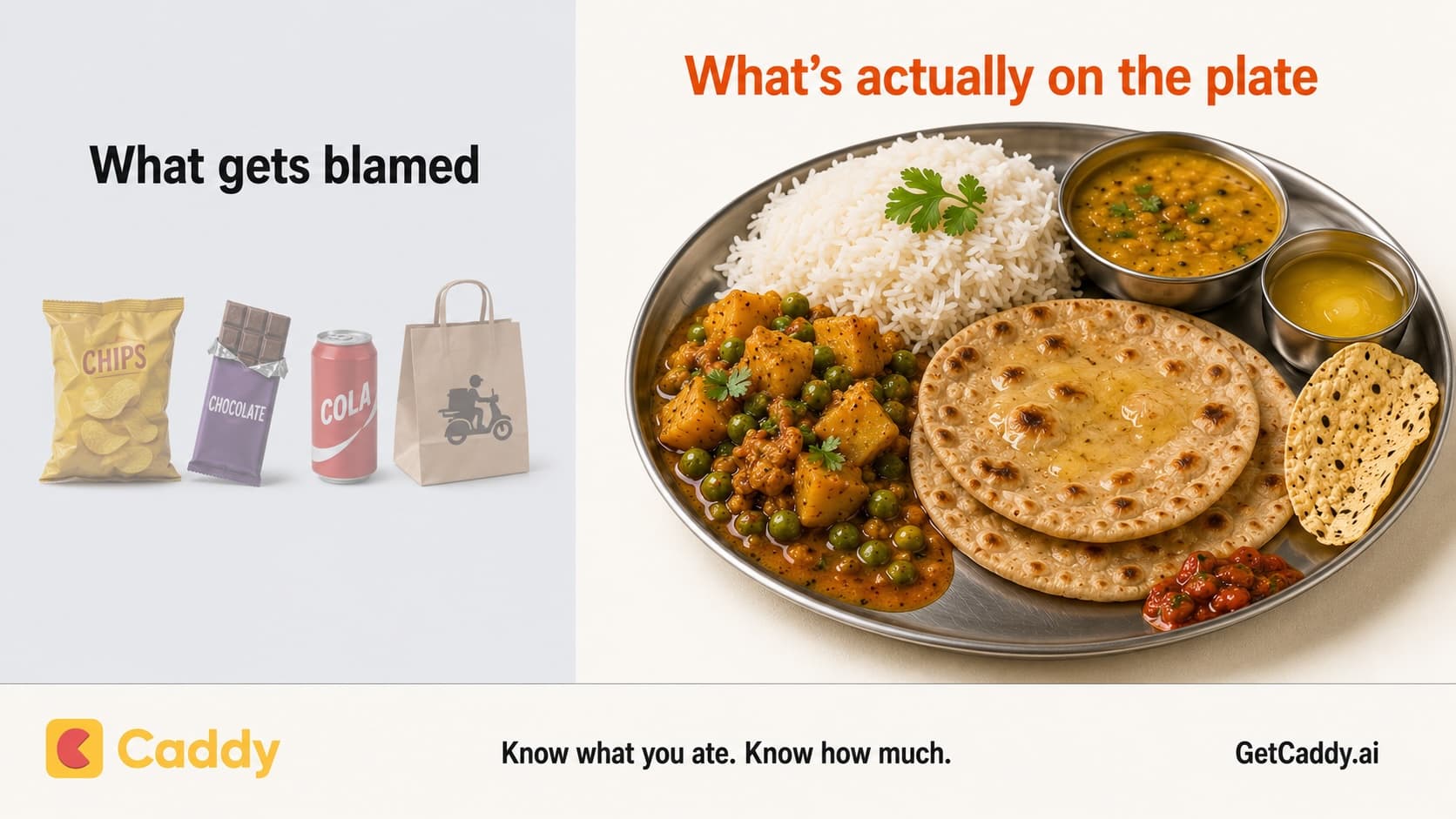
India's Obesity Crisis Isn't Fast Food — It's Portion Blindness at Home
Written by Rishi Bhojnagarwala
Nutrition Reviewed by Dr. Hetal Pal, PhD in Nutrition Science
Everyone's busy blaming Swiggy, Zomato, and packaged snacks. Meanwhile, the actual driver of the trend has been sitting on the family dinner table the whole time.
The Story We Keep Telling Ourselves
Every conversation about India's rising obesity and diabetes numbers follows the same script. Packaged food gets blamed first. Then street food. Then delivery apps, as if Swiggy and Zomato have some coordinated mission to make the country unhealthy. Palm oil gets a mention. Refined carbs get a mention. The villain always has a label, a logo, or an app icon.
Here's the problem with that story: most estimates suggest roughly 80% of what Indians actually eat is still cooked at home. If packaged and delivery food are the primary driver of a national metabolic health crisis, they're being asked to explain the whole trend using a fraction of the actual plate.

India Overeats. That Part Is Global.
Overconsumption relative to energy needs is the dominant driver of obesity and related metabolic disease worldwide — this isn't unique to India. What's specifically Indian is where the overconsumption is happening. It isn't concentrated in packaged snacks or restaurant meals. It's happening in ghar ka khaana — the meal everyone assumes is automatically the safe, healthy option because it wasn't bought from a shelf.
What Portion Blindness Actually Looks Like at an Indian Table
Look honestly at a typical home meal, and the pattern becomes obvious.
Rice served "andaza se." Nobody measures a serving of rice at home. It gets scooped by feel, and that feel tends to grow over the years without anyone noticing.
The extra roti. Not because anyone was still hungry — because it came off the tawa hot, and turning down a fresh roti feels almost rude in most Indian households.
Sabzi that isn't tempered, it's swimming. There's a real difference between a tadka — a spoon or two of oil for flavour — and a vegetable dish that's been cooked in enough oil to visibly pool at the bottom of the bowl. Most home kitchens default closer to the second version without registering it as excess.
Ghee on the roti, then ghee on the rice too. Both, in the same meal, with nobody counting either spoon, because ghee carries a cultural halo that makes it feel exempt from portion awareness — a halo the actual research doesn't fully support.
Achaar and papad on the side. Both oil-dense. Both mentally filed under "just a condiment" rather than an actual contributor to the meal's calorie count.
Mithai at every occasion. And Indian households, if anyone actually counted, have considerably more "occasions" across a year than anyone accounts for when estimating their own diet.

And the One Thing Everyone Already Agrees On
Ask any dietitian, doctor, or nutrition researcher in India what the single most consistent gap in the Indian diet is, and the answer is the same: protein.
This isn't a hunch. The ICMR-INDIAB study — one of the most comprehensive dietary surveys ever conducted in India, covering over 18,000 adults across 30 states — found that Indians derive approximately 62% of daily calories from carbohydrates, among the highest rates in the world. Protein intake sits at just 12% of daily energy, below the national dietary guideline recommendation of 15%.
Combine a diet that's carbohydrate-heavy by structure with portions that quietly creep upward across rice, roti, ghee, and oil— and you have a genuinely coherent explanation for rising metabolic disease, without needing to blame a single packaged snack.
Why the Packaged Food Narrative Persists Anyway
Packaged food is an easy target because it's visible and specific. A label can be photographed. An ingredient can be circled in red. A brand can be named. Home cooking, by contrast, is diffuse, personal, and emotionally loaded — questioning portion sizes in someone's own kitchen, cooked by their own mother or spouse, feels like an attack in a way that criticizing a chips brand never does.
But comfort with a narrative doesn't make it accurate. If 80% of the plate is going largely unexamined while 20% absorbs nearly all the blame, the resulting picture of what's actually driving obesity in India is going to be badly distorted.
None of the Foods Are the Enemy
To be clear, this isn't an argument against rice, roti, ghee, or any specific home-cooked staple. All of them have been eaten in India for generations without producing today's metabolic disease rates. The variable that's changed isn't the existence of these foods — it's the portion, applied inconsistently, meal after meal, without anyone tracking the running total.

How Caddy Fits Into This
This is exactly why Caddy isn't built around a list of foods to avoid. Take a picture of your plate — home-cooked, packaged, restaurant, doesn't matter — and get your Score out of 10. Score 8 means you're in a calorie deficit, regardless of whether today's calories came from a Swiggy order or your own kitchen.
Built specifically around Indian meals, at under ₹83/month, Caddy applies the same scrutiny to a home thali that everyone already applies to a chips packet — because that's where most of the actual calories have been hiding all along.
Know what you ate. Know how much.
Score 8. Lose weight. That's it.
GetCaddy.ai
Sources
[1] Dietary Profiles and Associated Metabolic Risk Factors in India from the ICMR–INDIAB Survey-21. Nature Medicine, 2025. https://www.nature.com/articles/s41591-025-03949-4
Frequently Asked Questions
- Is home-cooked Indian food automatically healthy for weight loss?
- Not automatically. Home-cooked meals can carry hidden excess through larger portions, extra ghee, oil-heavy sabzi, and second helpings — none of which show up the way a packaged snack's label does.
- What does the ICMR-INDIAB study say about Indian diets?
- Covering over 18,000 adults across 30 states, it found Indians derive roughly 62% of daily calories from carbohydrates — among the highest rates globally — while protein sits at just 12% of daily energy, below the recommended 15%.
- Is packaged food really not the main driver of India's obesity crisis?
- On its own, unlikely. Packaged and delivery food make up a modest fraction of what most Indians eat — roughly 20% — while home cooking accounts for the rest. A minority share of the diet can't fully explain a majority of the trend.
- Why does protein deficiency matter for weight management?
- Low protein intake makes meals less filling per calorie and can contribute to muscle loss during weight loss, making a carb-heavy, protein-low diet a harder starting point for sustainable weight management.
- How can I fix portion blindness in home-cooked meals?
- Start by actually measuring or photographing what you eat rather than serving "andaza se." The goal isn't to eliminate rice, roti, or ghee — it's to know the real quantity, since that's what typically drifts upward unnoticed.
Get Caddy
Your simplest way to eat smarter with Indian food
Download