
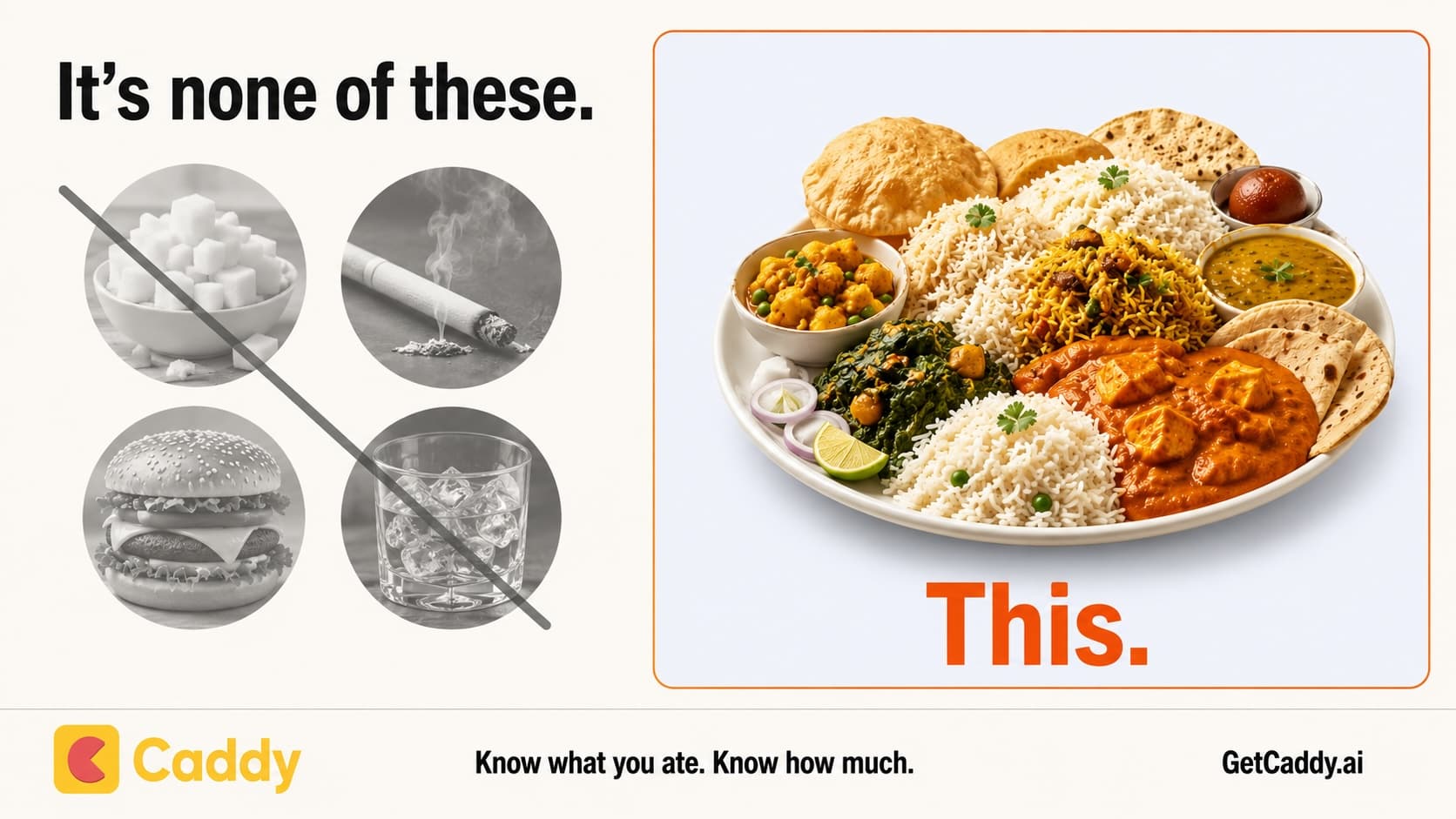
Why Overeating — Not Sugar or Fast Food — Is the World's Biggest Health Crisis
Written by Rishi Bhojnagarwala
Nutrition Reviewed by Dr. Hetal Pal, PhD in Nutrition Science
For the first time in recorded history, obese children now outnumber malnourished children globally. The villain everyone's been ignoring was never on any ingredient list.
The Wrong Villains
For roughly three decades, nutrition culture has been chasing specific ingredients. Sugar caused diabetes. Fat caused heart disease. Red meat caused cancer. Maida caused inflammation. Refined oils caused everything. Each decade brought a new list, a new documentary, a new category of food to eliminate — and the collective health of the world got worse, not better.
Here's the number that should reframe all of it: over 1 billion people are now living with obesity globally, and 2.5 billion adults are overweight. For the first time in recorded history, obese children outnumber malnourished and underweight children worldwide — UNICEF confirmed this in 2025. Not in a wealthy country, not in one demographic — globally.
The ingredient being blamed that year was ultra-processed food. The decade before, it was sugar. The decade before that, it was fat. None of those ingredient-level theories adequately explains why the problem kept growing regardless of which food got blamed.

What the Data Actually Shows
The scale of overconsumption-driven disease in 2025 is genuinely difficult to absorb.
More than 1 billion people live with obesity — roughly 1 in 8 people on earth. 2.5 billion adults are overweight. 589 million people have diabetes, according to the International Diabetes Federation's 2024 figures. A 2025 analysis published in Nature Communications found that 1.54 billion adults globally have metabolic syndrome — a cluster of conditions including abdominal obesity, high blood pressure, and abnormal blood sugar and lipid levels, all occurring together and dramatically raising the risk of heart disease, stroke, and type 2 diabetes.
Against all of that: 673 million people were hungry in 2024, according to the latest UN State of Food Security and Nutrition report.
For the first time in history, overconsumption affects more people than undernourishment. That is the defining nutrition paradox of our time — and it receives a fraction of the cultural attention that any individual ingredient does.
The Irony Nobody Wants to Sit With
There's an uncomfortable arithmetic in all of this. Hunger is a poverty and logistics problem — not a food volume problem. The world produces enough food. The issue is access, conflict, cost, and distribution, not total supply. Redistribution of surplus calories from overeaters to the hungry doesn't work as policy.
But as an illustration of the scale of the mismatch: the cumulative caloric surplus consumed daily by the world's overeating population, in a theoretical sense, could close the hunger gap. That's not a solution — it's an indicator of how dramatically out of balance the system has become.
The world has never been better at producing food. It has never been worse at consuming it in appropriate amounts.
The Real Common Thread
Trace back the root cause of obesity, type 2 diabetes, metabolic syndrome, cardiovascular disease, and fatty liver disease — the defining chronic illnesses of the 21st century — and the common thread isn't any specific macronutrient or ingredient. It's chronic positive energy balance: eating more energy than the body uses, repeatedly, over time.
Sugar contributes to this when consumed in excess. So does fat. So does alcohol. So does any food, in quantities that consistently exceed what the body can use. The ingredient isn't the mechanism — the quantity is. And this is why decades of ingredient-specific fear has failed to arrest the trend: you can replace sugar with jaggery, maida with atta, refined oil with cold-pressed oil, and still overeat your way to the same metabolic outcomes.
The research is consistent on this point. A Global Burden of Disease analysis found that high BMI — driven primarily by chronic overconsumption relative to energy expenditure — accounts for over half of BMI-attributable type 2 diabetes burden worldwide, a larger share than any other single risk factor examined. Not a specific food. Total energy intake exceeding total energy expenditure, compounded over time.

What This Means for How We Eat
This doesn't mean food quality is irrelevant. Nutrient density, fibre, protein, and micronutrient adequacy all matter for long-term health. What it does mean is that food quality cannot substitute for quantity awareness. The healthiest possible diet, eaten in excess of what your body needs, will still produce weight gain and the metabolic consequences that follow.
This is also why most popular nutrition advice, despite being well-intentioned, doesn't move the needle on population health. Telling people which oil to avoid, or which grain to cut, addresses a secondary variable while leaving the primary variable — total intake versus total expenditure — untouched.
The GLP-1 Angle
It's worth noting that the most significant pharmacological advance in metabolic health in a generation — GLP-1 receptor agonist medications — works precisely through this mechanism. These drugs reduce appetite and food intake, creating a calorie deficit that drives weight loss. They don't work by changing which foods you eat. They work by reducing how much of everything you eat. The mechanism of action of the most effective obesity drugs available is, at its core, a confirmation of everything in this piece.
How Caddy Fits Into This
This is the precise gap Caddy is built to address. Not by adding rules about which foods to avoid — but by making total intake visible.
Take a picture of your plate. Get your Score out of 10. Score 8 means you're in a calorie deficit — the one state that addresses the root cause of most metabolic disease for most people, regardless of which specific foods are on the plate today.
Built specifically for Indian food — where meals are often combinations that most nutrition apps can't accurately track — at under ₹83/month, Caddy replaces ingredient-level anxiety with the single measurement that actually predicts metabolic outcomes over time.
The world spent 30 years blaming ingredients. The data was always pointing somewhere else.
Know what you ate. Know how much.
Score 8. Lose weight. That's it.
GetCaddy.ai
Sources
[1] Obesity and overweight, fact sheet. World Health Organization. https://www.who.int/news-room/fact-sheets/detail/obesity-and-overweight
[2] Obesity exceeds underweight for the first time among school-age children and adolescents globally. UNICEF, September 2025. https://www.unicef.org/press-releases/obesity-exceeds-underweight-first-time-among-school-age-children-and-adolescents
[3] IDF Diabetes Atlas, 11th edition — global diabetes prevalence estimates for 2024. International Diabetes Federation. https://diabetesatlas.org/
[4] Worldwide trends in metabolic syndrome from 2000 to 2023: a systematic review and modelling analysis. Nature Communications, 2025. https://www.nature.com/articles/s41467-025-67268-5
[5] Global hunger declines, but rises in Africa and western Asia — SOFI 2025. FAO / UN, 2025. https://www.fao.org/newsroom/detail/global-hunger-declines--but-rises-in-africa-and-western-asia--un-report/en
[6] The global burden of type 2 diabetes attributable to high body mass index in 204 countries and territories, 1990–2019. PMC. https://pmc.ncbi.nlm.nih.gov/articles/PMC9500174/
Frequently Asked Questions
- Is sugar the main cause of the global obesity crisis?
- No single ingredient is. Global obesity has risen even as different ingredients — sugar, fat, refined oil, ultra-processed food — have each taken turns as the blamed culprit. The consistent driver across decades is total energy intake exceeding what the body uses, not any specific food.
- How many people worldwide are affected by obesity?
- More than 1 billion people globally live with obesity, and 2.5 billion adults are overweight, according to WHO. For the first time in recorded history, obese children now outnumber malnourished children worldwide.
- Can you gain weight eating only healthy food?
- Yes. Nutrient-dense foods like nuts, paneer, ghee, and olive oil are still calorie-dense, and eating more of them than your body needs still produces a calorie surplus. Food quality and total quantity are separate questions.
- What is metabolic syndrome?
- Metabolic syndrome is a cluster of conditions — abdominal obesity, high blood pressure, and abnormal blood sugar and lipid levels — that together sharply raise the risk of heart disease, stroke, and type 2 diabetes. An estimated 1.54 billion adults globally live with it.
- How do GLP-1 medications help with weight loss?
- GLP-1 medications work primarily by reducing appetite and overall food intake, creating a calorie deficit — not by changing which specific foods you eat. Their effectiveness is itself evidence that quantity, not ingredient choice, drives weight change.
- Does this mean food quality doesn't matter?
- No — nutrient density, protein, and fibre still matter for long-term health. But food quality can't substitute for quantity awareness. Even the healthiest diet, eaten in excess of what your body needs, will still lead to weight gain.
Get Caddy
Your simplest way to eat smarter with Indian food
Download