
Ghee Doesn't Beat Protein for Satiety or Blood Sugar — Here's the Data
Written by Rishi Bhojnagarwala
Nutrition Reviewed by Dr. Hetal Pal, PhD in Nutrition Science
Fat promoters say ghee keeps you full and blunts the carb it's paired with. Both claims are only half-true — and protein beats it on both counts.
The Ghee Pitch
Dip your roti in ghee. A spoonful in your dal. A ladle over your rice. The pitch, repeated across wellness content everywhere: ghee is good for satiety, and it lowers the glycemic impact of whatever carbohydrate it's paired with.
Both claims sound plausible. Fat slows digestion. Fat is calorically dense. It seems reasonable that it would fill you up and blunt a sugar spike. Let's check both claims against the research, one at a time.

Claim 1: Ghee Improves Satiety
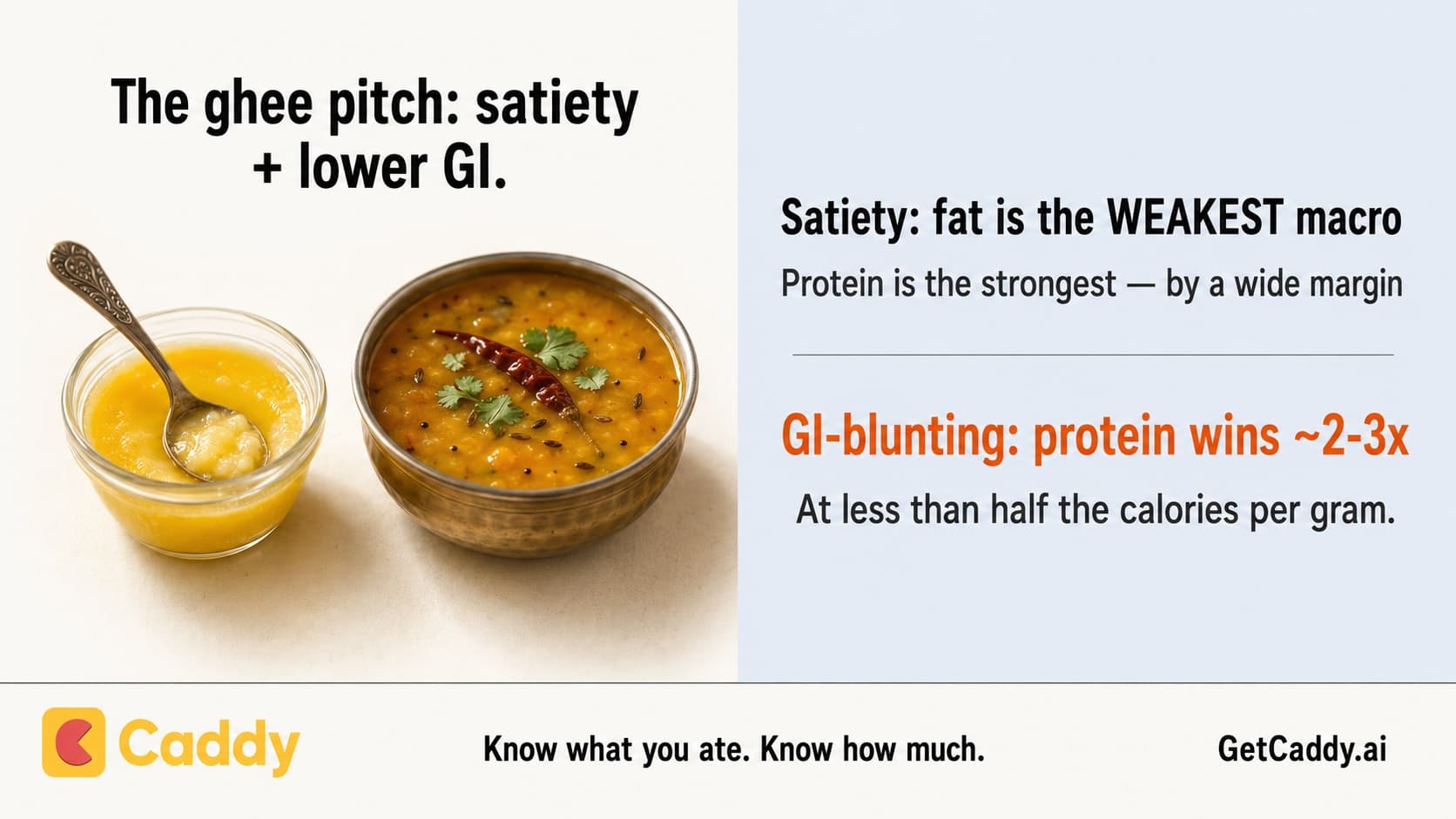
This is where the pitch runs into trouble immediately. Across the satiety research literature, appetite and food intake suppression has consistently been shown to be weaker after high-fat meals than after high-protein or high-carbohydrate meals of equivalent calories. Fat isn't the strongest of the three macronutrients for keeping you full. The evidence points to it being the weakest.
Protein sits at the opposite end. It's described in the research as a key driver behind successful weight loss and long-term weight maintenance, largely because of how effectively it suppresses hunger after eating — an effect documented across controlled feeding studies comparing protein-rich and protein-poor meals of matched calories.
So on the specific claim "fat is good for satiety" — the research doesn't support it. If anything, it says close to the opposite.
Claim 2: Ghee Lowers the GI of the Carb It's Paired With
This claim deserves more credit than the first. It's actually true, and worth being fair about.
Research on Indian rice varieties has found that adding ghee during cooking lowers rice's glycemic index and increases its resistant starch content — a more pronounced effect than adding vegetable oils produces. Fat genuinely does blunt a carbohydrate's glycemic response, likely through some combination of slower gastric emptying and starch-lipid complexes that change how the starch is digested.
So give ghee its due here. This part of the pitch isn't wrong.
Where the Comparison Falls Apart
Here's the problem for ghee's promoters: fat isn't the best tool for this job either.
Dose-response research from Wolever's lab at the University of Toronto found that, gram for gram, protein reduces a carbohydrate's glycemic response roughly twice as much as fat does. This is established dose-response data, not a single isolated finding.
Now factor in calories. Fat carries 9 calories per gram. Protein carries 4. So gram for gram, protein does roughly twice the blunting work, at less than half the caloric cost.
Run the two claims side by side, and protein outperforms fat on both:

This Doesn't Mean "Eliminate Fat"
It's worth being precise here, because it would be easy to overcorrect. Dietary fat is not optional. Essential fatty acids — compounds like linoleic acid — cannot be synthesized by the human body and must come from food. Documented cases of essential fatty acid deficiency, first identified in 1929, produce real physiological symptoms. Fat is also required to absorb vitamins A, D, E, and K, all of which are fat-soluble.
WHO's own guidance on dietary fat explicitly states that fat, including essential fatty acids, is necessary for proper physiological function — even while recommending limits on excessive intake for weight management. A zero-fat diet is not a goal worth pursuing, and nobody should attempt one.
The actual, defensible conclusion isn't "cut fat as much as possible." It's narrower and more useful than that: stop adding extra ghee to a meal specifically believing it's doing meaningful work for satiety or blood sugar control. It isn't the right tool for either job. Your baseline dietary fat, eaten as part of a normal, balanced meal, is fine and necessary. The additional spoonful on top, chasing a satiety or GI benefit — that's the part not supported by the evidence.

What Actually Works Better
If the goal is feeling full on fewer calories, or blunting the glycemic impact of a carb-heavy meal, protein is the more efficient lever on both fronts, by a wide margin. Paneer with your roti. Dal with your rice. Egg with your paratha. Chicken or fish alongside your dal-chawal. All of these do more of the exact job ghee is being marketed for — at less than half the calorie cost per gram.
This doesn't mean removing ghee from your food entirely. Indian cooking has used ghee for texture, flavour, and cultural reasons for centuries, independent of any satiety or glycemic claim. What it means is not treating an extra spoonful as a functional weight-loss or blood-sugar tool, because the data doesn't back that specific use case.
How Caddy Fits Into This
Score 8 doesn't care whether today's calories came from ghee or paneer — a calorie deficit is a calorie deficit, regardless of source. But if you're trying to solve two problems at once — staying full on fewer calories, and managing the glycemic impact of a carb-heavy plate — the data points clearly toward protein as the more efficient tool for both.
Built specifically around Indian meals, at under ₹83/month, Caddy tracks the one number that actually predicts your outcome — while giving you visibility, over time, into whether protein-forward days actually do keep you fuller for longer.
The ghee spoon isn't dangerous. It's just not doing the job it's been sold to do.
Know what you ate. Know how much.
Score 8. Lose weight. That's it.
Sources
[1] No evidence of differential effects of SFA, MUFA or PUFA on post-ingestive satiety and energy intake: a randomised trial of fatty acid saturation. PMC. https://www.ncbi.nlm.nih.gov/pmc/articles/PMC2893079/
[2] Dietary protein — its role in satiety, energetics, weight loss and health. British Journal of Nutrition, Cambridge Core. https://www.cambridge.org/core/journals/british-journal-of-nutrition/article/dietary-protein-its-role-in-satiety-energetics-weight-loss-and-health/CCA49F7254E34FF25FD08A78A05DECD7
[3] Rice with pulses or cooking oils can be used to elicit lower glycemic response. ScienceDirect. https://www.sciencedirect.com/science/article/abs/pii/S0889157518301121
[4] The Effects of Fat and Protein on Glycemic Responses in Nondiabetic Humans Vary with Waist Circumference, Fasting Plasma Insulin, and Dietary Fiber Intake. ScienceDirect (Moghaddam, Vogt, Wolever — University of Toronto). https://www.sciencedirect.com/science/article/pii/S002231662208470X
[5] Discovering Essential Fatty Acids. ASBMB Today. https://www.asbmb.org/asbmb-today/science/100412/the-discovery-of-essential-fatty-acids
[6] Total Fat Intake for the Prevention of Unhealthy Weight Gain in Adults and Children: WHO Guideline. NCBI Bookshelf. https://www.ncbi.nlm.nih.gov/books/NBK594740/
Frequently Asked Questions
- Does ghee help you feel full longer?
- Not particularly. Across the research literature, fat is consistently the weakest of the three macronutrients for satiety — weaker than both protein and carbohydrate at matched calories. Protein is the strongest.
- Does ghee lower the glycemic impact of rice?
- Yes, modestly. Research on Indian rice varieties confirms that adding ghee during cooking does lower the glycemic index and increase resistant starch, more than vegetable oils do. This part of the claim is real.
- Is protein or fat better at blunting a carb's blood sugar spike?
- Protein. University of Toronto dose-response research found that gram for gram, protein reduces the glycemic response of a carbohydrate roughly twice as much as fat does — while costing less than half the calories per gram.
- Should I stop eating ghee altogether?
- No. Dietary fat, including essential fatty acids your body can't make on its own, is necessary for normal physiological function — WHO's own guidance confirms this. The issue isn't ghee itself, it's adding extra ghee specifically expecting a satiety or blood sugar benefit it doesn't reliably deliver.
- What should I add to a meal instead, for fullness or blood sugar control?
- Protein-rich foods — paneer, dal, egg, chicken, fish — alongside your carbs. They do more of the job ghee is marketed for, at less than half the calorie cost per gram.
- Does a calorie from ghee count differently than a calorie from protein for weight loss?
- Not for the calorie deficit itself — a calorie is a calorie for that purpose. But if you're also trying to stay fuller on fewer calories or manage a carb-heavy plate's glycemic impact, protein does more of that specific work per gram than fat does.
Get Caddy
Your simplest way to eat smarter with Indian food
Download