
We Blame Packaged Food for India's Health Crisis. The Math Doesn't Add Up.
Written by Rishi Bhojnagarwala
Nutrition Reviewed by Dr. Hetal Pal, PhD in Nutrition Science
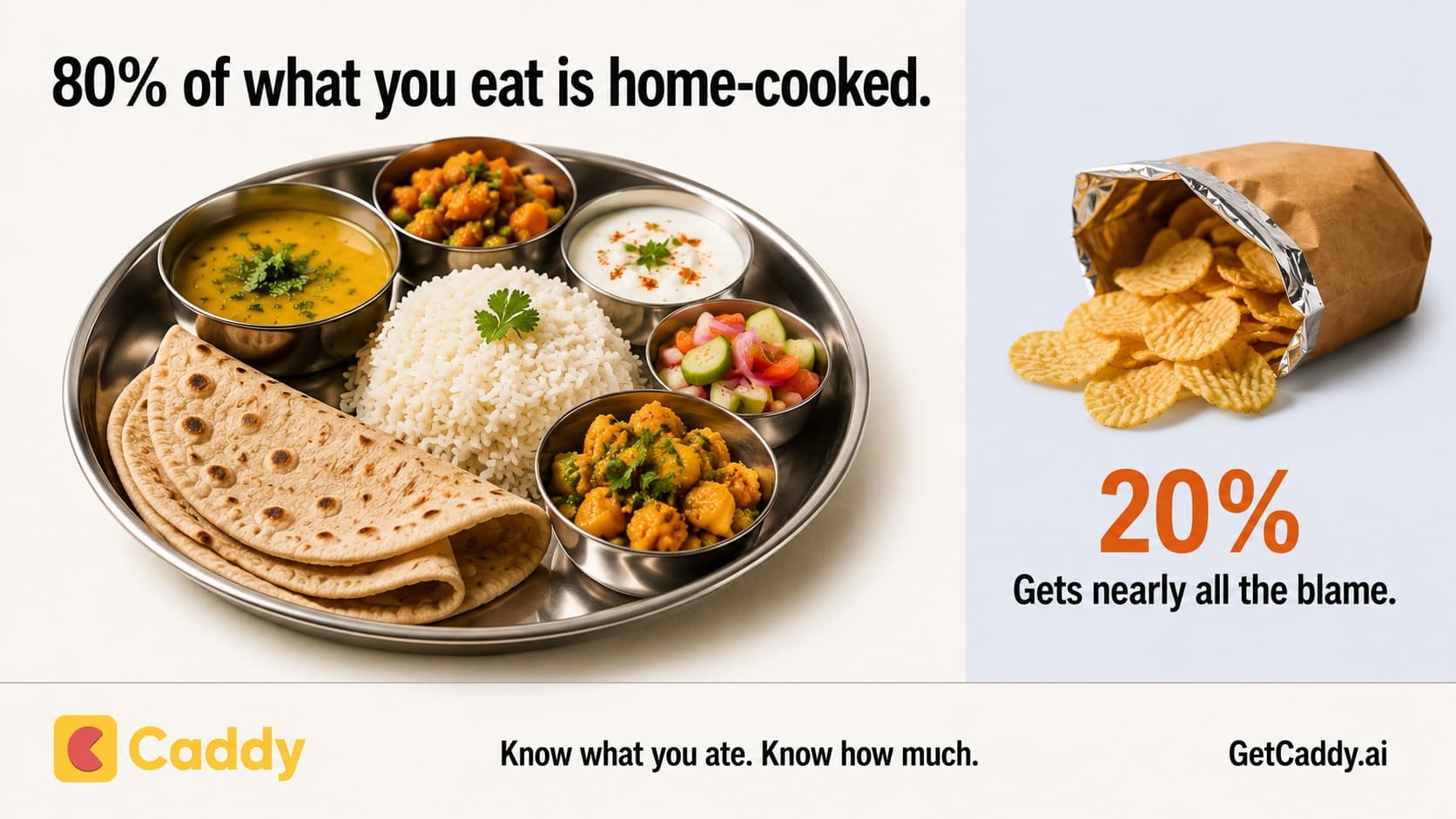
Biscuits, vada pav, instant noodles — all treated as the enemy. Meanwhile, 80% of the Indian plate goes almost entirely unexamined.
The Warnings Never Stop
Don't eat biscuits with your chai — loaded with sugar. Don't eat vada pav — refined carbs, unhygienic, fried in questionable oil. Don't eat instant noodles — just bad for you, full stop.
Packaged and processed food has become the default villain in nearly every piece of Indian nutrition content. It's an easy target: a visible ingredient label, an identifiable brand, a specific product to photograph and circle in red.
Here's the question almost nobody asks in the middle of all this warning: how much of the average Indian diet does packaged food actually represent?
A Smaller Slice Than the Panic Suggests
The honest answer, even using conservative estimates, is: not very much. Market research estimates for India's packaged food industry vary depending on methodology, ranging roughly from $76 billion to $129 billion. The US packaged food market, by comparison, is estimated at roughly $528 billion, with some projections putting the market closer to $855 billion depending on the report and category definitions used.
Run even the most conservative version of these numbers against population size, and the per capita gap is enormous — plausibly 20 to 30 times lower in India than in the US. Indians, as a population, are simply not consuming packaged food anywhere near the scale that dominant Western diets do.
Meanwhile, NSSO household consumption data shows packaged and processed food makes up only a low single-digit share of what Indian households spend on food, which — combined with eating-out accounting for roughly a tenth of food consumption — implies the large majority of what most Indians eat, across income groups, is still prepared at home. Packaged and restaurant food make up the remainder.
If That's True, the Math Gets Uncomfortable
If packaged food represents a comparatively modest fraction of what most Indians actually eat, it becomes difficult to credibly assign it primary responsibility for the country's rising rates of obesity, type 2 diabetes, and related metabolic conditions. A cause responsible for 20% of the picture cannot fully explain 100% of the trend — the same quantity-over-ingredient pattern shows up globally, not just in how India talks about packaged food specifically.
This isn't an argument that packaged food is harmless, or that reading labels doesn't matter. It's an argument about proportionality — the intensity of public attention on packaged food appears badly mismatched to its actual share of the average Indian plate.
The 80% Nobody's Examining
Home cooking in most Indian households isn't automatically calorie-light just because it's homemade. Oil use for tadka, for frying, for finishing a curry, adds up across a day in ways that rarely get tracked. Portion sizes — a second helping of rice, an extra roti "because it's fresh" — have grown in many households without anyone noticing, the same way plate and bowl sizes have quietly expanded over recent decades.
And plain overeating — simply consuming more of a completely home-cooked, "clean" meal than the body needs — doesn't trigger the same alarm that a packet of chips does, because there's no ingredient panel to screenshot, no E-number to circle, no brand to call out. The absence of a villain on the label doesn't mean the calories aren't there.

Why This Distinction Matters
This matters because where you point your attention determines what you actually try to fix. If the story is "packaged food is destroying India's health," the natural response is avoiding packets and trusting anything home-cooked by default. If the more accurate story is "total quantity, across all food, including home cooking, is the real driver," the response looks different: paying attention to portions and overall calorie intake regardless of where the food came from.
Whether it's ghar ka khaana or a bag of chips, the same principle applies. If overconsumption isn't the actual target, blaming specific foods — packaged or otherwise — doesn't move the underlying numbers.
How Caddy Fits Into This
This is exactly why Caddy doesn't sort food into "packaged bad, home-cooked safe" categories. Take a picture of your plate — home-cooked or otherwise — and get your Score out of 10. Score 8 means you're in a calorie deficit, regardless of whether today's calories came from a packet or your own kitchen.
Built specifically around Indian food, including the full range of home-cooked dishes most nutrition apps struggle to track accurately, at under ₹83/month, Caddy looks at the whole plate — not just the 20% that happens to come with a label.
Keep food simple. Watch the whole plate.
Know what you ate. Know how much.
Score 8. Lose weight. That's it.
Sources
[1] India Packaged Food Market Outlook to 2030. Ken Research. https://www.kenresearch.com/industry-reports/india-packaged-food-market
[2] Packaged Food Market in India: Size, Industry Trends 2034. IMARC Group. https://www.imarcgroup.com/india-packaged-food-market
[3] U.S. Packaged Food Market Size, Share | Growth Report. SkyQuest. https://www.skyquestt.com/report/us-packaged-food-market
[4] Household Consumption Expenditure Survey analysis. Data For India, based on NSSO 2023–24 data. https://www.dataforindia.com/consumption-expenditure/
Frequently Asked Questions
- Is packaged food really the main cause of obesity in India?
- The data doesn't support that as the primary driver. India's packaged food market is a small fraction of the size of markets like the US, and the large majority of what most Indians eat is prepared at home. A cause responsible for a small slice of the diet can't fully explain the whole trend.
- How big is India's packaged food market compared to other countries?
- India's packaged food market is estimated at roughly $76 to $129 billion, compared to over $500 billion in the US alone — a gap far larger than the population difference between the two countries would explain on its own.
- Is home-cooked food automatically calorie-safe?
- No. Oil used for tadka and frying, portion sizes, and second helpings all add calories that rarely get tracked, precisely because there's no label to scrutinize. Home-cooked doesn't mean calorie-light.
- Should I stop worrying about packaged food ingredients altogether?
- No — reading labels and understanding what's in packaged food still matters. The point isn't that packaged food is harmless, it's that its actual share of the average Indian diet doesn't match the amount of blame it gets.
- What actually drives rising obesity and diabetes rates in India?
- Total quantity of food eaten, regardless of source — packaged, restaurant, or home-cooked — appears to be the more consistent driver than any single food category.
Get Caddy
Your simplest way to eat smarter with Indian food
Download