
What Happened to an Honest Vada Pav?
Written by Rishi Bhojnagarwala
Nutrition Reviewed by Dr. Hetal Pal, PhD in Nutrition Science
One influencer calls it dangerous junk. Another says it's fine. Here's what's actually going on — and a combo worth trying.
Short answer: vada pav is neither. It's a deep-fried, carb-heavy street snack — not a health food, but not dangerous either. Eaten occasionally, it fits into a balanced day without any issue. Eaten daily, in large portions, on top of a diet that's already short on protein and vegetables, it adds up fast. The vada pav itself was never really the question. Frequency and portion size are — the same two things that decide whether almost any food becomes a problem.
A Simple Snack, Suddenly Complicated
Vada pav has existed for decades as exactly what it looks like: an affordable, filling, delicious street food. In the last few years, it's become something else entirely — a battleground in the broader confusion around food and nutrition content online.
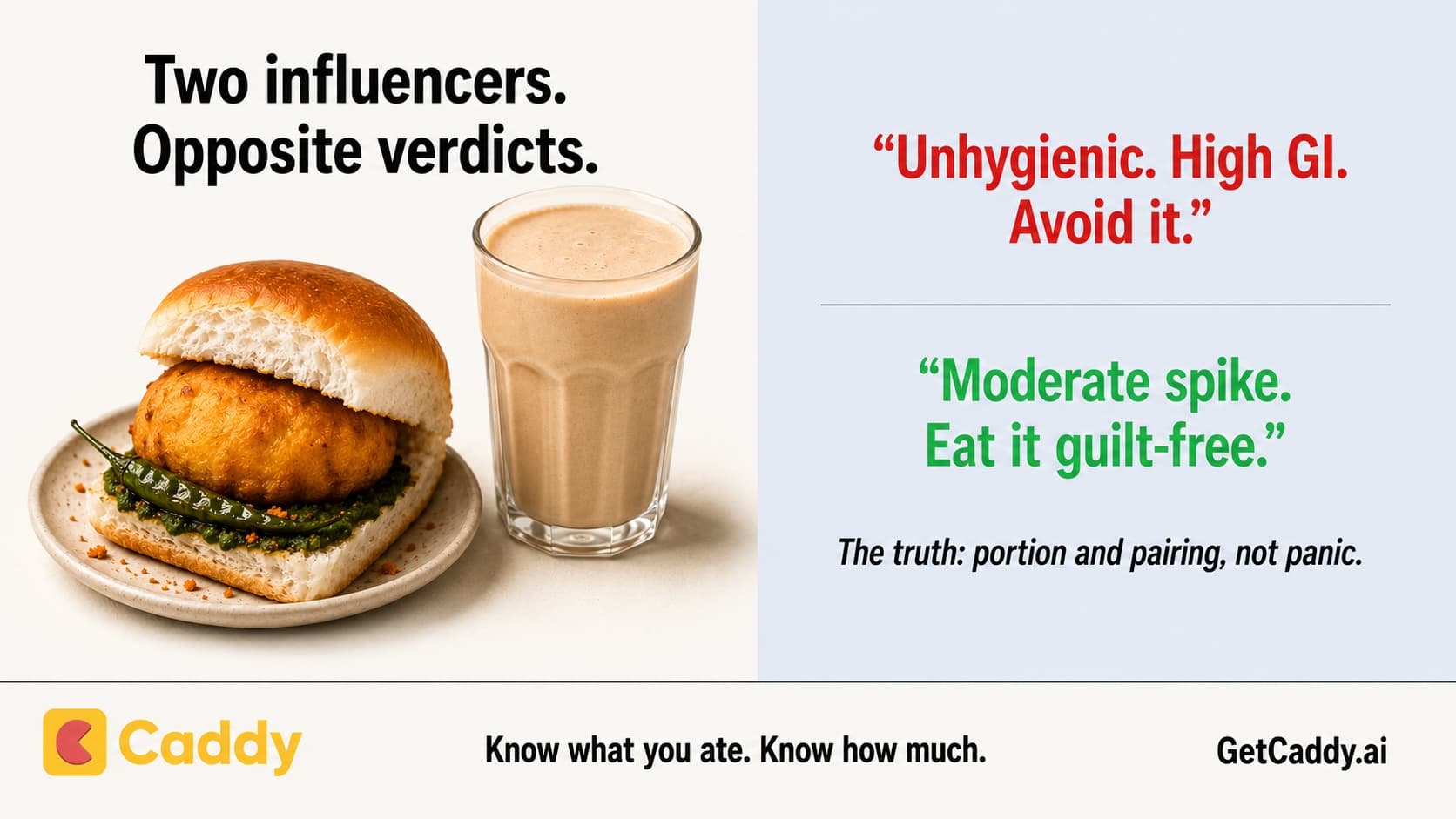
For a long time, the position from health-focused creators was consistent and negative. Vada pav uses refined carbohydrates. It's fried, often in oil that's reused multiple times. Street preparation raises hygiene concerns. Its glycemic index runs high. The advice: avoid it.
More recently, a different creator tested this directly using a continuous glucose monitor, ate a vada pav, and found the resulting blood glucose spike was moderate — not the dramatic response the "avoid this" framing implied. Their conclusion: eat it without guilt.
Two credible-sounding positions, built on real observations, arriving at opposite conclusions. This is worth sitting with, because it's not really about vada pav. It's about what's happened to nutrition content generally.
The Actual Problem: Confidence Without Context
Neither position is necessarily wrong in isolation. A single CGM reading from one person, on one occasion, tells you something real about that specific response — but it's a sample size of one, and glucose response varies meaningfully between individuals based on factors like existing insulin sensitivity, what else was eaten that day, and portion size. Meanwhile, the "avoid this" framing often treats a reasonably-portioned indulgence as equivalent to a daily staple, without distinguishing between the two.
What both sides skip is the same thing this entire content ecosystem tends to skip: quantity and frequency — the same principle that makes pairing matter more than the single ingredient in an entirely different food debate. One vada pav, occasionally, as part of a day that's otherwise balanced and within your calorie needs, behaves very differently from vada pav as a daily habit eaten in large portions alongside everything else.
The Freshness Argument Nobody Makes
There's a genuinely interesting counterpoint to the "street food is unhygienic" framing that rarely gets airtime: a well-established argument among chefs is that a lot of street food is fresher, not less fresh, than a meal cooked at home. Street vendors typically buy their vegetables, potatoes, and other ingredients each morning and sell through the same day — there's no refrigeration cycle, no ingredients sitting for a week before use. Home cooking, by contrast, frequently relies on vegetables and proteins stored for several days.
This doesn't mean every street vendor operates hygienically — cleanliness practices vary enormously and matter. It does mean "unhygienic" and "street food" aren't automatically synonymous, and freshness of ingredients is a real point in favour of well-run street food stalls.

A Combo Worth Trying
If you enjoy vada pav and want a version that fits well into a day focused on protein and calorie awareness, try pairing it with a protein shake. A single vada pav alongside a standard whey protein shake lands around 360 calories with roughly 30 grams of protein — a stronger protein-to-calorie ratio than most commercially marketed "healthy" protein bars, which frequently pack similar or higher calories with less protein per rupee spent.
This isn't a call to eat vada pav daily. It's a demonstration that a food treated as an outright villain can fit comfortably into a smart, protein-forward day, without needing to become a forbidden category.
The Real Takeaway
Food doesn't need to be this exhausting. A snack you enjoy taking a 10-minute break to eat shouldn't come wrapped in messaging suggesting it might genuinely threaten your health — not indigestion, not a stomach ache, but framed with the gravity of real danger. That kind of messaging generates engagement. It rarely generates better health outcomes, and it makes people anxious about food they've safely enjoyed for years.
Keep food simple. Enjoy your vada pav. Track your actual numbers instead of your anxiety.
How Caddy Fits Into This
Score 8 doesn't care whether today's calories came from a vada pav, a protein shake, or a home-cooked thali — a calorie deficit is a calorie deficit, regardless of which specific food delivered it. Built specifically around Indian food, including the street food you actually eat, at under ₹83/month, Caddy replaces conflicting influencer verdicts with the one number that tells you whether today worked.
Know what you ate. Know how much.
Score 8. Lose weight. That's it.
GetCaddy.ai
Sources
[1] Personalized Nutrition by Prediction of Glycemic Responses. Zeevi et al., Cell, 2015. https://www.wisdom.weizmann.ac.il/~eran/zeevi_cell_2015.pdf
[2] Vada pav nutrition data (140g serving, ~260 calories, 6–7g protein). Bon Happetee, Caddy's proprietary Indian food nutrition database.
[3] Calories in a Protein Shake — Nutrition Facts by Type. Nutrola. https://nutrola.app/en/nutrition-library/beverages/calories-in-a-protein-shake
Frequently Asked Questions
- Is vada pav healthy?
- It depends entirely on frequency and portion, not the food itself. An occasional vada pav, as part of an otherwise balanced day, fits into most calorie budgets. Daily vada pav in large portions is a different question.
- Does one CGM reading prove vada pav doesn't spike blood sugar?
- Not on its own. Glycemic response varies significantly between individuals, and a single reading is a sample size of one. Research using continuous glucose monitors has repeatedly shown that the same food can produce very different responses in different people.
- Is street food less hygienic than home-cooked food?
- Not automatically. Cleanliness practices vary by vendor and matter, but many street vendors buy fresh ingredients daily and sell through the same day, while home cooking often relies on ingredients stored for several days. Freshness and hygiene are separate questions.
- What's a good way to make vada pav more filling without giving it up?
- Pairing it with a protein source like a whey shake adds meaningful protein for relatively few extra calories, making the combined snack more balanced than vada pav alone.
- Why does vada pav have a high glycemic index?
- It's a combination of refined flour (the pav) and potato, both fast-digesting carbohydrates, fried in oil. That combination produces a quicker blood sugar rise than a meal with more fibre or protein.
Get Caddy
Your simplest way to eat smarter with Indian food
Download