
Most People Don't Need a Diet Plan. They Need a Scoreboard.
Written by Rishi Bhojnagarwala
Nutrition Reviewed by Dr. Hetal Pal, PhD in Nutrition Science
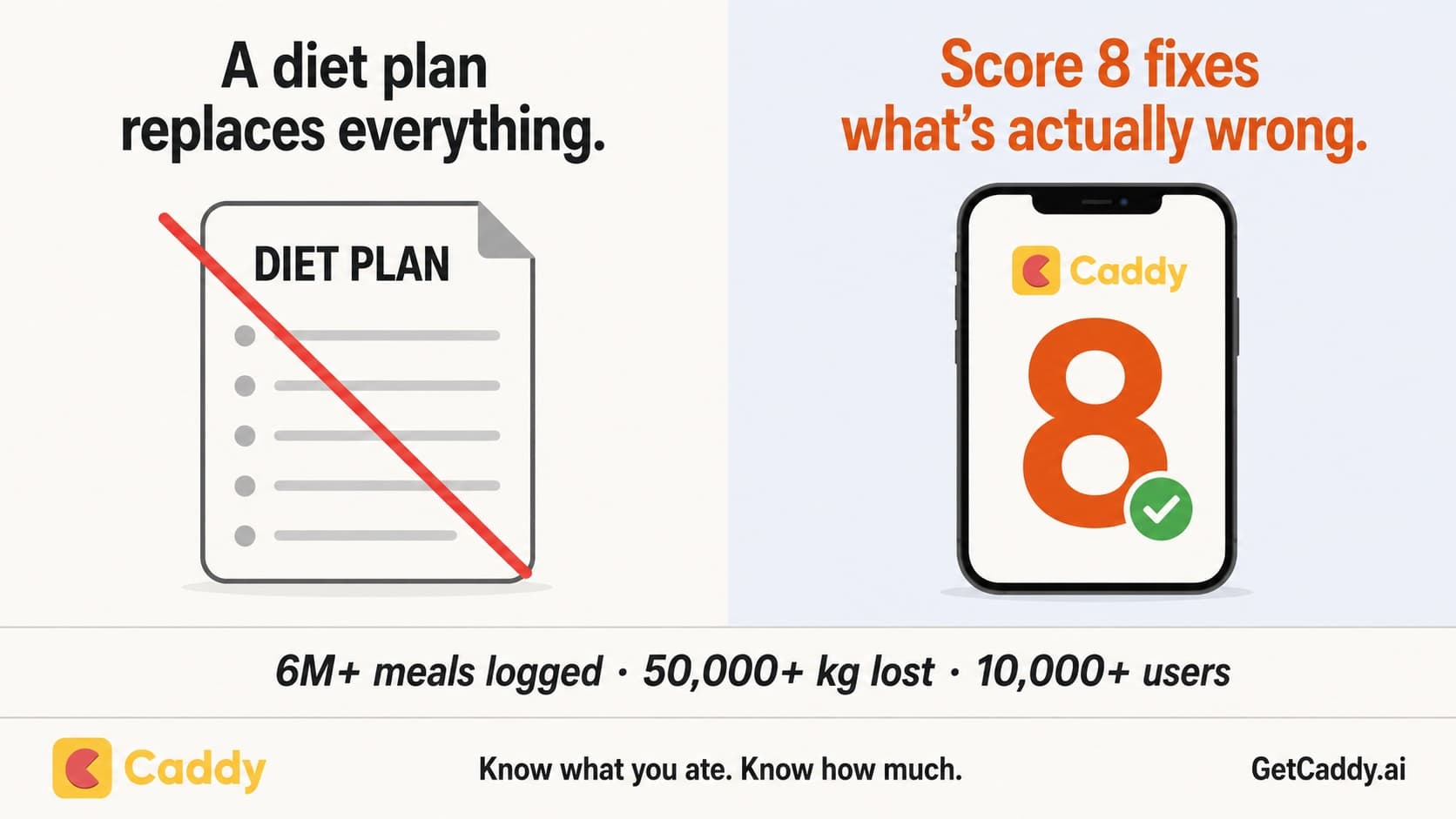
A diet plan assumes everything you eat is wrong and replaces all of it. The truth is usually 70-80% of your day was already fine.
What a Diet Plan Actually Assumes
Every diet plan starts from the same flawed premise: your current eating pattern is broken, so here's an entirely new one to follow instead. Cut this food group. Eat these exact meals, at these exact times, in these exact quantities. Follow it precisely, indefinitely, starting tomorrow.
This approach has a structural problem that has nothing to do with willpower. It doesn't know what you actually ate today. It can't see that most of your day — the roti, the dal, the sabzi, the base of how you already eat — is completely reasonable. It just discards all of it and prescribes a fictional new pattern from zero.

The 70-30 Reality
For most people, somewhere around 70 to 80% of what they eat on a normal day is genuinely fine. Reasonably balanced, appropriately portioned, not the actual obstacle to weight loss. The real leverage — the part that's quietly stalling progress — usually lives in the remaining 20 to 30%: a slightly oversized rice serving, a protein shortfall nobody noticed, a fried snack that tipped the day over.
A rigid diet plan can't identify that specific 20-30% because it never looked at your actual day in the first place. It just replaces the whole 100% with a new prescription, discarding the 70-80% that was working along with the fraction that wasn't.
How Score 8 Works Differently
Log a handful of meals on Caddy, and something useful happens almost immediately: the app starts effectively building your diet plan for you — not by prescribing a fixed menu, but by showing you, in real time, exactly where today's plate is coming up short.
You're not overhauling your eating. You're tweaking it, one gap at a time, until the Score lands at 8 or above.

What This Actually Looks Like
Evening, protein sitting at 60% of target. Rather than accepting the shortfall or panicking about it, the fix is simple: a protein shake, closing the gap before the day ends.
Carbs already high by mid-afternoon. Skip the rice at dinner. Add extra sabzi or a protein source instead. One swap, day rebalanced.
Fiber running low as the day winds down. A quick spoon of isabgol closes the gap without requiring an entirely different dinner.
Something fried at lunch. Go grilled or tandoori for the evening meal instead of frying again. Balance restored across the day, not within a single meal.
None of these adjustments require abandoning what you already eat. They're small, specific corrections applied to a day that was mostly already on track — which is a fundamentally different approach from a diet plan that assumes the whole day needs replacing.

Why Hitting 8 Actually Means Something
If you're consistently landing at a Score of 8 or higher, there's no realistic version of that outcome where you're not eating reasonably well and sitting in a calorie deficit. The math doesn't allow for both an 8-or-above Score and a genuinely poor diet — the Score is directly tied to the fundamentals that predict weight loss: adequate protein, reasonable fiber, and a calorie total that puts you in deficit.
This is also why Score 8 functions less like a diet and more like a scoreboard. A diet tells you what to eat before you've eaten it. A scoreboard shows you where you actually stand, and lets you make the smallest possible correction to get back on track — which tends to be far more sustainable than starting over with a completely new eating pattern every Monday.

This Isn't a New Idea. It's a Refined One.
The core approach behind Caddy isn't a recent experiment — the underlying idea dates back roughly a decade. What's changed is the scale and precision behind it: the system is now trained on over 6 million meals logged by thousands of Indian users, who have collectively lost more than 50,000 kg using this exact approach. Over 100,000 users rely on it today.
How to Actually Use This
Log your meals as you go, rather than all at once at the end of the day — this is what makes the real-time gap-fixing possible in the first place. When your Score dips below 8 partway through the day, look at which specific number is dragging it down — protein, fiber, or total calories — and make one small, targeted adjustment rather than overhauling the rest of your day.
Know what you ate. Know how much.
Score 8. Lose weight. That's it.
Frequently Asked Questions
- Do I need to follow a strict diet plan to use Caddy?
- No. Caddy doesn't prescribe a fixed menu — it shows you where your actual day is falling short (protein, fiber, or total calories) so you can make one small adjustment, rather than replacing your whole way of eating.
- What does a Score of 8 actually mean?
- A Score of 8 or higher means you're eating with adequate protein, reasonable fiber, and a calorie total that puts you in a deficit. There's no way to hit 8 consistently while eating poorly — the number is directly tied to the fundamentals that predict weight loss.
- What if my Score drops during the day?
- Check which specific number is dragging it down — protein, fiber, or calories — and make one targeted fix, like adding a protein shake or skipping a starchy side at your next meal, rather than overhauling the rest of your day.
- Why is logging meals in real time better than logging everything at the end of the day?
- Real-time logging is what makes same-day corrections possible. If you only log at night, you've already lost the chance to fix a protein or fiber gap before the day ends.
- Is most of what I already eat actually a problem?
- For most people, no — 70 to 80% of a typical day is already reasonably balanced. The actual leverage is usually in a much smaller part of the day, which is what Score 8 is built to identify.
Get Caddy
Your simplest way to eat smarter with Indian food
Download