
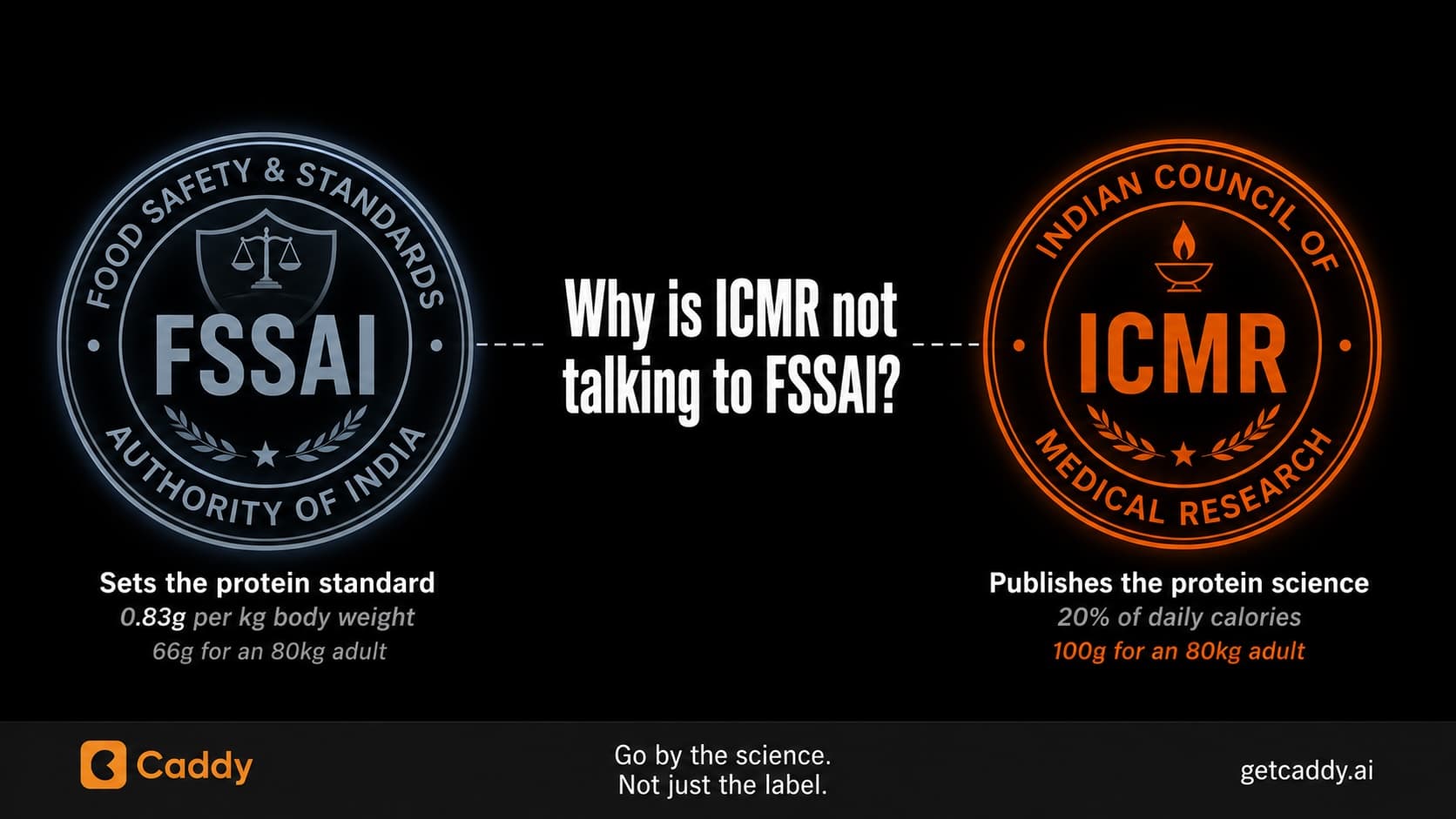
Why ICMR and FSSAI Disagree on How Much Protein You Need — And Why That Gap Is Everyone's Problem
Written by Rishi Bhojnagarwala
Medically Reviewed by Dr. Hetal Pal, PhD in Nutrition Science
Two official Indian government bodies. Two different protein recommendations. Apparently zero conversation between them. Here is why that matters more than you think.
The Number That Started This Conversation
0.83 grams of protein per kilogram of body weight.
That is the protein RDA — Recommended Dietary Allowance — set by FSSAI, the Food Safety and Standards Authority of India. It is the number that governs every protein-related claim on every food package sold in India. It determines what "high protein" means on your breakfast cereal, your atta, your biscuit, your protein bar.
0.83. Not 0.8. Not 1. Two decimal places — so it absolutely has to be backed by some science. Presumably very precise science.
For an 80 kilogram adult, this translates to a recommended protein intake of approximately 66 grams per day. This is the number that Indian food regulation is built on. This is the number that brands must meet to make certain claims. This is the number that Indian consumers are implicitly told represents adequate protein intake when they read a food label.
Now here is the second number.
The Other Official Number Nobody Is Talking About
The Indian Council of Medical Research — ICMR — is India's premier biomedical research body. It publishes the nutrition and health research that is supposed to inform policy in this country. In 2025 and 2026, as part of the landmark ICMR-INDIAB study series, it published recommendations advising that Indians should consume 16 to 20 percent of their daily calories from protein.
For an 80 kilogram adult eating a standard 2000 calorie diet, 16 to 20 percent of calories from protein translates to approximately 80 to 100 grams of protein per day.
Let us put both numbers side by side.
FSSAI recommended daily protein for an 80kg adult: 66 grams. ICMR recommended daily protein for an 80kg adult: 80 to 100 grams.
That is a gap of 14 to 34 grams of protein. Every single day. For every Indian adult.
This is not a minor rounding difference. This is a structurally significant discrepancy between two official Indian government bodies — one of which sets the regulatory standards that govern food labelling, and one of which publishes the nutritional science that should inform those standards.
And as far as anyone in the Indian food and nutrition space can determine, these two bodies are not in any meaningful active conversation about closing that gap.

Why This Gap Exists — And Why It Has Persisted
The FSSAI protein RDA of 0.83 grams per kilogram of body weight is derived from global dietary reference values that were established some years ago — values that reflected the science of their time and the population data available when they were set.
Nutritional science, particularly regarding protein requirements for populations with high rates of metabolic disease, has moved meaningfully since those values were established. The understanding of sarcopenia — age-related muscle loss — and its relationship to protein intake has deepened significantly. The evidence connecting adequate protein to metabolic health, insulin sensitivity, and healthy weight management has grown substantially. And the specific context of the Indian population — with its documented tendency toward sarcopenic obesity, its predominantly plant-based protein sources with lower bioavailability, and its high rates of metabolic disease — has become better understood.
ICMR's updated recommendations reflect this evolved understanding of what Indian bodies actually need. FSSAI's regulatory standards do not yet reflect it.
The result is a regulatory framework that is legally current but scientifically behind — and a population of Indian consumers making food decisions based on labels that are calibrated to a protein standard that India's own primary medical research body has effectively superseded.
How This Creates a Problem That Nobody Intended
Here is the mechanism through which this governance gap creates real-world consumer harm — and it is important to understand that nobody in this story is acting in bad faith.
A food brand wants to create a high protein product. It formulates to meet FSSAI's high protein threshold — which requires a product to provide 20 percent of the FSSAI-defined RDA per 100 grams. The brand invests in product development, reformulation, and testing. It achieves compliance. It carries the high protein claim legitimately and legally.
A consumer sees the high protein claim. They are health-conscious. They are trying to increase their protein intake. They have perhaps read something about ICMR's updated recommendations. They choose this product over alternatives partly because of the claim.
But the claim is calibrated to 66 grams of daily protein for an 80kg adult. If the same consumer is trying to hit 80 to 100 grams — as ICMR's more current science suggests they should — the product that carried the high protein claim is delivering them a meaningfully different nutritional outcome than the label implied.
The brand followed the rules. The label is legal. The consumer is misled — not by bad faith, but by a gap between two government bodies that nobody has formally addressed.
This is the definition of a systemic governance problem. The individual actors — the brand, the consumer, even the regulators within their own mandates — are behaving correctly. The system between them is broken.

The Protein Deficiency Context That Makes This Urgent
This would be a moderately important policy discussion in any context. In India's specific context, it is urgent.
India has a documented and severe protein deficiency problem at the population level. Multiple large-scale nutrition surveys have found that a significant majority of Indians — estimates range from 70 to 80 percent of the population — consume less protein than even FSSAI's existing RDA recommends. This is not a marginal deficiency. It is a foundational nutritional gap that contributes to the country's burden of sarcopenia, metabolic disease, poor immune function, and delayed recovery from illness.
The ICMR-INDIAB data that generated the updated protein recommendations also documented the metabolic consequences of India's current dietary pattern — 62 percent of daily calories from carbohydrates, protein intake at just 12 percent of energy, and 83 percent of adults carrying at least one metabolic risk factor.
Against this backdrop, having a food regulatory system calibrated to a protein standard that India's own medical research body has found to be insufficient is not an administrative technicality. It is a public health problem with real consequences for real people making food decisions based on the information available to them.
The Specific Problem With Food Labels
The labelling dimension of this gap deserves particular attention because it is where the governance disconnect becomes most visible to ordinary consumers.
Under current FSSAI regulations, a food product can claim to be "high protein" if it provides 20 percent of the FSSAI protein RDA — that is, 20 percent of 0.83 grams per kilogram, calculated against a reference body weight — per 100 grams of product. This threshold was set with reference to the existing RDA.
If the RDA itself is outdated relative to current science, then the high protein threshold derived from it is also outdated. A product that clears the high protein bar set by FSSAI might deliver 30 to 40 percent less protein than an ICMR-aligned high protein threshold would require. The claim is legally valid. The nutritional communication is misleading — not intentionally, but structurally.
This creates a particularly difficult situation for Indian consumers who are actively trying to improve their protein intake. They are using food labels as navigational tools — looking for high protein claims to guide their purchasing decisions toward products that will help them meet their goals. But the labels are calibrated to a goal that India's own research says is insufficient. The navigation system is pointing in the right general direction but is calibrated to a destination that has moved.
The Aashirwad Atta Example Revisited
This governance gap explains something important about a controversy that has received significant attention in Indian nutrition circles — the criticism of Aashirwad Select Atta for its high protein claim.
Aashirwad's high protein atta was attacked by nutrition content creators for making a claim that felt inflated relative to the product's actual protein contribution to an adult's daily needs. The criticism had surface logic — if an adult needs significantly more protein than the atta's contribution, calling it high protein seems misleading.
But the brand was compliant with FSSAI regulations. It met the threshold set by the food safety authority. It was following the rules exactly as written.
The critics were implicitly applying a higher protein standard — one closer to ICMR's updated recommendations — and finding the FSSAI-compliant claim wanting by that standard.
Both were right, in a sense. The brand followed FSSAI. The critics were applying ICMR. And nobody in the debate paused to note that the real story was not about Aashirwad's compliance or the critics' accuracy — it was about the gap between two government bodies whose numbers do not align.
The brand should not have been the villain of that story. The governance gap should have been.

What Should Actually Happen
The solution here is not complicated in principle, even if it is complex in execution.
FSSAI should formally review its protein RDA in light of ICMR's updated recommendations and the current scientific evidence on protein requirements for Indian adults. This review should involve active collaboration with ICMR — not a parallel process — so that the nutritional science and the regulatory standards are developed in conversation with each other rather than independently.
The high protein claim threshold should be recalibrated to reflect whatever revised RDA emerges from that process. Brands should be given a clear, reasonable transition timeline to reformulate or relabel products accordingly.
And the broader principle should be established that FSSAI's nutritional reference values — the numbers that underpin every health and nutrition claim on every food package in India — should be systematically reviewed and updated as the scientific evidence evolves, with ICMR as the formal scientific partner in that process.
This is not a radical proposal. It is how food regulatory systems are supposed to work. The science updates. The standards update. The labels update. The consumers get information that reflects current knowledge.
The gap that currently exists between ICMR and FSSAI is not the result of anyone actively choosing to keep it open. It is the result of two bodies doing their respective jobs without a formal mechanism for ensuring their outputs stay aligned.
That mechanism needs to exist. And someone in Indian public health governance needs to build it.
What This Means for You Right Now
While the governance conversation happens — and it will happen slowly, as these things do — there are practical implications for Indian consumers trying to make genuinely informed nutritional decisions.
The high protein claims on food packaging in India are calibrated to a standard that ICMR's current science suggests is insufficient for most Indian adults. This does not mean those products are bad or that the claims are fraudulent. It means that using food labels as your primary guide to protein adequacy may result in you consuming significantly less protein than current evidence suggests is optimal.
For most Indian adults — and particularly for those managing metabolic conditions, losing weight on GLP-1 medications, or over the age of 40 where muscle preservation becomes increasingly important — the practical target is closer to 80 to 100 grams of protein per day for an average weight adult, not the 66 grams that FSSAI's current RDA implies.
Getting there requires looking beyond the high protein label and understanding the actual grams of protein in what you eat — which is exactly the kind of nutritional clarity that good food tracking is designed to provide.
The Bottom Line
India has two government bodies publishing two different protein numbers for Indian adults. The gap between them is large enough to matter significantly to the health of the people navigating daily food choices based on the information available to them.
The brands selling food in India are following FSSAI. The science being published in India is coming from ICMR. Until those two are in active conversation — until updated nutritional science flows systematically into updated regulatory standards — Indian food labels will remain legally correct and scientifically incomplete simultaneously.
0.83 grams per kilogram. Two decimal places. Presumably very precise.
It is time for a conversation that produces a more current number.
About Caddy Caddy tracks your nutrition against what the current science actually recommends — not just what the label says. Built on one of India's most comprehensive food databases and designed around Indian eating patterns, Caddy helps you understand what you are actually consuming, make informed decisions about what you eat, and hit the protein targets that current evidence supports — wherever the regulatory label currently sits. Visit getcaddy.ai