
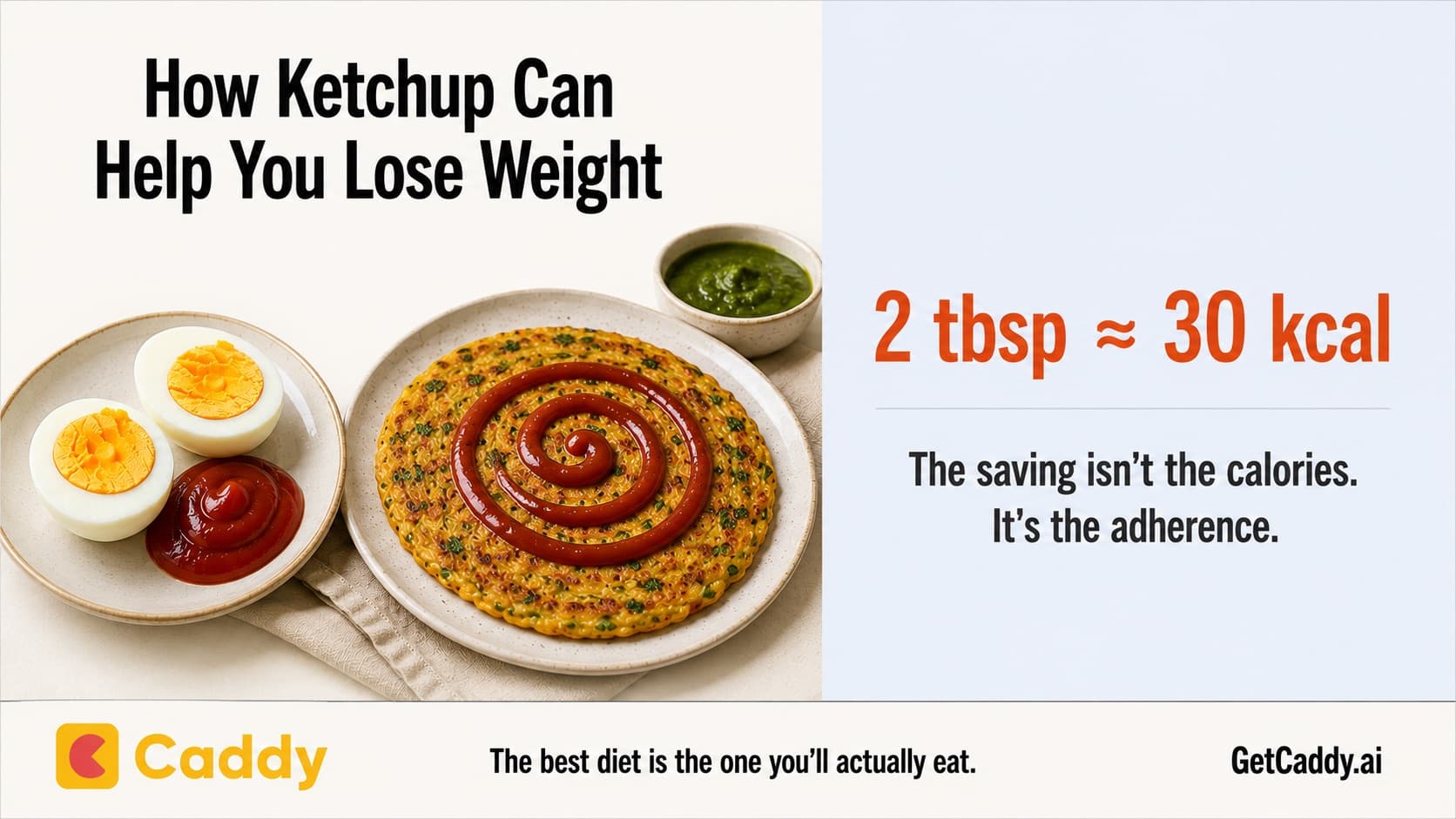
How Ketchup Can Actually Help You Lose Weight
Written by Rishi Bhojnagarwala
Nutrition Reviewed by Dr. Hetal Pal, PhD in Nutrition Science
2 tablespoons of ketchup is about 30 calories. Here's how that small fact can save you thousands of calories a year — and make the healthy breakfast you keep abandoning finally stick.
The Real Number
Ketchup gets treated like a sugar bomb. In reality, 2 tablespoons runs about 30 calories — a small enough number that it can actively work in favor of a weight loss diet, not against it, depending on what it's replacing.
The Boiled Egg Swap
Two fried eggs, or a proper omelet, typically run around 250 calories once you count the oil. Two boiled eggs with a couple of spoons of ketchup instead: closer to 190 calories. Same eggs, same protein — 60 calories saved, purely from how they're prepared and finished.

Here's the part that matters more than the math, though: plain boiled eggs, eaten daily with nothing on them, get boring fast. Almost nobody sustains "just eat it bland" for long — which is usually exactly why the fried version quietly wins back by week two, oil and all. Ketchup isn't only saving calories here. It's the reason the lower-calorie version is the one that actually survives daily repetition.
If you're eating eggs every day, that 60-calorie save compounds to roughly 22,000 calories a year — close to 3 kilograms of fat, from one small, genuinely sustainable swap.
The Chilla Problem
Besan or moong dal chilla, loaded with vegetables and paneer, is the textbook "perfect" vegetarian high-protein breakfast — fiber-rich, protein-rich, everything a nutrition plan would recommend. On paper, it's ideal.
In practice, most people can't picture eating it daily, because on its own, it's bland — and green chutney alone rarely closes that gap for most palates. The result: it gets eaten enthusiastically for two days, then quietly abandoned for something easier and tastier.
Add a spoon or two of ketchup, and the entire equation changes. It becomes a breakfast someone can genuinely see themselves eating tomorrow, and the day after that — not because the nutrition changed, but because the adherence problem got solved.

Why This Actually Matters
A "perfect" meal nobody sticks to loses to a good-enough meal eaten daily, every single time. This isn't just intuition — it's a documented pattern in dietary behavior research. Westenhoefer, Stunkard and Pudel's landmark study on dietary restraint, replicated across tens of thousands of participants since, found that flexible eating patterns — small, sustainable adjustments rather than rigid, "perfect" rules — predict lower long-term weight and less binge eating than strict, all-or-nothing approaches. Taste isn't the enemy of a healthy plate. It's usually the reason a healthy plate survives past the first week.
Fear-mongering around condiments like ketchup — driven by sugar-content scares that ignore actual serving size, the same pattern we've unpacked with palm oil and common food additives — pushes people away from exactly the kind of small addition that makes consistency possible. The result isn't a cleaner diet. It's often a diet people quietly give up on.
What a Registered Dietitian Sees in Practice
We asked Elisa Bremner, MS, RDN, CDN, a plant-based dietitian who works with clients ranging from adolescents in residential care to seniors on fixed incomes, to weigh in.
Is "the food tastes too bland" the real reason clients abandon a healthy meal plan?
Elisa: "The food tastes too bland" is rarely an excuse I hear — often it's something more along the lines of "it doesn't taste familiar." This is exactly where commonly used condiments can help.
Is there a downside to recommending condiments like ketchup specifically to make a healthy meal sustainable?
Elisa: Ketchup and other condiments are often high in sodium, may be used as a substitute for eating vegetables — they are not! — or may decrease flavor sensitivity, training us to crave more salty foods. But in most cases, in the amounts many people actually use, they are not a huge problem.
What's a small, low-effort swap you recommend most often to clients who keep giving up on a "perfect" meal plan within the first two weeks?
Elisa: I talk about the "healthy plate" — half vegetables and fruits, a quarter protein, a quarter whole grains or starchy veg — as a goal, but I encourage clients to move in that direction rather than hit it perfectly. The simplest swap I usually recommend isn't a swap at all, but an "add." If you can add beans to your meals, the benefits follow naturally — their strong satiety factor can crowd out less healthful foods on its own. As for a specific swap: subbing some of the ground meat in burgers, meatballs, or chili with vegetables, beans, or tofu is a simple way to retain — or even enhance — flavor, cut saturated fat, and increase fiber.
Worth holding both points at once: ketchup helping a boiled egg or a chilla survive daily repetition is real, and so is Elisa's caution that it's not a substitute for the vegetables it sometimes gets used in place of. At two tablespoons a day, the two aren't in conflict — the same "watch the amount, not the ingredient" principle this piece opened with.

How Caddy Fits Into This
Score 8 doesn't care whether your protein came from a fried omelet or a boiled egg with ketchup — it cares whether your day, in total, landed in a calorie deficit. Built specifically around Indian meals, Caddy tracks the actual numbers so you can make swaps like this one with real data, not guesswork or fear.
Know what you ate. Know how much.
Score 8. Lose weight. That's it.
Sources
Frequently Asked Questions
- How many calories are in 2 tablespoons of ketchup?
- About 30 calories — a small enough amount that it rarely derails a weight loss diet, and can even help by making lower-calorie meal choices more sustainable to eat daily.
- Are boiled eggs healthier than fried eggs for weight loss?
- Boiled eggs are lower in calories — roughly 160 calories for two, versus about 250 for two fried eggs or an omelet made with oil. Adding a couple of spoons of ketchup to boiled eggs still keeps the total around 190 calories, a meaningful saving while improving taste and daily adherence.
- Why is besan or moong dal chilla hard to eat every day?
- On its own, chilla tends to taste bland, even though it's protein-rich and fiber-rich. Green chutney alone often doesn't provide enough flavor variety for most people to sustain it as a daily breakfast, which is why it frequently gets abandoned after a few days.
- Does adding ketchup to healthy meals ruin their nutritional value?
- Not meaningfully, at typical serving sizes. Two tablespoons of ketchup adds around 30 calories — a small addition that can meaningfully improve the taste and long-term sustainability of an otherwise healthy, high-protein meal.
- Is it better to eat a "perfect" bland meal or a slightly less perfect one you'll actually finish daily?
- Consistency matters more than perfection for weight loss. A nutritionally ideal meal that gets abandoned after a few days provides far less benefit than a slightly adjusted version — like adding ketchup — that gets eaten consistently over weeks and months.
Score 8 to lose weight
Your simplest way to eat smarter with Indian food
Get Caddy