
Gym Membership Doesn't Predict Health — Japan vs. the US Proves It
Written by Rishi Bhojnagarwala
Nutrition Reviewed by Dr. Hetal Pal, PhD in Nutrition Science
More gyms per capita should mean a healthier population. The data says otherwise.
The Assumption Nobody Questions
Gym membership rates get treated as a rough proxy for a population's health consciousness — more people paying for a gym, presumably, means more people taking their health seriously, which should translate into better outcomes. This assumption rarely gets tested directly. When it is, the results are uncomfortable for anyone who's built a worldview around fitness-industry metrics.
The Numbers
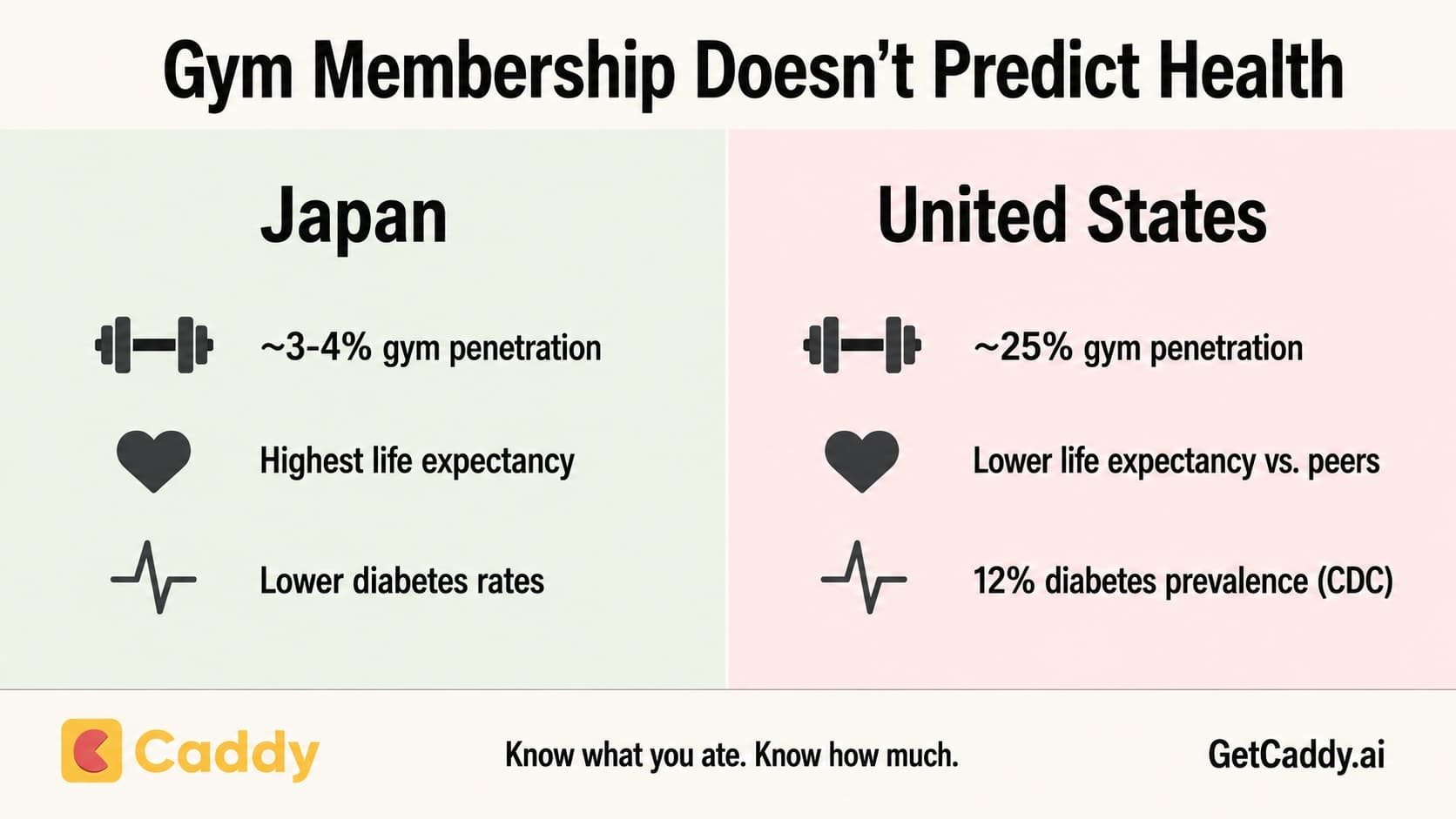
Japan's gym membership penetration rate has hovered between roughly 3.4% and 4.5% in recent years — among the lowest rates of any developed economy. Japan also has one of the highest life expectancies in the world, a statistic that has held for decades, and historically lower rates of diabetes and metabolic disease compared to most Western nations.
The United States sits at the opposite end. Roughly one in four Americans — about 25% of the population — now holds a gym membership, an all-time high, among the highest penetration rates globally, with even higher figures once pay-as-you-go fitness users are included. Yet the CDC's most recent National Diabetes Statistics Report puts US diabetes prevalence at 12% of the total population, alongside obesity and metabolic disease rates that rank among the worst in the developed world.

Higher gym penetration. Meaningfully worse metabolic outcomes. If gym membership were a genuine predictor of population health, this comparison should run in the opposite direction.
This Isn't Unique to Japan and the US
Look more broadly, and the pattern holds. Several of the world's most gym-obsessed countries — nations with high per-capita fitness club membership — don't rank near the top for life expectancy or metabolic health at all. Meanwhile, several countries with strong health and longevity outcomes have comparatively modest gym cultures. Gym membership and population health outcomes simply aren't tightly correlated once you look across countries rather than within a single gym-industry press release.
The relationship between gym membership and population-level metabolic health is not straightforward. Higher gym participation does not automatically translate into better metabolic outcomes, because gym attendance represents only one type of physical activity and may be influenced by socioeconomic factors, access, and cultural norms. Countries with high gym participation may still face significant rates of obesity, insulin resistance, and metabolic disease due to dietary patterns, sedentary behavior outside the gym, and environmental factors (Warburton & Bredin, 2017).
— Ilana Schachter, RDN, Consumer Health Digest
I would say that this pattern holds broadly. Nations with high metabolic health often bake physical activity into daily life through walking and public transit infrastructure, rather than required paid, structured gym time. Population-level metabolic outcomes are heavily driven by cultural portion size and the prevalence of ultra-processed foods, which a commercial gym subscription cannot offset. Holding a gym membership is a consumer behavior, whereas metabolic health is a physiological outcome influenced primarily by nutrition, chronic daily activities, and sleep.
— Dr. Antonika Chanel, Traditional Chinese Medicine doctor and acupuncturist
What This Doesn't Mean
To be clear, this isn't an argument that gyms are useless, or that individual people don't genuinely benefit from structured training. Plenty of people build real strength, cardiovascular fitness, and long-term health habits through gym-based exercise. The point isn't about the value of a workout to an individual — it's about what gym penetration tells you at a population level, which turns out to be very little. It's the same blind spot that shows up in how packaged food gets blamed for India's health numbers while the bigger, less visible factor goes unexamined — an easy-to-measure proxy standing in for the thing that actually matters.
What Actually Explains Japan's Numbers
The factors most plausibly behind Japan's outcomes have almost nothing to do with gym infrastructure. Walking and cycling function as routine daily transport rather than optional exercise, baked into how cities and commutes are designed. Portion sizes run smaller as a cultural default, not a diet strategy people have to consciously maintain. The traditional dietary pattern leans on fish, vegetables, rice, and fermented foods rather than the dense, highly processed calorie sources common in the standard American diet.
None of these factors would register in a gym-membership statistic. All of them would plausibly move the needle on long-term metabolic health far more than a monthly gym subscription would.

Countries with lower gym participation may still demonstrate favorable metabolic health outcomes because daily movement patterns, dietary habits, cultural norms, and broader social systems can have a significant influence. In Japan, several factors may contribute, including traditionally high levels of non-exercise activity such as walking and active transportation, smaller portion sizes, dietary patterns emphasizing fish, vegetables, legumes, and minimally processed foods, and lower consumption of ultra-processed foods and sugar-sweetened beverages compared with some Western dietary patterns (Popkin & Du, 2003). It's also important to recognize that national health outcomes reflect population-level patterns and don't mean every individual follows the same lifestyle — Japan has experienced increases in obesity and metabolic disease over time as dietary patterns and lifestyles have changed.
— Ilana Schachter, RDN, registered dietitian and nutritionist for Consumer Health Digest
Countries like Japan have a different lifestyle. They are the kind of country where you walk everywhere. In Japan, they have strict rules on how much chemical residue can remain on domestic and imported foods. They eat fresh, and they eat from the ocean since they are surrounded by water. I lived in Japan for over five years, and companies start their day with a company-wide exercise broadcast over a microphone — everybody stands outside and is guided through a morning routine, already incorporating wellness into corporate life.
— Dr. Antonika Chanel, Traditional Chinese Medicine doctor and acupuncturist
The Real Lesson: Stop Conflating Behavior With Outcome
This is the same mistake that shows up constantly in individual fitness tracking, not just national statistics. People log workouts obsessively — sets, reps, calories burned on a treadmill — while giving comparatively little attention to what and how much they actually eat.
Exercise has real, well-documented benefits: cardiovascular health, mental health, muscle preservation, and more. But for weight management and metabolic health specifically, the evidence consistently points to diet — total calorie intake — as the dominant lever. A country, or an individual, can have an impressive amount of gym activity and still lose the underlying metabolic battle if diet isn't managed alongside it.
Gym attendance is a behavior. Metabolic health is an outcome. Conflating the two, at a national or personal level, leads to a lot of wasted attention pointed at the wrong lever.
I would avoid thinking of diet and exercise as competing priorities, because they influence metabolic health through different pathways. Diet is often the strongest lever for improving blood glucose regulation, cholesterol, blood pressure, body composition, inflammation, and overall calorie balance. Exercise provides unique benefits diet can't fully replace — insulin sensitivity, cardiovascular fitness, muscle mass, mitochondrial function, mood. If prioritizing changes, I'd generally recommend improving dietary quality first, then adding consistent movement including resistance training, then optimizing sleep and stress. The biggest misconception is that health requires access to a gym or expensive fitness resources.
— Ilana Schachter, RDN, Consumer Health Digest
For someone trying to improve their overall metabolic health, I would rank their diet very high — the number one thing to focus on versus exercise, in terms of actual impact. We are carbon beings, and we need organic, nutrient-dense food in our system for our brain to function, to have mental clarity, energy, and focus. If we're going to add exercise on top of that, it's important to have the proper nutrition in our system first.
— Dr. Antonika Chanel, Traditional Chinese Medicine doctor and acupuncturist

How Caddy Fits Into This
This is exactly the gap Caddy is built to close. Instead of tracking workouts as a stand-in for health, Caddy tracks the thing that actually predicts outcomes: what you eat, and how much. Take a picture of your plate, get your Score out of 10. Score 8 means you're in a calorie deficit — the metric most directly tied to weight and metabolic outcomes, regardless of how often you're at the gym.
Built specifically around Indian food, at under ₹83/month, Caddy puts the attention where the actual data says it belongs.
You don't need a gym membership to be metabolically healthy. You need to know what you're eating, and how much.
Know what you ate. Know how much.
Score 8. Lose weight. That's it.
Sources
[1] Global Health and Fitness Industry Poised for Further Expansion. Health & Fitness Association. https://www.healthandfitness.org/global-health-and-fitness-industry-poised-for-further-expansion/
[2] How 77 Million Fitness Members Work Out: New HFA Data Reveals Shifting Equipment, Training, and Membership Trends. Health & Fitness Association, 2025. https://www.healthandfitness.org/how-77-million-fitness-members-work-out-new-hfa-data-reveals-shifting-equipment-training-and-membership-trends/
[3] National Diabetes Statistics Report. CDC, 2026 (2023 data). https://www.cdc.gov/diabetes/php/data-research/index.html
Frequently Asked Questions
- Does gym membership actually predict a population's health outcomes?
- Not reliably. Japan has one of the lowest gym membership rates among developed nations and some of the best longevity and metabolic health outcomes in the world, while the US has much higher gym membership and worse diabetes and obesity rates.
- Why does Japan have such good health outcomes with so few gym members?
- Likely factors include daily walking and cycling built into how cities and commutes are designed, smaller default portion sizes, and a traditional diet built around fish, vegetables, rice, and fermented foods — none of which show up in a gym-membership statistic.
- Does this mean exercise doesn't matter for health?
- No. Exercise has real, well-documented benefits for cardiovascular health, mental health, and muscle preservation. The point is narrower: for weight management and metabolic health specifically, diet is the dominant lever, and gym membership is a poor proxy for population-level metabolic health.
- What's a better predictor of metabolic health than gym membership?
- Total calorie intake relative to what the body needs, tracked consistently over time, is far more directly tied to weight and metabolic outcomes than exercise behavior or gym attendance.
- Is diet or exercise more important for weight loss?
- For weight loss specifically, diet — the size of your calorie deficit — plays the dominant role. Exercise adds real benefits beyond weight (cardiovascular fitness, mental health, muscle preservation), but it's a much smaller lever for the number on the scale than what and how much you eat.
Get Caddy
Score 8 today, lose weight tomorrow
Download