
E211 on Your Ketchup? Here's What Sodium Benzoate Actually Does
It's flagged on labels like a warning. Here's what E211 actually does in your food — and why it's doing a job nature already invented.
The Accusation
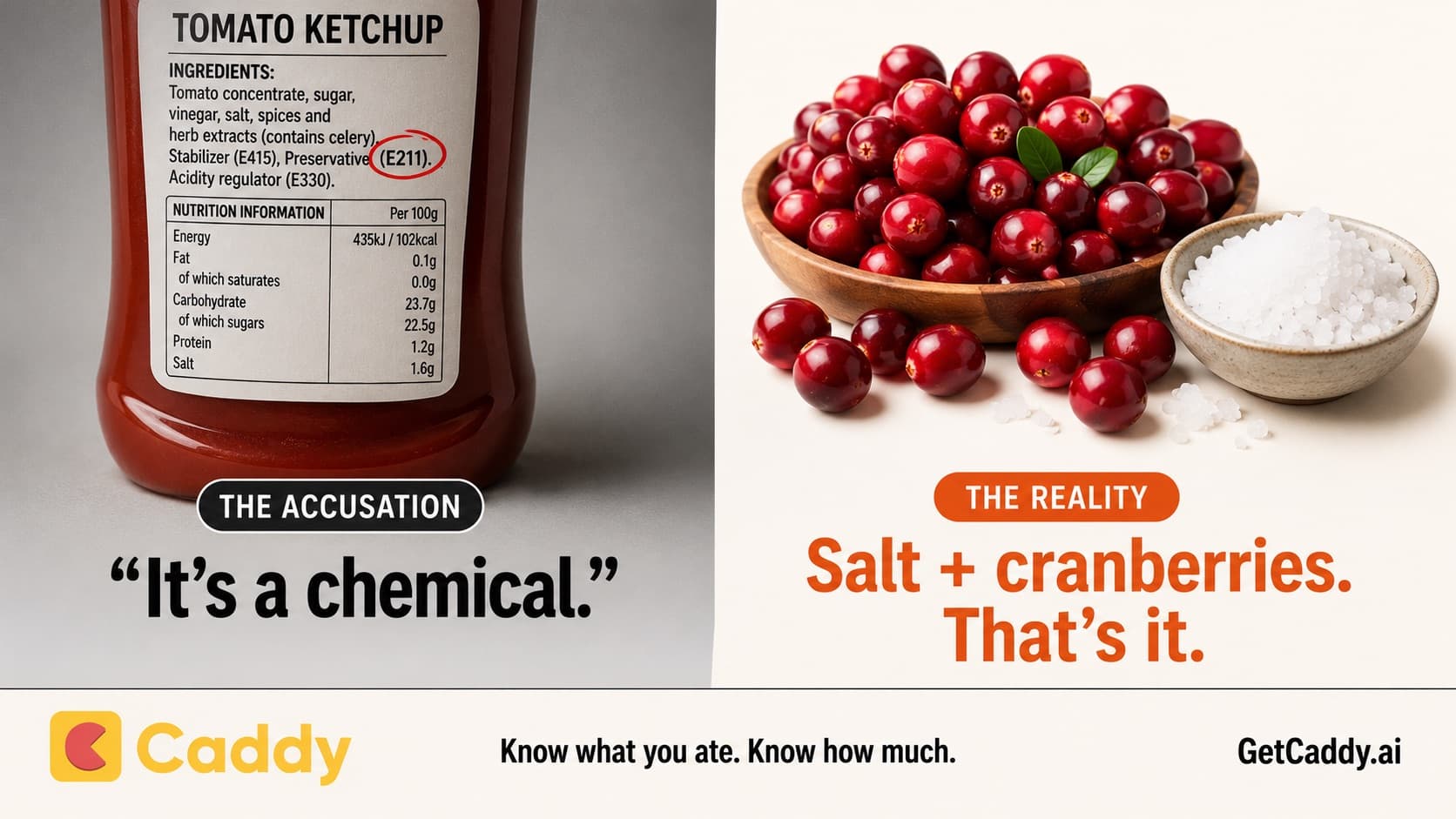
You've seen this play out: someone scans the ingredient list on a ketchup bottle or a jar of jam, lands on "E211," and declares it. "That's a chemical. This is bad for you." No explanation follows. Just the number, and the implication that a number on a label is inherently suspicious.
Let's actually look at what E211 is, and why it's there.
What Sodium Benzoate Actually Does
E211 is the labeling code for sodium benzoate — a water-soluble preservative and antimicrobial agent used to inhibit the growth of bacteria, yeast, and mould in food. Its effectiveness isn't universal — it works specifically in acidic environments, most effective in foods with a pH below 4.5, such as soft drinks, dressings, and preserves.
This detail matters, because it explains why sodium benzoate shows up specifically in ketchup and jam, rather than being scattered randomly across the food supply. Ketchup is acidic — vinegar and tomato both contribute to a low pH. Jam is acidic too, from fruit acid and often added citric acid. Sodium benzoate wasn't added at random. It was matched to exactly the chemical environment where it does its job best.

Sodium: The Same Element in Your Salt
Break "sodium benzoate" into its two halves, and the first one dissolves fear almost immediately. Sodium is the same element present in ordinary table salt — the desh ka namak used in every Indian kitchen, daily, without hesitation. There's no reason sodium becomes something to fear simply because it's paired with a different compound in a different context.
Benzoate: Nature's Own Preservative
The second half is where this gets genuinely interesting. Benzoate comes from benzoic acid, and this occurs naturally — in real, meaningful concentrations — in cranberries, plums, prunes, and most berries.
Cranberries specifically carry up to roughly 0.5% of their entire weight as benzoic acid, one of the richest natural concentrations found in any common fruit. This isn't a trivial trace amount. It's high enough that benzoic acid functions as the cranberry's own built-in preservative — a significant reason cranberries resist spoilage and store for remarkably long periods without any additive at all.
Here's the part worth sitting with: sodium benzoate isn't simply found in nature in some unrelated way. It's performing the exact same job inside a ketchup bottle that benzoic acid already performs inside a cranberry. The preservative didn't invade food chemistry from a laboratory. It borrowed a mechanism fruit was already using on itself, long before anyone printed "E211" on a label.

Is It Actually Safe? The Regulated Dose
Sodium benzoate's use as a food preservative isn't unregulated. Under FDA regulation, its use is capped at 0.1% of food weight, and it's classified as Generally Recognized As Safe (GRAS) at that concentration.
The safety margin behind that number is substantial. Animal toxicity studies place the no-observed-adverse-effect level for sodium benzoate at 800mg per kg of body weight per day or higher, and the World Health Organization, FDA, and EU food safety authorities all set the acceptable daily intake at just 0-5mg per kg of body weight per day — meaning real-world exposure from food, even for someone eating ketchup and jam daily, sits far below any level where an effect has actually been observed in research.
One Honest Footnote, for Completeness
There is one specific, narrow scenario worth knowing about — not to alarm you, but because leaving it out would make this an incomplete picture.
When sodium benzoate is combined with added vitamin C (ascorbic acid) — specifically in beverages — and exposed to heat or light, a chemical reaction can form small amounts of benzene, a recognised carcinogen. The FDA has tracked this since 1990 and investigated it seriously. Testing between November 2005 and May 2007 found 10 out of nearly 200 beverage samples above the drinking-water benzene safety threshold of 5 ppb; every one of those products was reformulated or discontinued, with reformulated versions testing below 1.5 ppb. This is specifically about added sodium benzoate combined with added ascorbic acid under storage conditions — not sodium benzoate on its own, and not the naturally occurring benzoic acid inside a whole cranberry. Current FDA testing shows benzene levels in today's market do not pose a safety concern.

By the Way — E211 Isn't Alone
Worth knowing, briefly: E-numbers exist purely as a standardised labeling code, not a danger rating. E100 is curcumin — the compound in turmeric. E300 is ascorbic acid, better known as vitamin C. E330 is the citric acid sitting in every lemon. The presence of a number on a label tells you nothing on its own about whether something is natural or synthetic, safe or risky — you have to actually look. We'll get into the wider world of E-numbers, and which ones genuinely warrant more scrutiny, in a future piece.
The Pattern Worth Naming
Pointing at a number on a label, offering no explanation of its function, and letting the silence imply danger isn't information. It's a tactic — usually one step ahead of a "clean," "chemical-free" alternative product being sold right after the fear lands. It's the same pattern we've unpacked with palm oil and soya chunks — a real chemical name, presented with zero explanation, doing the work fear-mongering needs it to do.
How Caddy Fits Into This
We're not in the business of flagging ingredients by how alarming their names sound. Caddy tracks the number that actually predicts your outcome — total calories and macros — regardless of which regulated, well-understood preservative happens to be keeping your ketchup shelf-stable.
Know what you ate. Know how much.
Score 8. Lose weight. That's it.
Sources
Frequently Asked Questions
- What is E211 in food?
- E211 is the labeling code for sodium benzoate, a water-soluble preservative and antimicrobial agent used to prevent the growth of bacteria, yeast, and mould, particularly in acidic foods like ketchup, jam, and soft drinks.
- Is sodium benzoate (E211) natural or synthetic?
- Both, in a sense. Sodium is the same element found in table salt. Benzoate comes from benzoic acid, which occurs naturally in cranberries, plums, prunes, and most berries — cranberries alone contain up to 0.5% of their weight as benzoic acid, functioning as the fruit's own natural preservative.
- Why is sodium benzoate used specifically in ketchup and jam?
- Sodium benzoate is most effective in acidic environments, typically foods with a pH below 4.5. Ketchup (from vinegar and tomato) and jam (from fruit acid) are both acidic, making sodium benzoate a well-matched preservative for these specific products.
- Is E211 safe to consume?
- Yes, at regulated levels. The FDA caps sodium benzoate at 0.1% of food weight and considers it Generally Recognized As Safe (GRAS) at that concentration. Animal studies place the no-observed-adverse-effect level at 800mg/kg body weight/day or higher, while global regulators set the acceptable daily intake at just 0-5mg/kg — a substantial built-in margin.
- Does sodium benzoate cause cancer?
- On its own, no. A specific reaction can occur when sodium benzoate is combined with added vitamin C in beverages and exposed to heat or light, forming trace amounts of benzene. The FDA tested nearly 200 beverages between 2005 and 2007, found 10 above the safety threshold, and all were reformulated or discontinued. Current testing shows no safety concern in today's market.
Score 8 to lose weight
Your simplest way to eat smarter with Indian food
Get Caddy