
Why Obesity Stigma Exploded After the 1970s
And why the conversation around weight may change again
Written by Rishi Bhojnagarwala
Nutrition Reviewed by Dr. Hetal Pal, PhD in Nutrition Science
For most of human history, body weight carried very different meanings than it does today. In many societies, being larger was often associated with wealth, fertility, and status. Today, excess weight is commonly viewed through a completely different lens — one that combines health risk, aesthetics, and social judgment. But this perception did not emerge naturally.
The explosion of obesity stigma after the 1970s was the result of several powerful forces converging at the same time: modern medical research, public health campaigns, media beauty standards, and the rapid growth of the weight-loss industry. Understanding how this shift happened helps explain why conversations around weight remain so complex today.
Here’s what Margaret M. Quinlan’s views are on this
(Professor in Communication Studies and a director of a Health & Medical Humanities program -University of North Carolina at Charlotte)
1. What's the clearest evidence that weight stigma actually worsens health outcomes rather than motivating people to lose weight?
Quinlan: My research on fat pregnancy with Dr. Erin Basinger shows that fat and weight shame do not work as a public health strategy… after centuries of perpetuating that framework, it still doesn’t improve health behaviors; instead, it drives people away from much-needed healthcare, joyful movement, and nutritional support. When we treat bodies as the problem that comes with its own health risks. Fat liberation asks us to stop asking about fat people’s motivation and focus on what we can do to support all bodies.
In my research with Dr. Erin Basginer and Dr. Bethany Johnson on fertility, pregnancy and postpartum periods, we see women blamed for their bodies as so-called failures to the student rather than working to improve the system. As a medical humanities scholar, we often confuse morality with health in that thin bodies are disciplined and fat bodies are a failure, which is not based in medical research but in cultural stigma.
2. Now that GLP-1 frames obesity as biological rather than a willpower failure, is that measurably reducing stigma, or just shifting the blame elsewhere?
Quinlan: GLP-1s may be shifting how we explain fatness, but they haven’t changed our view of fat people. In our research, we see the conversation shifting from lack of willpower to “you need to fix it,” which is not ending stigma. We know that medicalizing fatness is not the same as destigmatizing fatness. From my fat liberation perspective as a thin ally, I am less interested in weight’s biological reasons but whether people are receiving research, access to care regardless of size, and respect. I am interested in the ways that GLP-1s are being wrapped in a culture that already tells women that they need to be small and that small is healthy
3. What's one thing about weight bias in healthcare settings specifically that most people don't realize?
Quinlan: In my research, I try to get people to question assumptions like poor outcomes are because of larger bodies… instead, what research has shown is that poor outcomes happen because the system was never designed with fat bodies in mind.
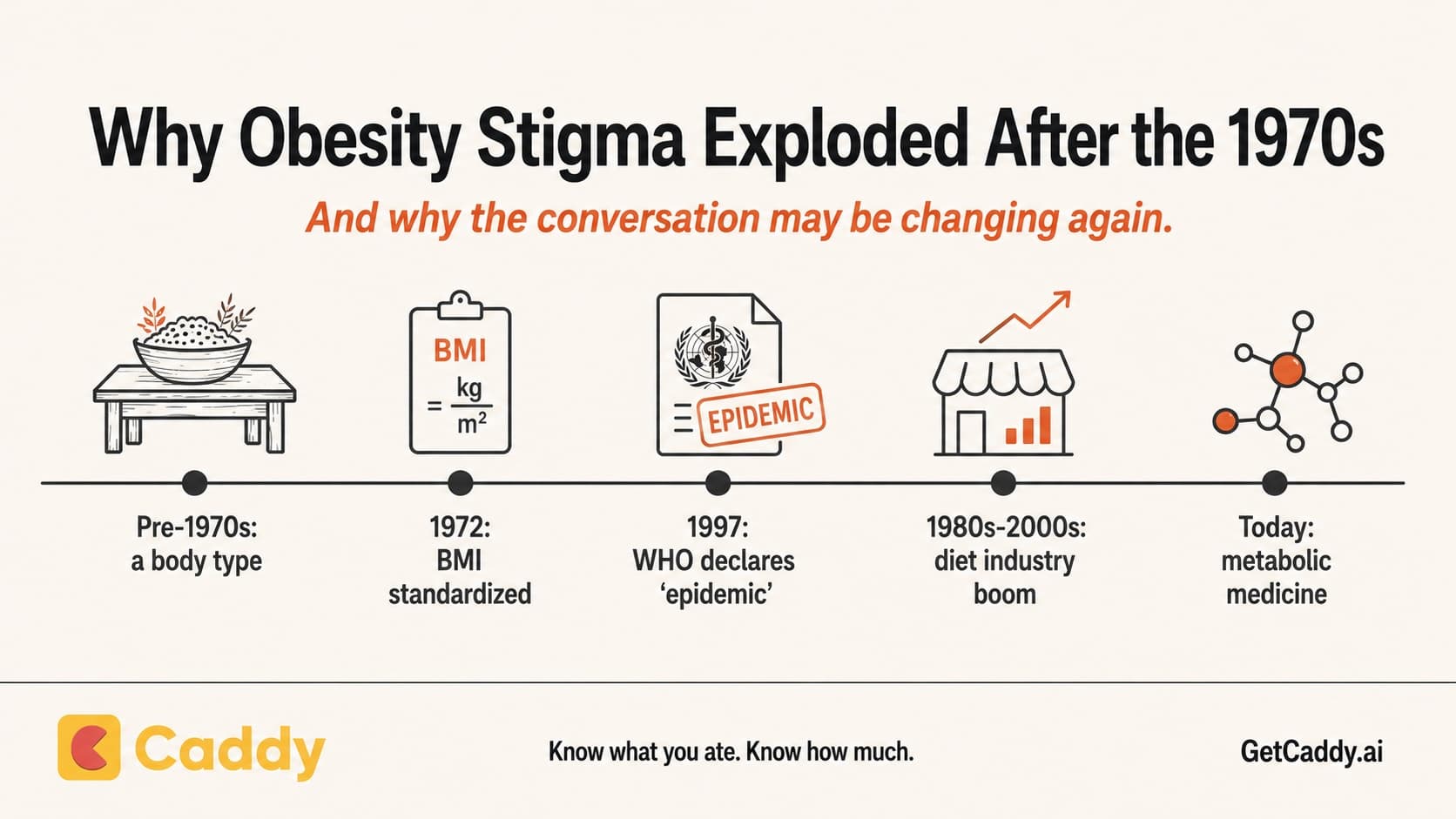
Before the 1970s: Body Weight Wasn't the Same Cultural Issue
For much of the 19th and early 20th centuries, being overweight didn't carry the widespread social stigma seen today. In many contexts, larger bodies were associated with prosperity, while thinness sometimes indicated poverty or illness. Body size varied widely without being framed as a medical crisis. Dieting existed in some form, but it wasn't a dominant cultural obsession — the narrative around weight was largely aesthetic or personal, not a large-scale public health issue. That began to change in the mid-20th century.
The First Major Shift: Medicine Began Measuring Body Weight
The first major transformation occurred when body weight became measurable in medical terms. During the 1960s and 1970s, researchers began studying large populations and noticed correlations between excess body fat and chronic diseases such as type 2 diabetes, cardiovascular disease, and hypertension. These findings gradually moved obesity from being seen as a body type to being considered a risk factor.
This is also when the modern Body Mass Index took its current form — physiologist Ancel Keys introduced the BMI formula in a 1972 paper, and health systems began adopting it widely through the following decade to sort people into "normal weight," "overweight," and "obese" categories. For the first time in history, body weight could be standardized into numbers and categories. This seemingly simple change had enormous cultural impact — once something can be measured and categorized, it becomes easier to frame it as a problem to solve.

The "Obesity Epidemic" Narrative
In the 1990s, the conversation around obesity intensified dramatically. The World Health Organization formally declared obesity a global epidemic in 1997, following a dedicated Consultation on Obesity. This language fundamentally changed how society perceived body weight. Instead of being framed as an individual trait, obesity became portrayed as a major public health crisis, a growing burden on healthcare systems, and a preventable disease affecting millions.
While these concerns were based on genuine health research, the language of epidemics and crises also amplified fear and urgency. This shift helped cement the idea that excess body weight was not only unhealthy but also socially problematic.
The Rise of Diet Culture
At the same time, another powerful force was growing rapidly: the weight-loss industry. From the 1980s onward, a massive global market developed around dieting programs, weight-loss supplements, fitness products, meal replacements, and cosmetic procedures. That market is now worth hundreds of billions of dollars globally, and the economic logic was simple: the more undesirable excess weight appeared socially, the larger the market for products promising to reduce it. Weight loss was no longer just a health goal — it became a commercial ecosystem, and as diet culture expanded, so did the social pressure to maintain a particular body shape.
Media and the Modern Body Ideal
Another major factor behind the rise of obesity stigma was the influence of mass media. Beginning in the late 20th century, television, magazines, advertising, and later social media began promoting a narrow body ideal characterized by slimness, toned physiques, and low body fat. These images repeated across movies, advertisements, and fitness campaigns, and over time the cultural definition of attractiveness increasingly aligned with lean body types. Anything outside this ideal began to be perceived as undesirable.
Importantly, this shift blurred the line between health messaging and beauty standards. What started as medical advice gradually merged with aesthetic expectations.

The Moral Narrative Around Body Weight
Another subtle change occurred in how society interpreted body weight. In many modern cultures, physical appearance became associated with values like discipline, productivity, and self-control. As a result, excess weight was sometimes interpreted not just as a health issue but as a lack of personal responsibility. This moral framing significantly intensified stigma — people with obesity often faced social judgments that extended far beyond health.
The Missing Piece: Biology and Appetite Regulation
For decades, discussions around obesity focused primarily on willpower and lifestyle choices. But modern research has revealed that body weight is heavily influenced by biological systems regulating hunger, satiety, metabolism, and energy balance. Hormones and neural pathways play a major role in determining how much we eat and how our bodies respond to food. This understanding has changed how scientists think about obesity — rather than being purely behavioral, it's increasingly viewed as a metabolic condition involving complex biological regulation.
The New Era: Metabolic Medicine
We may now be entering a new phase in how obesity is understood and treated. Medications like semaglutide and tirzepatide work by influencing the body's appetite and satiety systems directly. These treatments highlight a key insight explored further in our look at the shift from willpower to metabolic science: weight regulation isn't simply a matter of willpower, but is deeply connected to hormonal and neurological processes. This may gradually change how society views obesity — instead of being framed as a failure of discipline, it may increasingly be understood as a treatable metabolic condition.
Why This Matters for the Future of Weight Loss
Understanding the history of obesity stigma is important because it reveals how much our perceptions are shaped by broader social forces — medical research, public health narratives, media representation, and commercial industries. Today, a new chapter may be emerging. With advances in metabolic medicine, digital health tools, and personalized nutrition, the focus is shifting toward supporting individuals through science rather than judging them through stigma.
The Bottom Line
The rise of obesity stigma after the 1970s wasn't caused by a single factor. It emerged from the intersection of evolving medical knowledge, powerful media narratives, and rapidly growing commercial industries. But science continues to evolve. As we learn more about how appetite, metabolism, and hormones regulate body weight, the conversation around obesity may shift once again — and this time, the focus may finally move from judgment to understanding.
How Caddy Fits Into This
Caddy exists because of exactly the shift this piece describes. The old model of weight management leaned on shame, willpower, and moral judgment — count calories perfectly, feel guilty when you don't, blame yourself when the number doesn't move. That model was built on an incomplete understanding of how appetite and metabolism actually work.
Caddy is built on the newer one. Score 8 doesn't moralize your food choices or treat a missed target as a character flaw — it's a daily number that reflects whether you're in a deficit, nothing more. No guilt attached to any specific dish, no judgment for choosing chole bhature over a salad, because the science this piece describes is clear: total intake and pattern over time is what matters, not the presence or absence of willpower.
Built specifically for Indian food and Indian bodies, at under ₹83/month, Caddy replaces the old shame-based approach to weight loss with the one metric that actually reflects what your body needs — whether you're managing weight through nutrition alone or alongside a GLP-1 medication.
Know what you ate. Know how much.
Score 8. Lose weight. That's it.
GetCaddy.ai
Sources
[1] Downsizing Obesity: On Ancel Keys, the Origins of BMI, and the Neglect of Excess Weight as a Health Hazard in the United States from the 1950s to 1970s. Rasmussen, N., Journal of the History of the Behavioral Sciences, 2019. https://pubmed.ncbi.nlm.nih.gov/31338844/
[2] Obesity: Preventing and Managing the Global Epidemic — Report of a WHO Consultation on Obesity, Geneva, 1997. World Health Organization. https://iris.who.int/handle/10665/63854
[3] Weight Loss Market Size, Share, Growth Analysis 2033. IMARC Group. https://www.imarcgroup.com/weight-loss-market
Frequently Asked Questions
- Why did obesity become more stigmatized after the 1970s?
- A combination of forces converged: medicine began measuring body weight with BMI, public health agencies started calling rising obesity rates an "epidemic," media promoted a narrower body ideal, and a rapidly growing weight-loss industry had a financial incentive to make excess weight feel undesirable.
- When did BMI become the standard way to classify obesity?
- Physiologist Ancel Keys introduced the modern Body Mass Index formula in 1972, and health systems began adopting it widely through the late 1970s and 1980s as the standard classification tool.
- When did the WHO officially call obesity a "global epidemic"?
- In 1997, following a WHO Consultation on Obesity, the organization formally described rising obesity rates worldwide as a global epidemic — language that significantly shaped how the public and policymakers talked about body weight afterward.
- Is obesity really just about willpower?
- No. Modern research shows body weight is heavily influenced by biological systems — hormones and neural pathways that regulate hunger, satiety, and energy balance. This is part of why GLP-1 medications, which work directly on these systems, have been effective where willpower-based approaches often weren't.
- How might GLP-1 medications change the stigma around obesity?
- By demonstrating that appetite and weight are governed by measurable biological mechanisms, not just discipline, these medications may help shift the cultural narrative from moral judgment toward treating obesity as a manageable metabolic condition.
Get Caddy
Your simplest way to eat smarter with Indian food
Download