
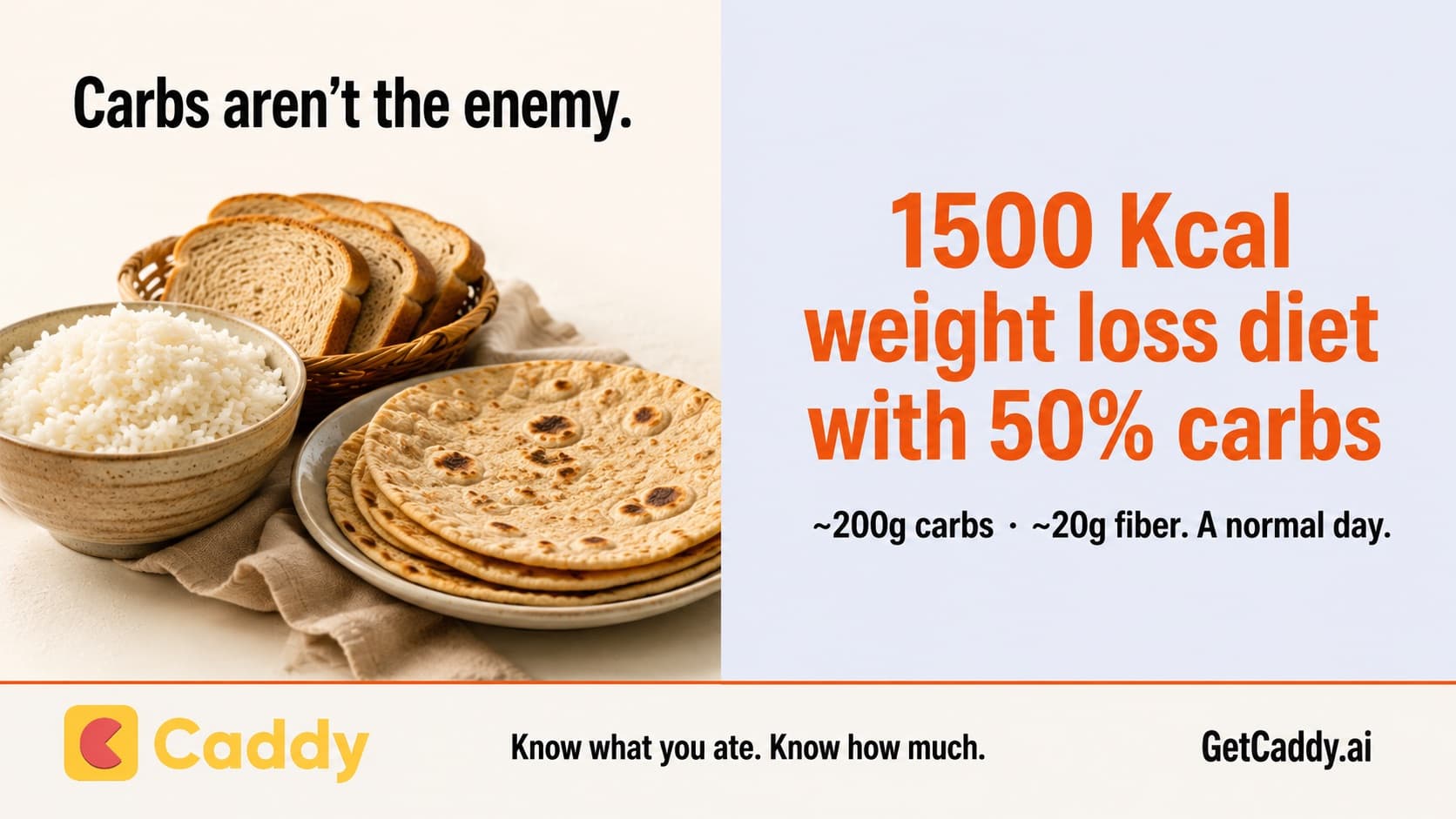
Carbs Aren't the Enemy. Here's the Real Math
Even official Indian dietary guidelines keep carbohydrates above half of daily calories. Here's why — and exactly what that looks like on a real weight loss day.
The Carb Scare Nobody Questions
Open almost any weight loss conversation and carbs are the first thing blamed. Cut the rice. Skip the roti. Go low-carb. And yet ICMR-NIN's own Dietary Guidelines for Indians cap cereal intake at 45% of total energy on their own — before adding the carbohydrate content of pulses, fruit, and vegetables on top — with total fat capped at 30% and pulses/eggs/flesh foods around 14-15%. Once fruit, vegetables, and pulses are counted in, official guidance for most Indian adults still lands with carbohydrates comfortably above half of daily calories.
If carbs were genuinely the enemy, this wouldn't be the starting point for the country's own nutrition authority. The actual issue was never the macronutrient — it's the quantity, unmeasured.
Why Carbs Actually Matter
Carbohydrates are your primary dietary source of fiber. There's no meaningful substitute — protein and fat sources carry little to none. A long-term, aggressively low-carb diet carries a real risk of fiber deficiency, which we've covered in detail in our piece on protecting fiber while raising protein — and the downstream consequences, including gut health problems, are well documented.

Carbs also do the thing they've always been known for: they provide fast, usable energy. The goal was never to eliminate that. It's to make sure the carbs you're eating are fiber-rich, and — as we've written about in the PPTF framework — paired with a protein source, which meaningfully blunts the resulting glycemic impact. In a Weill Cornell study published in Diabetes Care, eating protein before carbohydrates in the same meal cut post-meal glucose spikes by 29-37%.
The Actual Math for a Weight Loss Day
Here's where this gets concrete. An average overweight adult on a calorie-deficit diet still needs roughly 1,500 calories a day. Even on a deficit, around 50% of that should come from carbohydrates — that's 750 to 800 calories, or approximately 200 grams of carbohydrate.
Two hundred grams sounds like a lot when you've been taught to fear carbs. Here's what it actually looks like, spread across a real day, per Bon Happetee's Indian food database:
Bread with breakfast, rice or roti with your main meals, a piece of fruit, a bowl of dal — this is not a restrictive or unusual day. It's an ordinary one, and it fits entirely within a 1,500-calorie weight loss budget while hitting roughly 50% carbohydrate intake.

What a Registered Dietitian Says About This
We asked Ilana Schachter, RDN, a registered dietitian and nutritionist for Consumer Health Digest, to weigh in on the approach this piece takes.
When clients come to you wanting to cut carbs for weight loss, what's the first thing you check before agreeing that's the right lever for them?
Ilana: As a Registered Dietitian, the first thing I assess is what types of carbohydrates they are currently eating and what their overall calorie intake looks like, rather than assuming carbohydrates themselves are the problem. I look at portions, added sugars, refined grains, fiber intake, protein, vegetables, and overall dietary quality; often, improving carbohydrate quality and portions is more appropriate than broadly eliminating carbohydrate-containing foods.
Is 200 grams of carbs a reasonable target for most Indian adults on a 1,500-calorie deficit day, or does that vary more than a single number suggests?
Ilana: When calculating, I have found that two hundred grams provides about 53% of calories on a 1,500-calorie diet, so it falls within a moderate carbohydrate intake and can absolutely be reasonable for some adults. However, I would not prescribe 200 grams as a universal target because carbohydrate needs should be individualized based on total energy needs, activity level, medical conditions, protein and fat requirements, food preferences, and the person's ability to maintain the diet; the quality of those carbohydrates — particularly whole grains, pulses, vegetables, and fruits — is also extremely important (ICMR-NIN, 2024; WHO, 2023).
What's the earliest sign you see in a client that a low-carb diet has started cutting into their fiber intake, before it becomes a bigger problem?
Ilana: One of the earliest signs is often a noticeable reduction in high-fiber foods in the person's food record — for example, fewer servings of whole grains, dals and other pulses, fruits, vegetables, nuts, and seeds. Constipation or changes in bowel regularity can follow, but I prefer to identify the dietary pattern before symptoms develop, because a very restrictive approach to carbohydrates can unintentionally remove many of the foods that contribute fiber. WHO recommends that adults consume at least 25 grams of naturally occurring dietary fiber per day.
Her math checks out precisely, and it's a useful refinement: 200g of carbs on a 1,500-calorie day works out to 53%, not just "around 50%" — comfortably moderate, but as she notes, not a number to prescribe universally.
The Fiber Bonus Hiding in This Math
Here's the part that matters most: this same combination of foods brings roughly 18-20 grams of fiber along with it — most of the way to a daily target of around 25-30 grams, with vegetables making up the remainder.
This is the actual argument against low-carb eating for most people: it isn't that carbs are dangerous, it's that cutting them aggressively also cuts your fiber intake, often without anyone noticing until deficiency symptoms show up. Roughly 95% of American adults fall short of fiber recommendations for exactly this kind of reason, and there's no evidence Indian low-carb dieters are immune to the same pattern.
What This Actually Means
None of this is a call to eat carbs without limit. The point is precision, not permission. Carbs, at the right quantity — around 200 grams on a 1,500-calorie deficit day — are not just acceptable, they're structurally necessary for adequate fiber and energy. The failure mode was never "ate carbs." It was "ate an unmeasured amount of carbs," the same failure mode that applies to every other macronutrient.

How Caddy Fits Into This
This is exactly why Caddy tracks carbs and fiber with the same precision it tracks total calories — not to help you avoid carbohydrates, but to help you actually hit your real number, whatever that is for your day. Built specifically around Indian meals — roti, rice, dal, and everything in between — at under ₹83/month, Caddy replaces carb fear with an actual measurement.
Carbs were never the enemy. An unmeasured plate always was.
Know what you ate. Know how much.
Score 8. Lose weight. That's it.
Sources
Frequently Asked Questions
- How many carbs should I eat per day on a weight loss diet?
- On a typical 1,500-calorie weight loss deficit, roughly 50% of calories — about 750-800 calories, or approximately 200 grams — should come from carbohydrates. This aligns with the macronutrient split used in official Indian dietary guidelines.
- Do low-carb diets cause fiber deficiency?
- Long-term, aggressively low-carb diets carry a real risk of fiber deficiency, since carbohydrates are the primary dietary source of fiber. This can contribute to gut health problems and other downstream issues over time.
- What does 200 grams of carbs look like in a real day?
- Roughly: 2 slices of whole wheat bread (~40g), a bowl of rice (~45g), 2 chapatis or parathas (~50-60g), a piece of fruit (~25g), and a bowl of dal (~25-30g) — an ordinary day's worth of meals, not a restrictive plan.
- How much fiber does a typical weight loss diet provide from carbs alone?
- A day built around whole wheat, rice, roti, fruit, and dal — roughly 200g of carbohydrate — typically provides 18-20 grams of fiber, close to the daily target of around 25-30 grams, with vegetables making up the remainder.
- Should I pair carbs with protein?
- Yes. Pairing a carbohydrate source with protein meaningfully reduces the resulting glycemic response — one clinical study found eating protein before carbs cut post-meal glucose spikes by 29-37% — which is part of why traditional combined meals, like dal with rice or paneer with roti, work well without any deliberate planning.
Get Caddy
Your simplest way to eat smarter with Indian food
Download