
Why Portion Control Is Everything
Written by Rishi Bhojnagarwala
Nutrition Reviewed by Dr. Hetal Pal, PhD in Nutrition Science
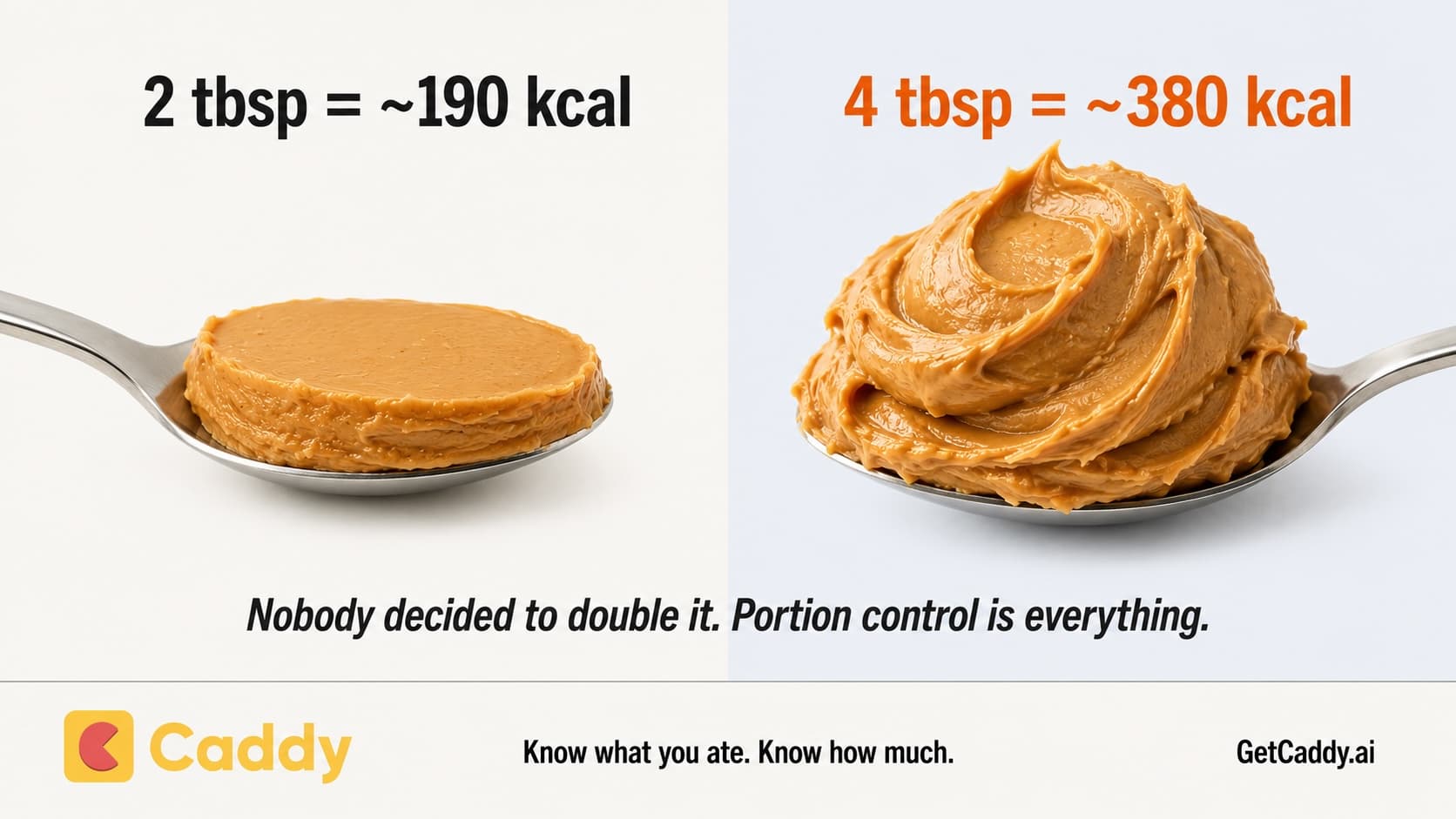
Two tablespoons of peanut butter is about 190 calories. Four tablespoons doubles it — and nobody decides to scoop twice as much. It just happens.
The Scoop That Changes Everything
Two tablespoons of peanut butter carries roughly 190–200 calories, consistent across standard nutrition references. It's a genuinely good food — real protein, healthy fats, the kind of snack that actually keeps you full.
Here's the problem: almost nobody eats exactly two tablespoons. The spoon goes in, comes out a little generous, goes back in for "just a bit more." That's not two tablespoons anymore. That's closer to four — and the calorie count just doubled, without anyone consciously deciding to eat twice as much.
This is the part of eating that almost never gets the attention it deserves. Not what's on the plate. How much of it actually is.

The Foods That Hide the Most
Peanut butter isn't unique — it's just an easy example because the math is so clean. The same invisible-portion effect shows up everywhere.
A "healthy handful" of nuts, grabbed casually while walking past the kitchen counter, can easily land around 300 calories — far more than the mental image of "just a few nuts" suggests. A salad, treated by almost everyone as the automatically safe menu choice, can hit 600 calories once a generous pour of dressing, cheese, or croutons gets added — quietly outperforming the "unhealthy" option sitting next to it on the menu.
None of these foods are the actual problem. Peanut butter, nuts, and salad dressing are all reasonable things to eat. The gap between the portion you think you took and the portion you actually took is what's driving the outcome — and that gap is invisible until you measure it.

What a Nutrition Coach Sees in Practice
We asked Rena Awada, Certified Nutrition Coach (PN1), founder of Healthy Fitness Meals, to weigh in on why this specific blind spot is so common.
Which everyday foods do people most consistently underestimate the portion of, and why?
Rena: Small-sized foods with high amounts of calories (calorie density) are the easiest to underestimate. Some examples include nut butter, nuts, cheese, cooking oil, salad dressing, granola, and avocado. Since people typically judge portion size based on how large a piece of food looks, what appears to be a "small" amount of food is really more, in terms of calories, than you'd estimate.
Can people recalibrate their internal portion sense within weeks, or does it require ongoing check-ins?
Rena: Awareness of portion size may be achieved in a matter of weeks through consistent measurement of foods' serving sizes or comparing measured portions to familiar visual aids. However, I wouldn't call that an established awareness. Eating at restaurants, using larger plates, and eating directly from packaging will eventually reset your expectations for what counts as a typical portion. Periodic measuring or checking labels generally helps maintain reasonable expectations about how much you're actually eating.
How often is portion size the issue when someone eats reasonably but isn't losing weight?
Rena: When a person's diet consists mainly of healthy food choices but they're over-consuming calories without realizing it, portion size is among the first practical things to check. Healthy food items do contain calories, and adding just a few extra calories from small additions quickly adds up. Before cutting nutrient-rich foods, I'd review serving sizes, cooking oils or fats used in preparation, added toppings and condiments, additional beverages consumed with meals, and seconds at mealtime.
That last point is worth sitting with — before removing a food, check whether the actual issue is how much of it, or what's been quietly added around it.
What Tracking Actually Does
This is the real value of food tracking, and it has almost nothing to do with restriction. Logging a meal forces you to look directly at portion size instead of estimating it from memory or habit.
Want peanut butter? Measure it. Want rice? Weigh it. Nothing gets removed from your plate in this process. What changes is that you stop unconsciously rounding your own portions up — the four tablespoons that felt like two, the salad dressing that felt like "a little."
That single shift — replacing an assumed portion with an actual one — is often enough on its own to move someone from a maintenance-level day into a genuine calorie deficit, without cutting a single food they enjoy.

You Don't Need to Track Forever
Here's what we've consistently seen at Caddy: most users develop a genuinely accurate internal sense of portion size within 2-3 weeks of tracking. It's not a skill that takes months to build — it's closer to recalibrating an instinct that had quietly drifted over years of eyeballing servings.
Rena's caution above is a useful complement to this: that early recalibration is real, but it isn't permanent immunity. Restaurant meals, bigger plates, and eating straight from the packet will keep nudging your sense of "normal" back upward over time — which is exactly why an occasional check-in, not constant logging, is the actual goal.
After that initial stretch, most people aren't logging every single meal anymore. They check in when they're genuinely unsure — a new dish, a bigger-than-usual serving, a day that felt off — rather than weighing every gram of every meal indefinitely.
How Caddy Fits Into This
This is exactly what Caddy is built around. Take a picture of your plate, and get a Score out of 10 — built specifically to make portion size visible, not just food choice. Score 8 means you're in a calorie deficit, regardless of whether tonight's meal was peanut butter toast, a salad, or a full Indian thali.
Built specifically for Indian food, at under ₹83/month, Caddy helps you close the gap between the portion you think you're eating and the one you actually are — usually within a few weeks, not a lifetime of tracking.
Know what you ate. Know how much.
Score 8. Lose weight. That's it.
Sources
Frequently Asked Questions
- How many calories are in 2 tablespoons of peanut butter?
- About 190 calories, consistent across major nutrition databases. It's a nutrient-dense food with real protein and healthy fats — but because it's also calorie-dense, small portion increases add up fast. Four tablespoons, for example, roughly doubles the calorie count to around 380.
- Why does portion size matter more than food choice for weight loss?
- Most foods people eat day to day are reasonable choices — the actual gap between weight loss and weight maintenance is usually in the amount eaten, not the food itself. A "healthy handful" of nuts or a salad with dressing can easily carry more calories than people assume, simply because portions tend to creep upward without anyone noticing.
- Do I need to track my food forever to control my portions?
- No. Most people develop an accurate internal sense of portion size within about 2-3 weeks of consistent tracking. After that initial period, many people only need to check in occasionally — for new foods, larger-than-usual servings, or days when they're genuinely unsure — rather than logging every meal indefinitely.
- Can I still eat foods like peanut butter, nuts, and salad dressing while losing weight?
- Yes. Portion tracking isn't about eliminating foods — it's about knowing the actual quantity you're eating instead of an assumed one. Once you know your real portion sizes, you can fit peanut butter, nuts, dressing, or any other food into a calorie deficit without cutting them out.
- What's the easiest way to start tracking portions accurately?
- Start by measuring or weighing the foods you eat most often — a spoon of peanut butter, a serving of rice, a handful of nuts — rather than estimating by eye. Apps like Caddy make this faster by letting you photograph your plate and get an instant portion and calorie estimate, so you're not manually measuring every single item.
Get Caddy
Your simplest way to eat smarter with Indian food
Download