
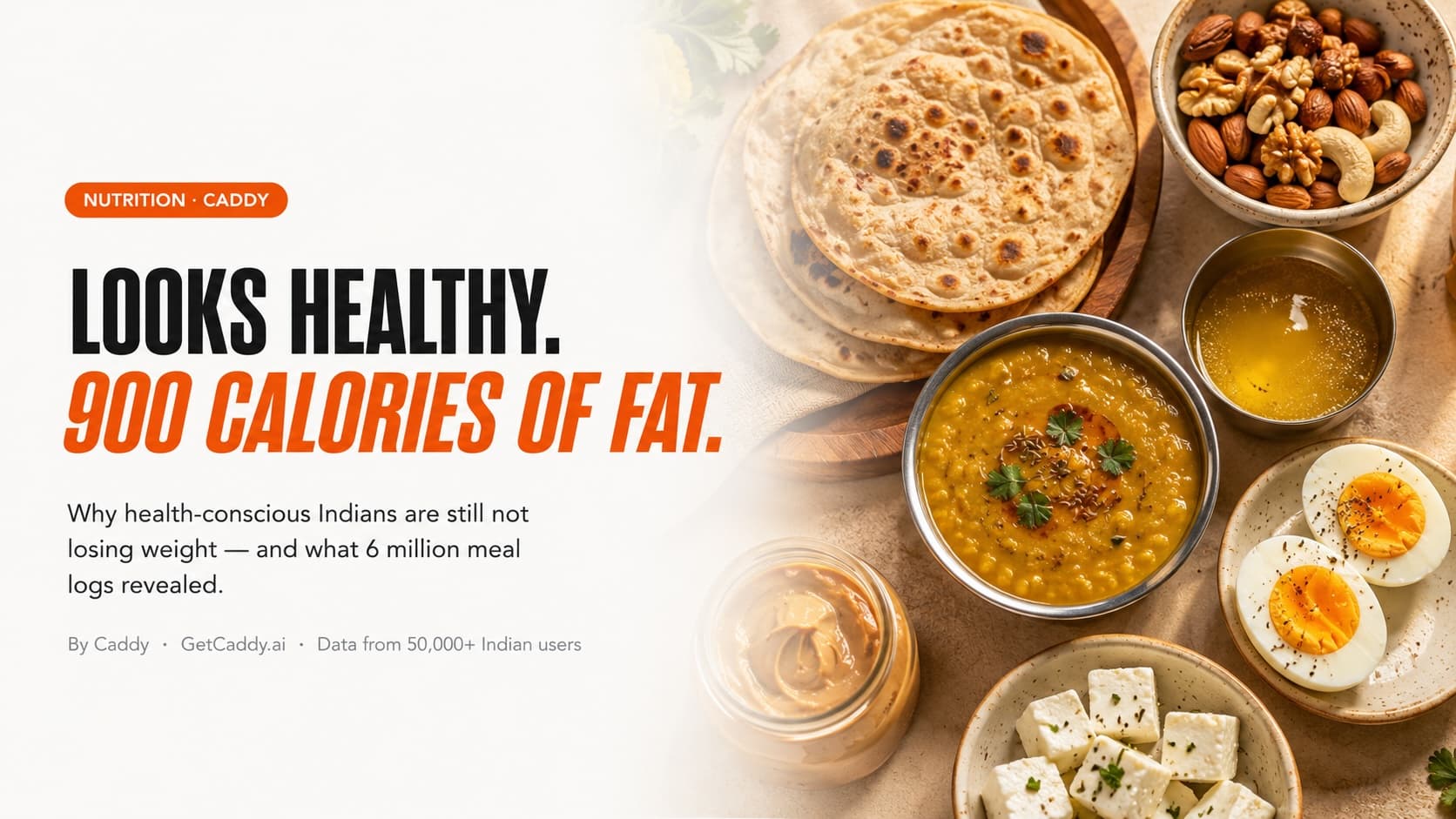
WHY INDIANS AREN'T LOSING WEIGHT: THE HIDDEN FAT PROBLEM NOBODY IS TALKING ABOUT
Written by Rishi Bhojnagarwala
Medically Reviewed by Dr. Hetal Pal, PhD in Nutrition Science
The Wrong Suspect
Every conversation about weight loss in India starts with the same list: too many carbs, not enough protein, too little exercise, too much processed food.
These are not wrong. But they are incomplete. And by focusing on them, we consistently miss the single biggest driver of excess calories in the average Indian diet.
It is not the roti. It is not the rice. It is the fat hiding in plain sight — in foods we have been told to celebrate.
Caddy has analysed millions of meal logs from over 50,000 Indian users across a decade. The pattern that emerged was not what most people expect. The diets were not junk food heavy. They were not full of chips and soft drinks and fast food. They looked genuinely healthy — nuts, ghee, paneer, eggs, dal, homemade sabji. The kind of food a nutritionist would recommend.
And they were significantly over-calorie. Almost entirely because of fat.
The Math of Weight Loss
Before getting to the food, the math needs to be clear.
Weight loss requires a calorie deficit. The human body loses approximately 1 kg of fat for every 7,700 calories of deficit accumulated over time. A sustainable, steady weight loss pace — roughly 0.5 to 1 kg per week — requires a daily deficit of approximately 400–550 calories.
For most Indian adults, a maintenance calorie level sits between 1,800 and 2,200 calories depending on activity, age, and body size. A weight loss target, accounting for that deficit, typically lands at 1,400–1,600 calories daily.
That is the budget. Everything eaten needs to fit within it — and crucially, within it there needs to be enough space for adequate protein (which preserves muscle during weight loss) and enough fiber-rich carbohydrates (which protect gut health and manage hunger).
The question is: where is that budget actually going?

A Healthy Indian Day, Analysed
Here is a composite of what a "healthy-eating" Indian's day looks like — the kind of person who is genuinely trying, eating home food, avoiding obvious junk, choosing what the wellness world has told them are good options.
Morning: A handful of mixed nuts — almonds, walnuts, cashews. Considered a health food. Approximately 30g, which contains 10–12 grams of fat and 160–180 calories.
Breakfast or lunch: 2 eggs — scrambled, boiled, or bhurji. Provides excellent protein. Also contains approximately 12 grams of fat and 140 calories.
Lunch and dinner: 4–5 rotis across both meals, each with a small scrape of ghee — culturally normal, widely considered appropriate. This adds approximately 20–25 grams of fat from ghee alone, contributing 180–225 calories purely from the ghee.
Two sabji and two dal dishes across both meals, cooked in standard Indian home quantities of oil with tadka. A moderate home cook uses 1–2 tablespoons of oil per dish. Across four preparations this contributes approximately 25 grams of fat and 225 calories.
Snack or with meals: 40 grams of paneer or a slice of cheese — viewed as a protein food, which it is. At this quantity, approximately 10 grams of fat and 100 calories.
Spread or breakfast addition: A tablespoon of peanut butter — marketed heavily as a health food. One tablespoon of standard peanut butter contains approximately 8 grams of fat and 90 calories. Two tablespoons, which is a common serving, adds 15–16 grams of fat.
Incidental hidden fats: Butter on toast, a biscuit, the oil residue in a curry, the fat in full-fat milk. Conservatively, this adds another 5 grams of fat across the day.
The Total
Adding these together:
Nuts: 12g fat 4–5 rotis with ghee: 25g fat 2 sabji + 2 dal (oil and tadka): 25g fat 2 eggs: 12g fat Paneer/cheese: 10g fat Peanut butter: 15g fat Hidden fats: 5g fat
Total: approximately 100 grams of fat.
At 9 calories per gram, 100 grams of fat equals 900 calories.
In a 1,500-calorie weight loss budget, fat has consumed 60% of the entire day's allowance — before a single grain of rice, roti (beyond those already counted), fruit, dal portion, or protein supplement has been added.
The remaining 600 calories need to cover everything else. It is almost impossible to hit an adequate protein target (60–100g depending on body weight) and maintain sufficient fiber within that remaining space. Something always gets crowded out — and it is usually protein.
And this is before the paratha. Before the restaurant meal. Before the fried snack, the mithai at a colleague's birthday, the extra tadka at a wedding dinner. Add those and the picture becomes significantly worse.
Why "Healthy" Fats Are Still Fats
The wellness industry has done an effective job of rebranding fat — particularly certain fats — as not just acceptable but actively beneficial. Ghee restores gut health. Nuts provide omega-3s. Olive oil is heart-protective. Avocado is a superfood.
None of these claims are false. But they are incomplete in a way that is causing real harm to people trying to manage their weight.
Fat — all fat, including the "healthy" varieties — contains 9 calories per gram. This does not change based on whether the fat comes from ghee, extra virgin olive oil, walnuts, or palm oil. The caloric density is identical.
Fat plays genuinely critical roles in human biology. Fat-soluble vitamins — A, D, E, and K — cannot be absorbed without dietary fat. Hormone production, including sex hormones and cortisol, requires fat as a raw material. Every cell membrane in the human body is composed partially of fat. The brain is approximately 60% fat by dry weight. Inflammatory regulation, particularly the balance between omega-3 and omega-6 fatty acids, is a genuine and important area of nutritional science.
All of this is true. And none of it requires 100 grams of fat per day to be achieved.
Research consistently shows that 50–60 grams of fat daily is sufficient to support all of these biological functions in a healthy adult. This is roughly half of what the data suggests the average health-conscious Indian is currently consuming.
The recommendation from a working nutritionist is not a daily handful of nuts and ghee-laden rotis. In the context of a weight loss plan, it is typically two almonds and two walnuts. Low-fat dairy. Minimal added cooking fat. Fat where it naturally exists in protein sources — eggs, chicken, fish, paneer — but not layered on top as a wellness virtue signal.
This is not a fringe position. It is what every nutritionist who has actually sat across from a patient trying to lose weight recommends in practice. The problem is that social media nutrition culture has diverged sharply from clinical practice on the question of fat.

The Structural Problem: Fat Crowds Out Protein
Beyond the raw calorie mathematics, there is a structural problem with high-fat Indian diets during weight loss.
Protein is the most important macronutrient during a calorie deficit. It preserves lean muscle mass, which would otherwise be lost alongside fat. It is the most satiating macronutrient per calorie, meaning adequate protein reduces hunger and makes the deficit more sustainable. And protein has a high thermic effect — the body burns more calories digesting it than it does digesting fat or carbohydrates.
But the foods richest in protein — eggs, paneer, chicken, fish, Greek yogurt — all contain fat. An egg has approximately 6g of protein and 5–6g of fat. 100g of paneer has 18–20g of protein and 15–20g of fat depending on the preparation. These are excellent foods for weight loss precisely because of their protein content — but they carry fat with them.
If the fat budget for the day is already exhausted by cooking oil, ghee on rotis, and a handful of nuts, there is no room left for the fat that arrives with the protein foods you need most.
The roti + sabji + dal block across two meals — perfectly normal, perfectly Indian, genuinely nutritious — uses nearly the entire recommended fat quota for a weight loss diet. That is the structural problem. Not that these foods are bad, but that they leave no space for anything else.
What 50,000 Users Taught Us
Caddy has built its product on a decade of Indian food data and user behaviour. When active users began tracking their meals and receiving daily Score feedback, the pattern was consistent: within the first week, high-fat foods showed up clearly as the primary factor limiting their calorie deficit.
Users who engaged with this insight and started making adjustments — not eliminating foods, but understanding the fat math and making deliberate choices — lost weight. The aggregate result across 50,000+ users: 50,000 kgs lost. An average of 5 kgs per active, engaged user.
The adjustment was never about cutting Indian food. It was about understanding that 100 grams of fat in a 1,500-calorie budget is a structural impossibility, and choosing where to reduce. Some users reduced ghee on rotis. Some switched to low-fat dairy. Some had their nuts less frequently. The specific choice varied. The result was consistent.
What to Actually Do
The goal is not to eliminate fat. It is to fit fat intelligently within the calorie budget available for weight loss.
A working framework:
Total fat target on a weight loss plan: 50–60 grams per day.
Allocate this across the day intentionally: — Eggs (2): 12g fat — worth it for the protein — Cooking oil across sabji and dal: aim for 10–15g total (2–3 teaspoons across all cooking) — Paneer or dairy protein: 8–10g fat — Incidental fats in staples: 5g
That leaves approximately 10–15g of fat budget for nuts, ghee, butter, or any other added fat. Not a handful of nuts and ghee on every roti. One or the other, in modest quantity.
This is not deprivation. It is arithmetic.
The roti stays. The dal stays. The eggs stay. The paneer stays. The ghee can stay — just not on every roti, every meal, every day.

How Caddy Helps
Caddy is built on intelligence from 10 years of Indian food data, millions of user logs, and in-house scientists and nutritionists. It is the only Indian nutrition tracker where a katori of dal tadka, a ladle of sabji, and ghee on a roti all have accurate fat content — not approximations borrowed from a Western database.
The Score 8 mechanism translates this complexity into one daily number. Track your fat, protein, calories, and fiber in real Indian portions. Score 8 means you're in deficit. Lose weight. That's it.
Don't rack your brain. Track it on Caddy and let the data show you where the calories are actually going.
Frequently Asked Questions
- 1. Why am I not losing weight even though I eat healthy Indian food?
- Many healthy Indian foods are also high in fat and calories. Ghee, cooking oil, nuts, paneer, and peanut butter can quickly consume your daily calorie budget, making it difficult to stay in a calorie deficit even if you're avoiding junk food.
- 2. Is ghee stopping me from losing weight?
- Ghee isn't unhealthy, but it is very calorie-dense. A small amount can fit into a balanced diet, but using ghee generously on rotis or in cooking can add hundreds of extra calories over the day and slow weight loss.
- 3. How much fat should I eat while trying to lose weight?
- There's no single number that suits everyone, but many weight loss plans aim for around 50–60 grams of fat per day, depending on your calorie needs. This leaves enough room for protein, fiber, and other nutrients while maintaining a healthy calorie deficit.
- 4. Should I stop eating nuts, paneer, or eggs to lose weight?
- No. These foods are nutritious and can be part of a healthy weight loss diet. The key is portion size and total fat intake across the day, rather than eliminating individual foods.
- 5. What's the biggest reason Indians struggle to stay in a calorie deficit?
- One common reason is underestimating the calories from cooking oil, ghee, fried foods, and other hidden fats. Tracking your meals can help identify where those extra calories are coming from and make weight loss more sustainable.
Get Caddy
Your simplest way to eat smarter with Indian food
Download