
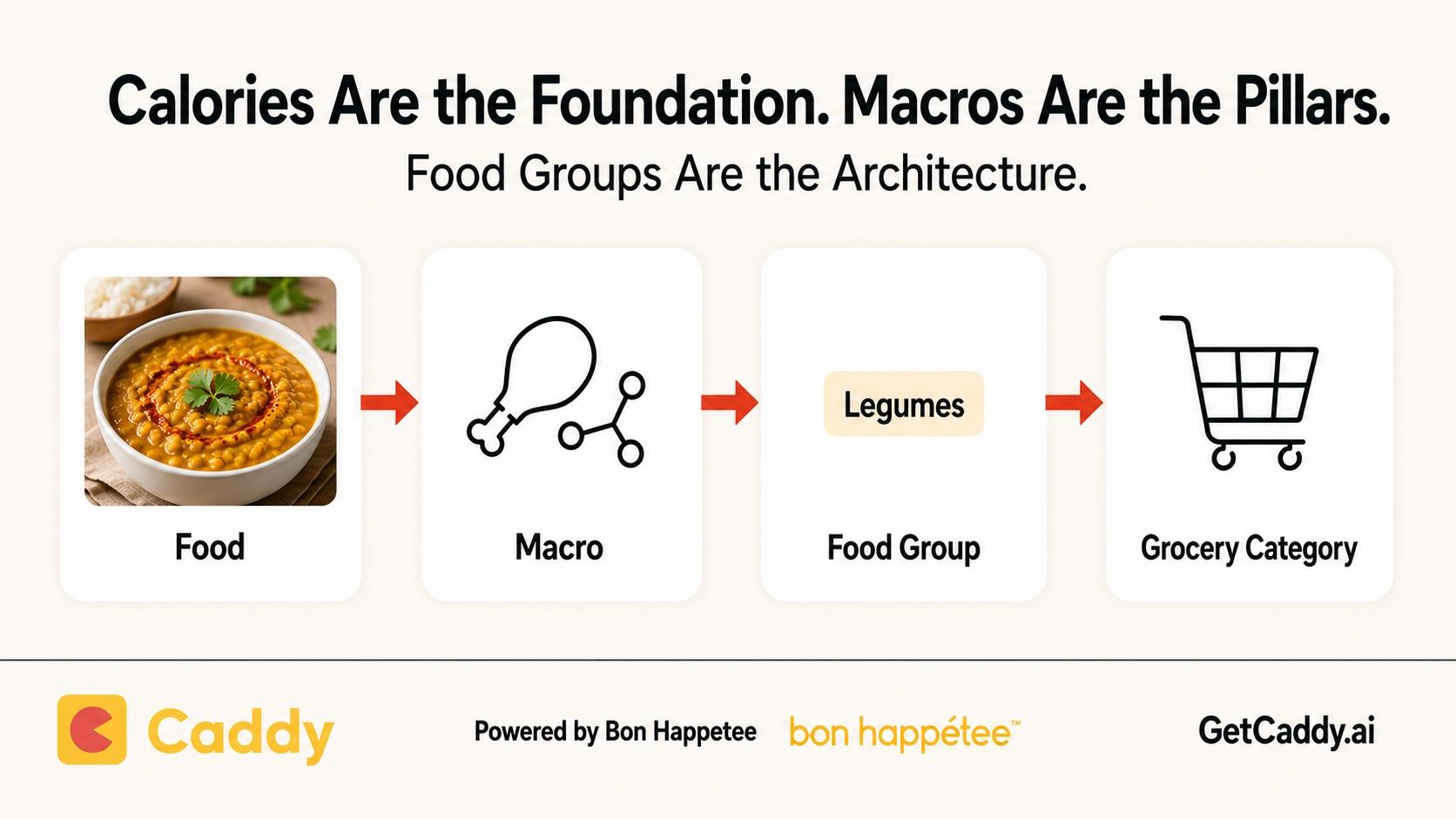
Calories Are the Foundation. Macros Are the Pillars. Food Groups Are the Architecture
Most nutrition tracking stops at two layers: how many calories, and how much protein, carbs, and fat. Useful information — but it answers “how much” and “what kind,” not “why.” That third question is where food groups come in, and it’s the layer most databases never build.
What Each Food Group Actually Brings to the Table
Every food group does a specific job, and none of them substitute for another:
Fruits and vegetables — fiber, vitamins, and antioxidants. This is the group most closely tied to fiber intake specifically.
Grains — energy-dense carbohydrates, along with a meaningful amount of fiber depending on the grain.
Legumes, nuts, and seeds — protein, healthy fats, and fiber, all three at once, which is part of why they’re such efficient foods.
Dairy — calcium and complete protein.
Meat and eggs — complete, high-quality protein, along with key micronutrients like iron and B12 that plant sources don’t provide as readily.
Oils, butter, and ghee — the cooking medium and flavour carrier, and functionally important for helping the body absorb fat-soluble vitamins (A, D, E, K) from the rest of the meal.
Stick to just one or two of these groups — a protein-shakes-all-day approach is the classic example — and you’re not just risking specific deficiencies. You’re also signing up for a genuinely boring diet, which is its own adherence problem.

What Macros Alone Miss
Here’s where the limitation of macro-only tracking becomes concrete. Picture a day where fiber comes in at 20g against a 32g target. That’s a real gap — but as an instruction, “eat more fiber” is almost useless.
As Harman Bajwa, UK Registered Nutritionist (MBBS, MSc, AfN Reg. No. 6477, UKVRN) and founder of Nutrificient, puts it: “‘Eat more fibre’ is good advice, but on its own it can be quite meaningless — people need to know what that actually looks like in their everyday diet. I find it much more useful to translate fibre into foods: adding lentils or chickpeas to a curry, choosing a higher-fibre roti, including more vegetables and fruit, or adding nuts and seeds to meals. Focusing on foods also makes it less about chasing a number.”
Now break that same day down by food group instead of macro. Fruit intake: 180g against a 340g target. Vegetables: 210g against 400g. Suddenly the fiber gap isn’t abstract — it’s specifically a fruit-and-vegetable shortfall, which is a completely different, far more actionable instruction than “eat more fiber.” One tells you there’s a problem. The other tells you exactly what to buy.
This tracks with what practitioners see directly. Alison Neov, RD, Owner of Neov Nutrition, has observed this consistently in her own Indian client base: “The majority of my Indian clients struggle with getting enough fruits and vegetables. It’s not that they don’t eat them — we have to actively work on increasing the portion size.” Bajwa sees a related but distinct gap: “Vegetables are one of the most common gaps I see, particularly the variety of vegetables people are eating. Someone may have rice or roti with dal or another protein source at most meals, but only have two or three vegetables regularly — the diet can look quite balanced on macros alone, but there’s still a lack of variety.”
This same logic plays out across every macro. Two people can both hit their protein target for the day and still be in very different positions — one getting it primarily from dal and paneer, another almost entirely from meat, with completely different fat, fiber, and micronutrient profiles as a result, despite an identical protein number.

Bajwa puts the underlying principle simply: “There isn’t a magic number of protein sources you need to eat, but different foods provide different nutrients alongside the protein — lentils and beans provide protein and fibre, nuts and seeds provide protein and unsaturated fats, fish provides protein and omega-3s, dairy provides protein and calcium. I try to move the conversation from ‘how much protein did I eat’ to ‘where did that protein come from, and what else did that food provide.’” Neov frames the risk on the other side of that same coin: “If you just consume the same foods over and over, you increase your chances of missing out on key micronutrients and risk a deficiency.”
Why This Data Doesn’t Already Exist Everywhere
Building this properly requires four layers, not two: mapping individual foods to their macros, mapping those foods to the food group they actually belong to, and — critically for making the data useful — mapping food groups to real grocery categories, so a gap in the data translates into something a person can act on the next time they’re shopping.
We haven’t found another database that maps this full chain — food to macro to food group to grocery category — with this level of granularity for Indian food specifically, built around how people in India actually eat and shop, rather than adapted after the fact from a database built for a different market.

The stakes for getting this right aren’t small. A study of dietary diversity and nutritional inadequacy among Indian adults found that over 80% had intakes below national recommendations across pulses, eggs, flesh foods, dairy, fruits, vegetables, and nuts — and that lower dietary diversity scores correlated directly with a higher risk of micronutrient inadequacy across zinc, folate, and niacin specifically. Macro-level tracking alone doesn’t surface this kind of gap. Food-group-level data does, because it’s structured to.
Powered by Bon Happetee
This food-to-macro-to-food-group-to-grocery mapping is the core structure of Bon Happetee’s nutrition database — built from the ground up around Indian recipes, ingredients, and eating patterns, rather than translated from an international template after the fact. It’s the data layer underneath the insight in this piece, and it’s what makes food-group-level tracking possible instead of just macro-level tracking.
About Caddy
Caddy is a nutrition and weight-loss companion built on Bon Happetee’s food database, applying this same food-group-level intelligence to everyday tracking. Score 8 covers the calorie deficit; the underlying data covers whether that deficit is coming from a varied, balanced plate or a narrow one — so a low fiber score doesn’t just sit there as a number, it points you toward what to actually add to your next grocery run.
Visit GetCaddy.ai
Sources
Frequently Asked Questions
- Why isn't tracking macros alone enough?
- Macros tell you how much protein, carbs, and fat you consumed, but not which foods they came from. Two people can hit an identical protein target from very different food sources, with very different fiber, fat, and micronutrient profiles as a result.
- What does a low fiber score actually mean?
- On its own, not much beyond "below target." Breaking the same data down by food group — specifically fruit and vegetable intake — usually reveals the actual, actionable gap, rather than leaving fiber as a vague number to fix.
- What food group provides the most fiber?
- Fruits and vegetables are the primary fiber source in most diets, with grains and legumes contributing meaningfully as well, depending on the specific food.
- Are Indian diets typically deficient across specific food groups?
- Research on urban Indian adults found over 80% had intakes below recommendations across pulses, eggs, dairy, fruits, vegetables, and nuts specifically — with lower dietary diversity linked to a higher risk of micronutrient inadequacy.
- What makes Bon Happetee's food database different from other nutrition databases?
- It maps individual foods to macros, food groups, and real grocery categories specifically for Indian food and shopping patterns, rather than adapting a database built for a different market's foods and units.
Score 8 to lose weight
Your simplest way to eat smarter with Indian food
Get Caddy