
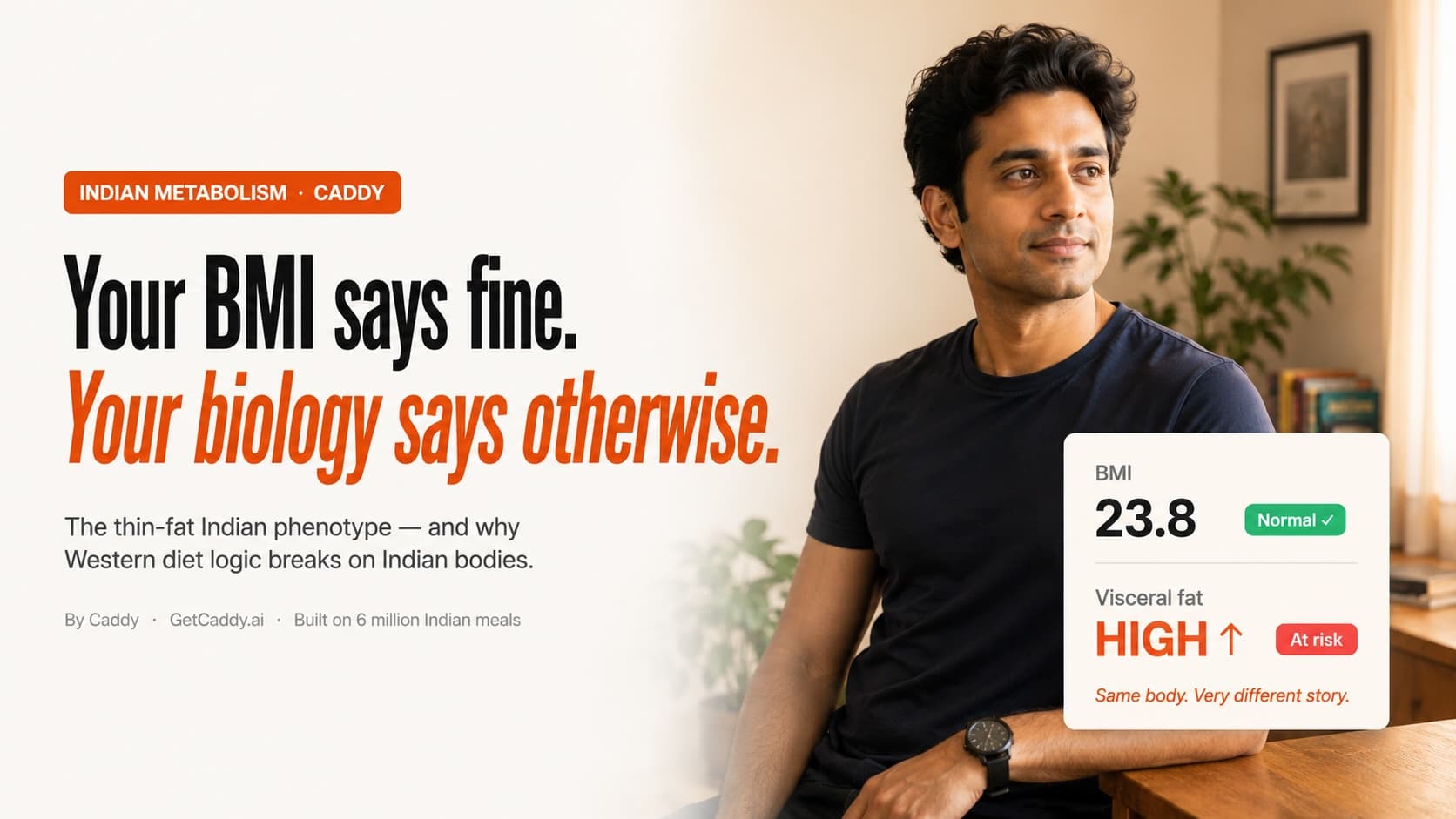
THE THIN-FAT INDIAN: WHY YOUR BMI IS LYING TO YOU AND WESTERN DIET LOGIC DOESN'T APPLY
Written by Rishi Bhojnagarwala
Medically Reviewed by Dr. Hetal Pal, PhD in Nutrition Science
A Bug That Wasn't a Bug
When Caddy relaunched in 2025 — bringing back the platform that ran as Bon Happetee for a decade, now rebuilt with GLP-1 support and a sharper product — one of the first calls the founder received was from a friend who'd been testing the app.
"There's a bug. My BMI is 24 and it's showing me as overweight."
There was no bug.
Caddy uses Indian BMI guidelines, where overweight begins at 23 — not 25. That single number difference reflects something significant about Indian biology that most Indians have never been told. This post is about what that difference means, where it comes from, and why it should change how every Indian thinks about diet, weight loss, and metabolic health.
The YY Paradox: Where It Started
In a now-famous paper published in The Lancet, two physicians compared their body compositions. Dr. C.S. Yajnik, an Indian endocrinologist based in Pune, and Dr. J.S. Yudkin, a British physician, had almost identical BMIs. But Dr. Yajnik had nearly double the body fat percentage of Dr. Yudkin.
Same number on the scale. Very different bodies. Very different metabolic risk.
This was the first formal description of what researchers now call the thin-fat Indian phenotype — and it has since been replicated in dozens of studies across Indian populations.
The thin-fat Indian phenotype is unique to India, associated with higher insulin resistance and a greater risk of cardiometabolic abnormalities despite a normal body mass index. ResearchGate
AIIMS and ICMR research consistently show that Indians carry 3–5% higher body fat at the same BMI compared to Caucasians — with significantly more stored in the visceral compartment, around the liver and pancreas. Inbody Blog

What "Thin-Fat" Actually Means
The term refers to a body composition pattern where a person appears slim or normal weight by standard measures — BMI, the mirror, their clothes — but carries a disproportionate amount of fat in the wrong places and insufficient lean muscle mass.
Compared to a Western adult of identical weight, the average South Asian has 10–20% more visceral fat, 15–20% less skeletal muscle mass per kg of body weight, and 3–4 times the rate of fatty liver disease at the same BMI. Inbody Blog
Visceral fat — the fat that wraps around internal organs — is metabolically active in the most harmful way. It drives insulin resistance, raises triglycerides, promotes chronic inflammation, and significantly increases the risk of type 2 diabetes and cardiovascular disease. In a study of 1,500 adults in Gujarat, 45% of participants with normal BMI had high body fat percentages and were identified as having the thin-fat Indian phenotype — with 50% showing elevated fasting glucose and 40% demonstrating high insulin resistance. Diabetes Journals
This is not a marginal phenomenon. Approximately 25–30% of Indian adults under 40 with BMI under 25 have at least one metabolic syndrome component. These are people who a standard health check would classify as fine. Inbody Blog

Why the Indian BMI Threshold Is Set at 23
The global WHO standard for overweight is BMI 25. For Indians — and South Asians broadly — the threshold is 23, with obesity beginning at 25 rather than 30.
BMI cutoffs for defining overweight and obesity are lower in the Asian population due to the thin-fat phenotype, with higher visceral fat for the same BMI in South Asians compared to the Caucasian population. South Asians have higher insulin resistance and cardiometabolic risk at lower BMIs. Sage Journals
This means that an Indian with a BMI of 24 — whom a Western calculator would call healthy — is, by Indian clinical standards, overweight. And the metabolic risk that comes with that classification is real, not theoretical.
The Caddy app reflects this. When that friend called with his "bug report," his BMI of 24 was correctly classified as overweight for an Indian body. This is not pessimism. It is accuracy.
The Diet Problem: What Indians Actually Eat vs. What We Need
The thin-fat phenotype is driven by a combination of genetics, physical inactivity, and a macronutrient distribution that is almost perfectly calibrated to make it worse.
Indian adults consume 65–75% of calories from carbohydrates — among the highest in the world — with only 9–11% from protein. For a phenotype characterised by low muscle mass and high insulin resistance, this is a structural mismatch. Nature
Low protein intake contributes directly to sarcopenic obesity — the combination of low muscle and high fat that defines the thin-fat body. Muscle is metabolically active tissue: it burns glucose, improves insulin sensitivity, and protects against the fat accumulation pattern that makes Indian metabolisms vulnerable.
South Asian populations have a characteristic macronutrient distribution with high carbohydrate and low protein content compared to the Western diet — a pattern that is responsible for the typical thin-fat Indian phenotype with sarcopenic obesity. Sage Journals
The solution is not a Western low-carb diet. Indian food is structurally carbohydrate-based — dal, rice, roti, vegetables — and that structure also delivers fiber, micronutrients, and satiety. Stripping carbohydrates out of an Indian diet also strips out fiber, with significant consequences for gut health.
What the research actually supports for Indians:
More protein. Dal, paneer, eggs, curd, fish — Indian protein sources are abundant but typically under-consumed. ICMR 2024 guidelines have begun addressing protein quality explicitly, recognising that getting adequate protein from Indian food requires genuine awareness of portions.
Better carbohydrate quality. Whole grains over refined. Millets. Fiber-rich vegetables. The shift from simple to complex carbohydrates reduces postprandial glucose spikes and improves the insulin resistance that drives the thin-fat phenotype. High intakes of low-quality carbohydrates are associated with 14–30% higher cardiometabolic risk, which can be reduced by substituting carbohydrates with protein. Nature
Reduced invisible fat. Cooking oil, ghee on rotis, fried snacks — the invisible fat in Indian cooking accumulates silently and significantly. For a phenotype already prone to visceral fat accumulation, this is the highest-leverage dietary change most Indians can make.
Resistance training. Diet alone cannot address sarcopenic obesity. Building muscle requires resistance exercise. Every 1 kg of skeletal muscle gained improves insulin sensitivity by approximately 3%. For thin-fat Indians, this is not optional. Inbody Blog
The GLP-1 Threshold Problem
Global guidelines recommend GLP-1 receptor agonists — semaglutide, tirzepatide — for individuals with BMI ≥ 30, or ≥ 27 with comorbidities like hypertension or type 2 diabetes.
Apply Indian BMI logic and this threshold needs revisiting.
If overweight in India begins at BMI 23 and obesity at 25 — and if the metabolic risk of an Indian at BMI 27 is comparable to a Caucasian at BMI 32 — the argument for lowering GLP-1 eligibility thresholds for South Asians is straightforward.
Research on GLP-1 receptor agonists in Asian populations supports efficacy at lower BMI thresholds — trials enrolling participants at BMI ≥ 24 with comorbidities achieved comparable results to trials using Western BMI thresholds. Dedicated studies in South Asia are required to establish appropriate dosing and eligibility criteria given differences in body composition and adiposity patterns. ResearchGate
GLP-1 is particularly effective for the thin-fat phenotype with central obesity at normal Western BMI cutoffs. Indian patients with this phenotype often experience disproportionately high improvements in waist circumference and metabolic markers even with modest overall weight loss, because GLP-1 preferentially targets the visceral fat that drives metabolic disease. CDSCO
The evidence for lowering the Indian GLP-1 threshold is building. The clinical and regulatory conversation needs to move faster.
What This Means for How Indians Should Approach Weight Loss
The thin-fat Indian phenotype requires a specifically Indian framework — not a Western program translated into Hindi.
The goals are not the same as Western weight loss. The target is not a lower number on the scale. It is a better body composition — reduced visceral fat, preserved or increased muscle mass, improved insulin sensitivity. The scale may barely move while the metabolic picture improves dramatically, or vice versa. BMI alone tells you almost nothing about whether you're heading in the right direction.
Tracking needs to be Indian-specific. A calorie counter that doesn't know what's in a thali, or how much protein is in dal tadka, or the fiber content of a ragi dosa, is not useful for this population. The data needs to be built from Indian meals, not adapted from Western databases.
And awareness — genuine, accurate, non-judgmental awareness of what you eat — is the foundation of everything else. You cannot manage what you do not measure.
What Caddy Does
Caddy is built on a decade of Indian food data — 6 million meals tracked, 140,000 users across Bon Happetee and Caddy — and uses Indian BMI guidelines, Indian protein targets, and Indian food databases built from the ground up, not translated from Western nutritional data.
The Score 8 mechanism — daily calorie deficit tracked through an Indian food lens — is the simplest practical application of everything described in this post. Not a Western macro framework. Not a diet plan. Just accurate awareness of what you ate, against a target that reflects how Indian bodies actually work.
For Indians on GLP-1, Caddy's GLP-1 Buddy tracks medications, symptoms, and nutrition — calibrated for smaller portions and Indian eating patterns.
The app that flagged BMI 24 as overweight wasn't wrong. It was, for once, right.
References
https://www.inbody.in/blog/body-fat-percentage-chart-india-men-women-age
https://www.inbody.in/blog/type-2-diabetes-body-composition-india
https://www.nature.com/articles/s41591-025-03949-4
Frequently Asked Questions
- 1. What is the thin-fat Indian phenotype?
- The thin-fat Indian phenotype describes people who appear slim or have a normal BMI but carry higher levels of visceral fat and lower muscle mass than expected. This body composition increases the risk of diabetes, fatty liver, and heart disease even when body weight appears normal.
- 2. Why is the overweight BMI cutoff lower for Indians?
- Indian and South Asian populations tend to develop excess body fat and metabolic disease at lower BMIs than Western populations. That's why Indian health guidelines classify a BMI of 23 or above as overweight, compared to the global WHO cutoff of 25.
- 3. Can I have unhealthy body fat even if my BMI is normal?
- Yes. A normal BMI doesn't always mean you're metabolically healthy. Many Indians with a BMI below 25 have excess visceral fat, low muscle mass, or insulin resistance, making body composition and waist circumference just as important as body weight.
- 4. How should thin-fat Indians lose weight?
- The goal shouldn't be just losing weight—it should be improving body composition. Prioritising protein, eating more fiber-rich whole foods, reducing excess cooking oil and ghee, and doing regular resistance training can help reduce visceral fat while preserving or building muscle.
- 5. Should GLP-1 medications be prescribed at lower BMI levels for Indians?
- Research suggests Indians develop obesity-related health risks at lower BMIs than Western populations, leading to ongoing discussions about whether GLP-1 eligibility thresholds should also be lower. Any decision about starting medications like semaglutide or tirzepatide should be made by a qualified doctor based on your overall metabolic health, not BMI alone.
Get Caddy
Your simplest way to eat smarter with Indian food
Download