
Samosa vs Bhujiya — 80 Grams of Each, and the Science That Changes Everything
Written by Rishi Bhojnagarwala
Medically Reviewed by Dr. Hetal Pal, PhD in Nutrition Science
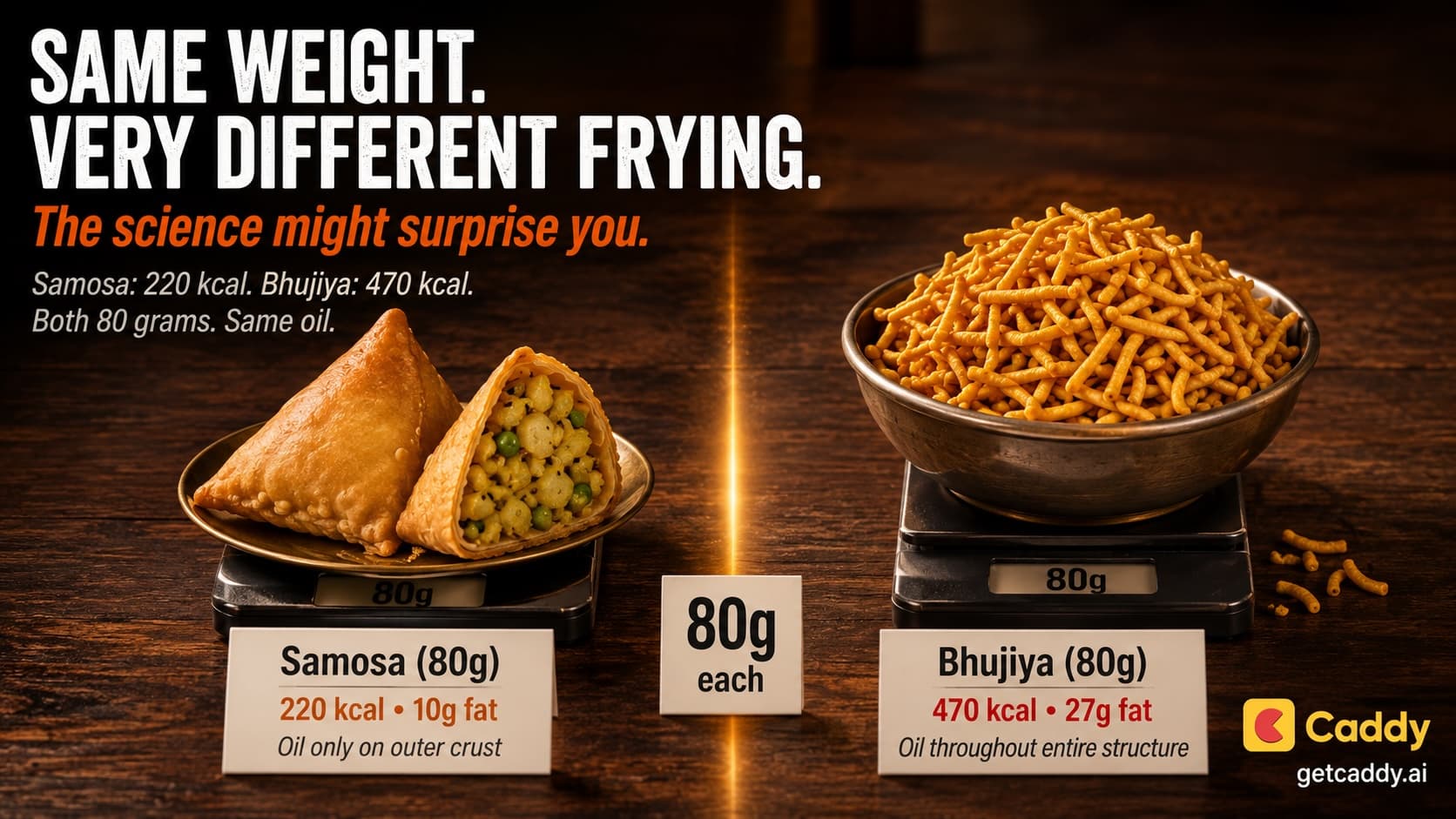
80 grams of samosa: 220 calories, 10 grams of fat. 80 grams of bhujiya: 470 calories, 27 grams of fat. Same weight. Same oil. Completely different physics. Here is why.
The Problem With Saying Fried Is Bad
The nutritional guidance most Indians have absorbed about fried food operates at the same level of precision as saying all liquids are wet therefore all liquids are the same.
Fried is a method of cooking. It is not a nutritional category with fixed outcomes. What happens to food in hot oil is almost entirely determined by the structure of what you are frying — its surface area, moisture content, interior geometry, and the presence or absence of a coating that can form a barrier between the oil and the interior.
These structural differences produce calorie and fat outcomes that differ by a factor of two to three between different fried foods at equivalent weights. Understanding those differences does not make samosas a health food. It makes you a more accurate eater who can make actual decisions rather than following a rule that has no culinary basis.
What Happens When a Samosa Hits Hot Oil
To understand fried food properly you need to understand what oil does — and equally importantly, what it cannot do — when it encounters different food structures at frying temperature.
When a samosa is submerged in oil at the correct frying temperature of approximately 170 to 180 degrees Celsius, several things happen simultaneously.
The Maillard reaction begins immediately. The outer surface of the maida or atta crust encounters intense heat and the sugars and amino acids begin to react, producing the characteristic golden-brown colour and flavour of fried food. This reaction creates a progressively hardening and sealing crust on the exterior surface.
Moisture in the filling converts to steam. The potato filling of a samosa — typically 60 to 75% water by weight — rapidly heats to boiling point and converts to steam. Steam has approximately 1,600 times the volume of liquid water at the same mass. This expanding steam has nowhere to go but outward through the crust.
Steam creates positive outward pressure. This is the central mechanism governing oil content in stuffed fried items. The steam escaping outward through the crust creates pressure that directly opposes oil trying to enter from outside. Oil cannot flow against a stream of steam escaping at pressure. The outward steam flow is the barrier between the oil bath and the interior of the samosa for the entire duration of frying.
The crust seals. As the Maillard reaction progresses, the outer crust becomes denser and less permeable. Within approximately 60 to 90 seconds at correct temperature, the outer surface of a well-made samosa is essentially sealed — oil can coat it but cannot penetrate it in meaningful quantities.
The result: oil in a stuffed fried item exists almost entirely on the outermost surface. Open a freshly fried samosa and examine the inside of the outer crust. It is dry. Examine the filling. It is dry. The filling was steam-cooked by heat radiating through the sealed crust. It never touched oil.
An 80-gram samosa contains approximately 10 grams of fat — almost entirely concentrated in the outer millimetre of the crust. That is approximately 12 to 13% of the total weight in fat.
The same physics applies to batata vada, bread pakora, battered fish, fried chicken with skin or batter, and any stuffed or coated fried item where interior moisture generates ongoing steam during cooking.

What Happens When Bhujiya Hits Hot Oil
Now consider what happens when bhujiya — or chips, sev, chiwda, or similar thin open-structure snacks — encounters the same frying oil at the same temperature.
There is no interior moisture reservoir. The thin besan strands of bhujiya or the thin potato slices of chips contain relatively little moisture by weight, and what moisture they contain converts to steam and escapes within the first few seconds of frying. There is no ongoing source of outward steam pressure after that initial escape.
There is no meaningful crust barrier. A thin strand of bhujiya cannot form a meaningful protective crust because there is essentially no interior separated from the exterior. The item is almost entirely surface. Everything that can be exposed to oil is exposed to oil.
Surface area is enormous relative to volume. This is the geometric factor that drives everything. Bhujiya strands, sev, chips, and chiwda are specifically shaped — thin, open, often curled or ridged — to maximise the surface area exposed to oil relative to their total volume. This is what makes them crispy. It is also what makes them oil-dense.
Oil absorption in fried food is directly proportional to exposed surface area and inversely proportional to protected interior volume. An item that is almost entirely surface absorbs oil from every direction simultaneously with no barrier opposing it. An item with a large protected interior and a sealed outer crust absorbs oil only on that outer layer.
80 grams of bhujiya contains approximately 27 grams of fat — approximately 34% of total weight in fat, and 470 total calories. Compared to the same weight of samosa at 10 grams of fat and 220 calories, the oil content per gram is more than two and a half times higher and the calorie density is more than double.
This is not a marginal difference. It is the direct mathematical consequence of geometry and physics applied to two different food structures in the same oil.

The Serving Size Reality
The equal-weight comparison establishes the science. The serving size reality makes it personally relevant.
The recommended serving size of bhujiya is approximately 30 grams — the amount typically listed on packaging nutritional labels. At 30 grams, bhujiya delivers approximately 175 calories and 10 grams of fat — broadly comparable to the 80-gram samosa in calorie terms.
But 30 grams of bhujiya is a small handful. It is the serving size that a nutritionist would recommend and that almost no one eating bhujiya from a packet actually adheres to. The combination of small physical size, open crispy texture, high salt content, and absence of any natural portion signal makes bhujiya one of the most difficult foods to eat in controlled quantities. Actual consumption from a bhujiya packet during a single snacking occasion is commonly 60 to 100 grams — two to three times the nominal serving.
An 80-gram samosa is a complete, discrete, satisfying snack with a natural endpoint. You eat the samosa. It ends. There is no implicit invitation to eat three more samosas in the same sitting.
The food that looks like the indulgence has a natural stopping point. The food that looks like a harmless snack does not.
The Nutritional Reality of Stuffed Fried Items
Honest assessment of samosas, batata vada, and similar stuffed fried items requires acknowledging what they are not, not only what they are.
They are low in protein. The potato filling is predominantly carbohydrate with minimal protein content. They are low in fibre relative to their calorie content. They are low in vitamins and minerals beyond modest amounts of vitamin C and potassium from potato.
These are genuine nutritional limitations. They are also nutritional limitations shared with plain bread, plain rice, plain pasta, and most other carbohydrate-dominant foods consumed in isolation. The solution for carbohydrate-dominant foods has always been the same: pair them with protein, fibre, and micronutrient-dense foods to create a nutritionally complete meal.

Applied to samosas and batata vada this produces eating patterns that are both enjoyable and nutritionally sound.
Two 40-gram samosas paired with two boiled eggs and a cup of full-fat curd:
Calories: approximately 420 to 450 kcal
Protein: approximately 20 to 22 grams
Fat: approximately 22 to 25 grams
Carbohydrates: approximately 38 to 42 grams
Fibre: approximately 3 to 4 grams
This is a nutritionally complete and respectable breakfast. The only element that makes it seem indulgent is the word samosa.
Two batata vadas paired with a bowl of sprouted moong chaat and a piece of fruit for an evening meal delivers protein from the sprouts, fibre from the vegetables and fruit, and the satisfaction of a meal that includes something genuinely enjoyable. The nutritional profile is broadly comparable to many meals that would not attract any comment in a nutritional context.
Temperature, Oil Quality, and Home Frying
The science of oil absorption is not only about food structure. The conditions of frying produce significant differences in actual oil content and in the nutritional quality of the oil itself.
Temperature matters more than most people realise. Oil that is too cool — below approximately 160 degrees Celsius — does not produce rapid crust formation or the steam pressure that keeps oil out of stuffed items. The item sits in cool oil, the crust forms slowly, oil penetrates before the barrier seals, and the result is greasy food with significantly higher oil content than the same item fried at correct temperature. Paradoxically, correctly fried food at 170 to 180 degrees Celsius is less oily than incorrectly fried food at lower temperature.
Oil quality and reuse change the nutritional calculus. Fresh oil at the correct temperature contains none of the degradation products — polar compounds, aldehydes, and oxidised lipids — that develop with repeated heating and reuse. From a health perspective, the difference between fresh oil and degraded repeatedly reused oil is considerably more significant than the difference between fried and not fried. When eating fried food at restaurants or street vendors, the question of oil quality and reuse frequency is worth asking.
Home frying gives you control. Fresh oil of your choice, correct temperature using a thermometer or the standard bread-cube test, appropriate cooking time, and proper draining on absorbent paper produce food that is genuinely different in oil content and in the absence of degradation compounds from commercially produced equivalents at incorrect temperature.
The Practical Framework
The science above generates a small number of practical principles that can be applied directly.
Choose structure over surface area. Stuffed, coated, and wrapped fried items — samosa, vada, pakora, fried chicken — absorb significantly less oil per gram than open-structure snacks at equivalent weights. When choosing between fried options, the physics favour the stuffed item.
Respect the serving size of open-structure snacks specifically. 30 grams of bhujiya is the appropriate quantity — equivalent in calorie terms to a full samosa, but a fraction of the satisfaction. If you are going to eat bhujiya, measure and portion it rather than eating from the packet.
Pair with protein and fibre to build a complete meal. Two samosas eaten alone are a carbohydrate snack. Two samosas with eggs and curd are a meal that happens to include samosas.
Fry at home at the right temperature with fresh oil. The result is meaningfully less oily and more nutritious than the commercially produced equivalent.
When eating out, observe the oil. Fresh oil, clean equipment, and appropriate temperature produce fried food that is different in both oil content and oil quality from what reused degraded oil at incorrect temperature produces.
Offset oil across the day as balance not punishment. If lunch included fried items, reduce added fat elsewhere in the day. This is the same calorie management principle that governs all food decisions.
The Bottom Line
80 grams of samosa: 220 calories, 10 grams of fat.
80 grams of bhujiya: 470 calories, 27 grams of fat.
Same weight. The same oil. Dramatically different outcomes because of structure, surface area, steam pressure, and basic physics.
The samosa is a steamed filling in a fried crust. The bhujiya is fried throughout, with no interior and no barrier. Treating them as equivalent because both involve hot oil is nutritional oversimplification that turns manageable food into unnecessary guilt.
Understand the structure. Know the numbers. Pair your samosa right.
The word fried is not the problem. The structure of what you are frying — and how much of it you eat — is where the actual conversation belongs.
About Caddy
Caddy tracks samosas, bhujiya, batata vada, pakoras, and 4 million other Indian foods with accurate oil content and real nutritional data. Whether you are eating a samosa for breakfast with eggs or a handful of bhujiya while watching cricket, Caddy gives you the actual numbers. Know what you eat. Know how much. Score 8.
Frequently Asked Questions
- Why does bhujiya have so much more fat than samosa at the same weight?
- Bhujiya is almost entirely surface area with no protected interior, so oil penetrates it from every direction during frying. A samosa's filling generates outward steam pressure that blocks oil from entering, so oil stays concentrated in a thin outer crust layer.
- Is samosa actually healthier than bhujiya?
- Neither is inherently "healthy," but at equal weights, samosa contains less than half the fat and calories of bhujiya — 10g fat and 220 calories versus 27g fat and 470 calories per 80 grams. The difference comes from food structure, not one being a better food overall.
- What's the correct temperature for frying to reduce oil absorption?
- Approximately 170-180°C. Frying at lower temperatures actually increases oil absorption, because the crust forms too slowly to block oil penetration — correctly fried food absorbs less oil than food fried in oil that's too cool.
- How much bhujiya is actually a normal serving?
- The labeled serving size is around 30 grams — a small handful. Most people eating from a packet consume 60-100 grams in one sitting, two to three times the nominal serving, largely because bhujiya lacks a natural stopping point the way a discrete item like a samosa has.
- Can I still eat samosas and stay on track with a calorie deficit for weight loss?
- Yes — pairing samosas with protein and fibre (like eggs and curd) turns them into a nutritionally complete meal rather than an isolated carbohydrate snack. Two 40g samosas with two boiled eggs and a cup of curd delivers roughly 420-450 calories with 20-22g of protein.
Get Caddy
Your simplest way to eat smarter with Indian food
Download