
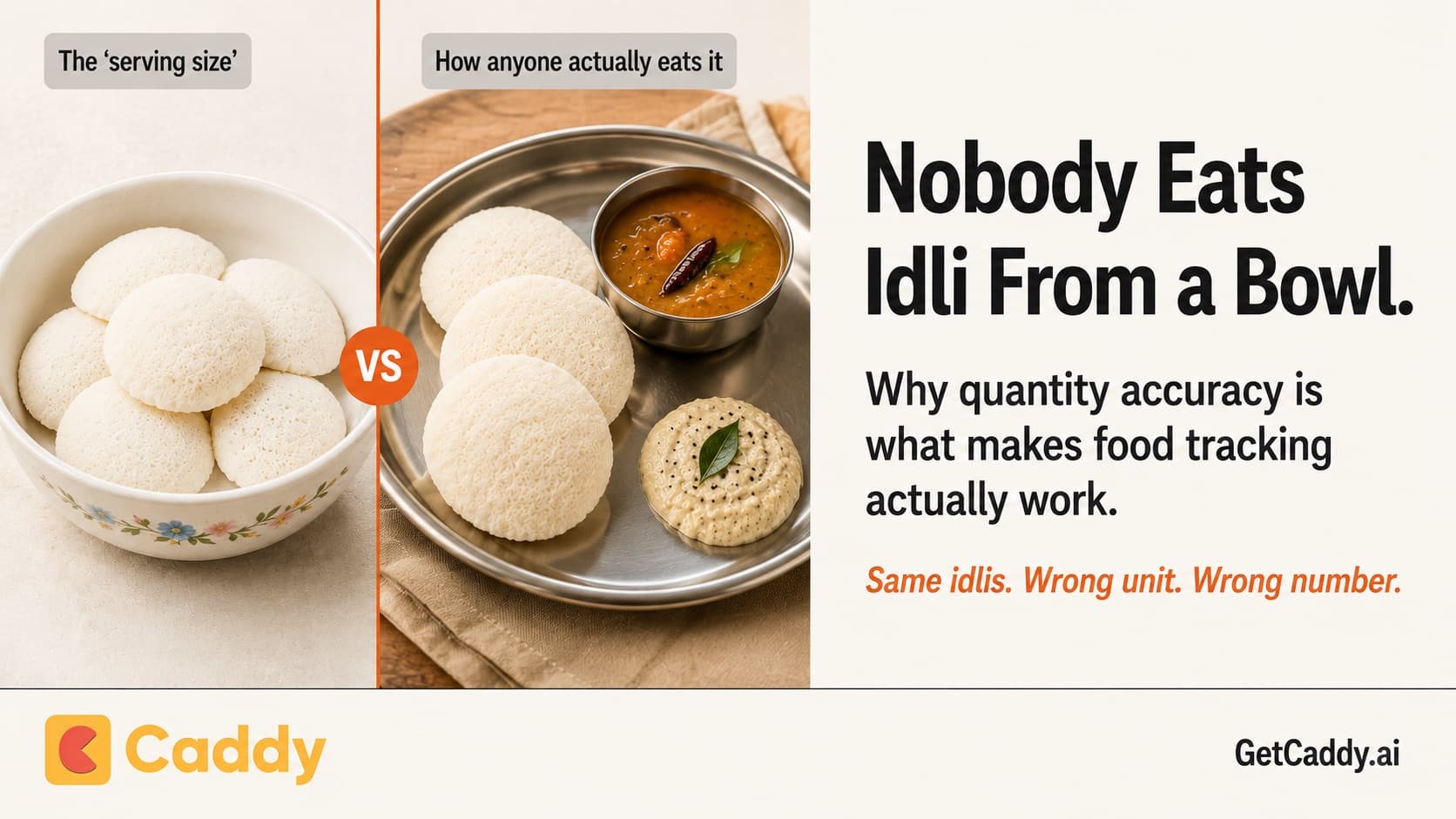
Nobody Measures Idli From a Bowl
Written by Rishi Bhojnagarwala
Nutrition Reviewed by Dr. Hetal Pal, PhD in Nutrition Science
Somewhere in the design meeting for a popular food-tracking app, someone decided idli should be measured in bowls. Not pieces. Not plates. Bowls.
If you're Indian, you don't need this explained to you. You've never once eaten idli from a bowl, and neither has anyone you know. But scroll through the serving-size options on most nutrition trackers and you'll find exactly this kind of unit — technically a measurement, practically meaningless to the person using it.
"Serving of dal." Serving, defined how? "A cup of rice." Who is measuring rice in a cup? These aren't edge cases. They're the default.
What We Actually Found in the Data
As Ilana Schachter, RDN, a registered dietitian and nutritionist for Consumer Health Digest, puts it: "The most common mistake I see is assuming that a familiar household measure represents a standard portion when it can vary significantly. Someone may log 'one cup of rice' or 'a bowl of soup,' but the actual amount can be very different depending on the size of the bowl, how full it is, or how densely the food is packed."
Here's something we didn't expect going in, and it's the kind of finding you only get from real usage, not a design assumption.
Ask someone directly, "did you have a bowl of dal today?" and most people will say yes. Not because that's genuinely how they experienced the meal, but because "bowl" was the only frame available to answer with. It's the option in front of them, so it becomes the answer.
Now change the question. Offer the same person a 180g bowl and a 125g katori, side by side, as two real choices. Nine times out of ten, they pick katori. Consistently, across millions of logged meals in our own app. Not a hypothesis, not a survey — behavior, at scale.

Schachter sees the same pattern clinically: "Culturally familiar measurements can make logging more intuitive and potentially more accurate. People are much more likely to accurately describe something using the dish or utensil they actually use at home than to mentally convert it into an unfamiliar standardized measurement. A katori or ladle can provide a meaningful visual reference. That said, the most accurate approach is still to provide a consistent reference for the approximate volume or weight associated with that unit" — which is exactly the mapping work behind every unit in Caddy.
That gap between "what people say when given one option" and "what people actually pick when given the real one" is the entire argument for why quantity accuracy matters. It's not a small rounding error. It's the difference between logging what you think you ate and logging what you actually ate.
Five Things a Food-Quantity System Has to Get Right
Human relatability. Nobody thinks in grams while eating. They think in katori, bowl, ladle, spoon, handful. A tracker that only speaks in grams is asking people to translate their own meal in real time, and most people either give up or guess.
Context. The same unit word can mean genuinely different things depending on what's in it and how someone actually uses that word day to day.
Density: volume vs. weight. A container holds a volume. Food has a density. Multiply those together and you get weight — and if you skip that step, every measurement is wrong by however much the food's density differs from whatever the system assumed.
Multiple measure options. Some people think in pieces. Others think in standard servings. A single piece of chicken tikka is a real, common way to log a meal — so is the more typical restaurant serving of 3 pieces at roughly 180g. Offering both isn't redundant, it's meeting two different mental models with the same underlying accuracy.
A precise option for people who want it. Some users genuinely want to enter exact grams — a kitchen scale, a specific recipe, real precision. That option needs to exist alongside the human-relatable ones, not instead of them.

The Same Word Doesn't Mean the Same Amount
This is where most tracking systems quietly break, because they treat units as fixed conversions instead of context-dependent ones.
A cup of tea is roughly 150ml. A cup of milk is roughly 250ml. Same word, same mental image of "a cup," genuinely different amount — because the vessel people actually use for tea isn't the vessel they use for milk, and a system that applies one blanket "cup = X ml" conversion gets one of the two wrong every time.
Density complicates it further. A katori of dal is roughly 120g. The exact same katori filled with bhujiya is closer to 60-80g — because namkeen is largely air and crunch, while dal is dense liquid and lentils. A bowl of curry runs about 180g. A bowl of popcorn is closer to 30g. Same container. Wildly different weight. If a system doesn't separately account for what food is actually sitting in the container, it's applying a single container-to-gram conversion across foods with completely different densities, and the resulting number is wrong by design, not by accident.
You're Not Supposed to Notice Any of This
Here's the part that actually matters to you as someone using the app, not building it: none of the above should ever cross your mind while you're logging a meal.
That's the entire point of doing this work up front. We mapped density, context, and real Indian measurement units — bowl, katori, ladle, the actual spoon that's in your kitchen drawer (not a chef's precise teaspoon or tablespoon, the everyday one somewhere in between), a handful of nuts — so that when you tap "1 katori of dal," the correct number is already sitting behind that tap. You get the option to log a single chicken tikka piece or the standard 3-piece serving, whichever matches how you actually ate, and if you want to skip all of it and enter exact grams, that's there too. The complexity is our job. Your job is just to log what's actually on your plate, in the words you'd naturally use to describe it.

Why This Is the Actual Foundation
A calorie deficit is the mechanism behind weight loss. But a calorie deficit only works if the calories you're counting are close to the calories you actually consumed. Get the quantity wrong consistently — even by "just" choosing bowl instead of katori — and every calculation built on top of that number inherits the error.
Schachter describes exactly how that plays out over time: "A small error repeated consistently can become meaningful. If someone consistently underestimates a portion by 10–15%, that difference is minor on any individual meal but can add up across multiple meals and days. Over several weeks, this can create a substantial gap between someone's logged intake and their actual intake — which can make it harder to understand why their weight, energy levels, or other nutrition goals aren't changing as expected."
Precise data is what makes the number trustworthy. A trustworthy number is what makes someone actually stick to the plan, day after day, instead of quietly losing faith in an app that never quite matched what they felt like they ate. And the plan, in the end, is simple: hit Score 8, and weight loss follows.
About Caddy
Caddy's food database was built from scratch around Indian recipes, ingredients, and the way Indians actually describe their meals — not translated from a generic international template. Bowl, katori, ladle, spoon, handful, piece-or-serving, or exact grams if you want them: whichever way you naturally think about your food, that's the way you can log it, and the accuracy behind it is already handled.
Visit GetCaddy.ai
Frequently Asked Questions
- How much does a katori actually weigh in grams?
- It depends on what's in it — that's the core issue with fixed conversions. A katori of dal is roughly 120g, while the same katori filled with bhujiya is closer to 60-80g, because density varies significantly between foods.
- Why do nutrition apps use vague serving sizes like "1 bowl" or "1 cup"?
- Most apps use generic, borrowed unit systems that aren't built specifically around how a given population actually measures food, which produces technically-present but practically meaningless serving options.
- Is a cup of tea the same as a cup of milk in nutrition tracking?
- No. A cup of tea is typically around 150ml, while a cup of milk is closer to 250ml. Using one blanket conversion for "cup" across different foods introduces a real, consistent error.
- Do I need to weigh my food to track accurately on Caddy?
- No. Caddy is built around real Indian measurement units — bowl, katori, ladle, spoon, handful, and piece-based servings — so you can log meals the way you'd naturally describe them. A gram-entry option exists if you want extra precision, but it's optional.
- Why does portion size accuracy matter more than people think?
- Because every calorie-deficit calculation is built on top of it. If your logged quantity is consistently off — even something as small as choosing "bowl" over "katori" — the resulting numbers inherit that error, which undermines the whole point of tracking.
Score 8 to lose weight
Your simplest way to eat smarter with Indian food
Get Caddy