
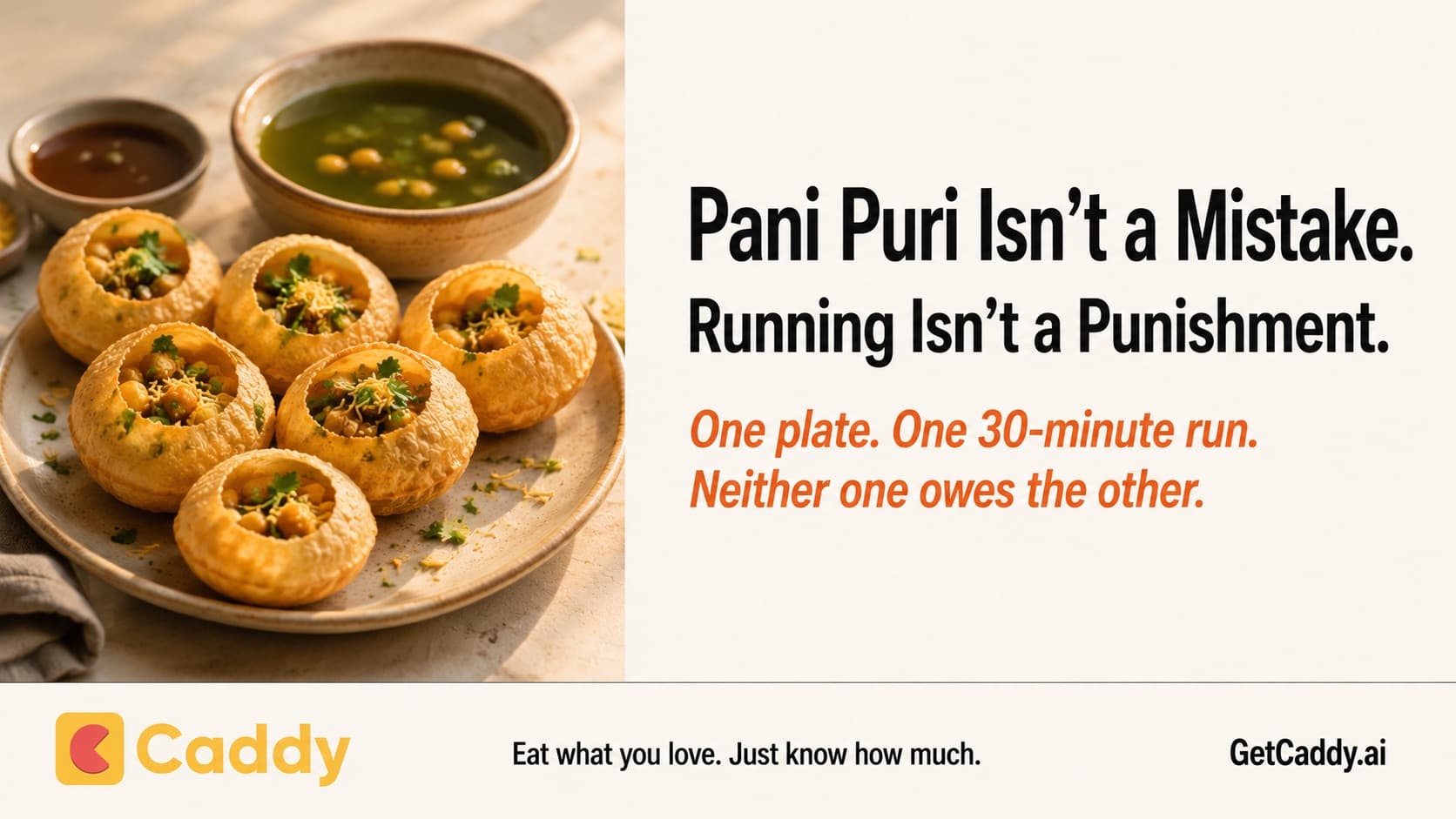
Pani Puri Isn't a Mistake. Running Isn't a Punishment.
Written by Rishi Bhojnagarwala
Nutrition Reviewed by Dr. Hetal Pal, PhD in Nutrition Science
One plate of pani puri costs about 300 calories. Burn that off running, and you’re looking at roughly 30 minutes at a moderate pace — a fairly standard estimate for how long it takes an average adult to run off that many calories.
Worth it? Absolutely. But not for the reason you might think.
The Math Isn’t the Point
It’s tempting to read “300 calories = 30 minutes” as a kind of debt — eat the pani puri, now go pay it back on a treadmill. That’s the exact framing this piece wants to push back on.
Pani puri is not a mistake. Running is not a punishment. They’re two entirely separate good things that fitness culture has spent years bundling together into a transaction that doesn’t actually need to exist.
As Ilana Schachter, RDN, a registered dietitian and nutritionist for Consumer Health Digest, puts it: “When exercise becomes a way to ‘pay back’ food, it can turn eating and movement into a transactional relationship: food has to be earned, and exercise becomes punishment for eating something perceived as indulgent. That mindset can make it harder to listen to hunger, fatigue, and recovery needs, and can take some of the enjoyment out of movement. I’d rather someone think, ‘I exercise because I want a stronger heart and stronger muscles,’ rather than, ‘I ate dessert, so now I need to burn it off.’”

What Exercise Is Actually For
Here’s the part that gets lost: exercise’s biggest, best-documented job isn’t burning off last night’s dinner. It’s your heart and your muscles.
Cardiovascular exercise strengthens the heart, lowers blood pressure, and improves how your body processes glucose — and according to Harvard Health Publishing, these benefits show up even when exercise doesn’t produce weight loss at all. Strength training builds and preserves muscle, which matters for metabolism, mobility, and long-term health regardless of what the scale says that week.
Schachter points to a second reason the “run it off” math rarely works out the way people expect: “Exercise can feel much more strenuous than the amount of energy it actually contributes to total daily expenditure, and calorie estimates from fitness trackers and cardio machines are just estimates that vary with the equipment and the individual. There’s also a tendency to treat it as a calorie-for-calorie transaction, but the relationship is more complicated — people may unconsciously eat a little more later or move less during the rest of the day.” That second effect is well documented: structured exercise sessions are often offset by a reduction in incidental movement for the rest of the day, quietly eating into the deficit the workout was supposed to create.
None of that makes exercise irrelevant to weight loss — it plays a role. But it’s generally far easier to manage a calorie deficit by adjusting what you eat than by trying to out-exercise it, which is the whole reason “you can’t out-exercise a bad diet” became such a common piece of fitness wisdom in the first place. Treating a run as payment for a plate of pani puri gets the relationship backwards: you don’t run because you ate. You run because it’s good for your heart. You eat the pani puri because it’s genuinely enjoyable food. Neither one is the price of the other.
Where Weight Loss Actually Comes From
Weight loss, specifically, comes down to a calorie deficit — consistently eating less than you burn, over time. That’s the mechanism, and it doesn’t care whether the deficit came from a smaller portion, a skipped second helping, or an extra 20 minutes of walking. What it does care about is consistency.
This is exactly why Caddy is built around one number instead of a list of banned foods or a mandatory workout quota. Score 8 means you’re in a deficit — full stop. It doesn’t require a specific plate to look a specific way, and it doesn’t require you to run off a specific snack. It requires knowing where your day actually landed.

The Practical Trick: Pair, Don’t Eliminate
Once you can actually see your numbers, small adjustments start doing real work — and they’re a lot more sustainable than blanket avoidance.
Craving pani puri? Pair it with a boiled egg or a protein shake. You get the craving satisfied, some protein to help you stay full, and a day that’s still easy to balance out. There’s real mechanism behind this: protein has a stronger effect on fullness than carbohydrate or fat alone, and a meta-analysis of randomized controlled trials found that increased protein intake reduces hunger and increases fullness, though the size of the effect varies by amount and individual. As Schachter puts it: “Adding a protein-rich food to a treat can make the eating occasion more satisfying and may help with hunger later, although it doesn’t ‘cancel out’ the treat or change its calories. If someone wants pani puri, pairing it with an egg, Greek yogurt, or lentils is a practical way to build a more satisfying eating occasion — the goal isn’t to make the treat ‘healthier,’ just to add something that contributes to fullness.”
Craving chocolate? Take the smaller piece instead of the bigger one, and adjust the rest of your meals slightly to make room. You’re not eliminating anything — you’re right-sizing it and building the rest of the day around it.
This is the entire logic behind sustainable tracking: nothing is forbidden, everything has a number, and the number tells you how to fit it in rather than whether you’re allowed to.
The Actual Takeaway
Run because it’s good for your heart. Lift because it’s good for your muscles. Eat the pani puri because it’s genuinely good, and you don’t need to earn it first.
Score 8, consistently, is what actually moves the number on the scale — not a specific run, not a specific skipped meal, just the accumulated pattern of staying in a deficit over time. Caddy’s users figure out how to fit in the samosa and the pani puri regularly, precisely because the app was never built around restriction. It was built around visibility.

About Caddy
Caddy is a nutrition and weight-loss companion built for Indians who don’t want to choose between enjoying their food and understanding it. Score 8 consistently, and losing weight stops requiring guilt, elimination, or a treadmill session for every plate of pani puri — it just requires knowing your number.
Visit GetCaddy.ai
Sources
Frequently Asked Questions
- How many calories does a plate of pani puri actually have?
- A standard plate is typically around 250-300 calories, depending on the number of puris, the filling, and how much of the tangy water is used.
- Do I need to exercise to burn off what I eat?
- Not specifically — weight loss comes from an overall calorie deficit, which can be achieved through eating less, moving more, or a combination. You don't need to "earn back" a specific food with a specific workout.
- Is exercise pointless for weight loss then?
- No — exercise absolutely contributes to a calorie deficit and offers major benefits (heart health, muscle preservation, long-term maintenance) independent of weight loss. It's just generally less efficient for creating a deficit than adjusting your diet, which is why both matter but aren't interchangeable.
- How can I enjoy pani puri without feeling guilty about calories?
- Track it, don't avoid it. Pairing it with a protein source like a boiled egg or protein shake helps balance the meal, and knowing your day's total lets you adjust elsewhere instead of skipping the food entirely.
- What's the fastest way to know if I'm actually in a calorie deficit?
- Track your meals consistently rather than estimating. Caddy's Score 8 reflects whether your day landed in a deficit, so you don't have to do the math yourself every time you want to eat something you enjoy.
Score 8 to lose weight
Your simplest way to eat smarter with Indian food
Get Caddy