
“Ozempic Face” Is Not a Side Effect. It’s Weight Loss.
Written by Rishi Bhojnagarwala
Medically Reviewed by Dr. Hetal Pal, PhD in Nutrition Science
The rise of GLP-1 medications like semaglutide has brought with it a wave of conversation, curiosity… and increasingly, fear-mongering.
One of the most viral terms doing the rounds?
“Ozempic face.”
It sounds clinical.
It sounds alarming.
It sounds like a side effect you should worry about.
But here’s the truth:
👉 “Ozempic face” is not a medical condition.
It’s simply what happens when you lose weight.
What Is “Ozempic Face”?
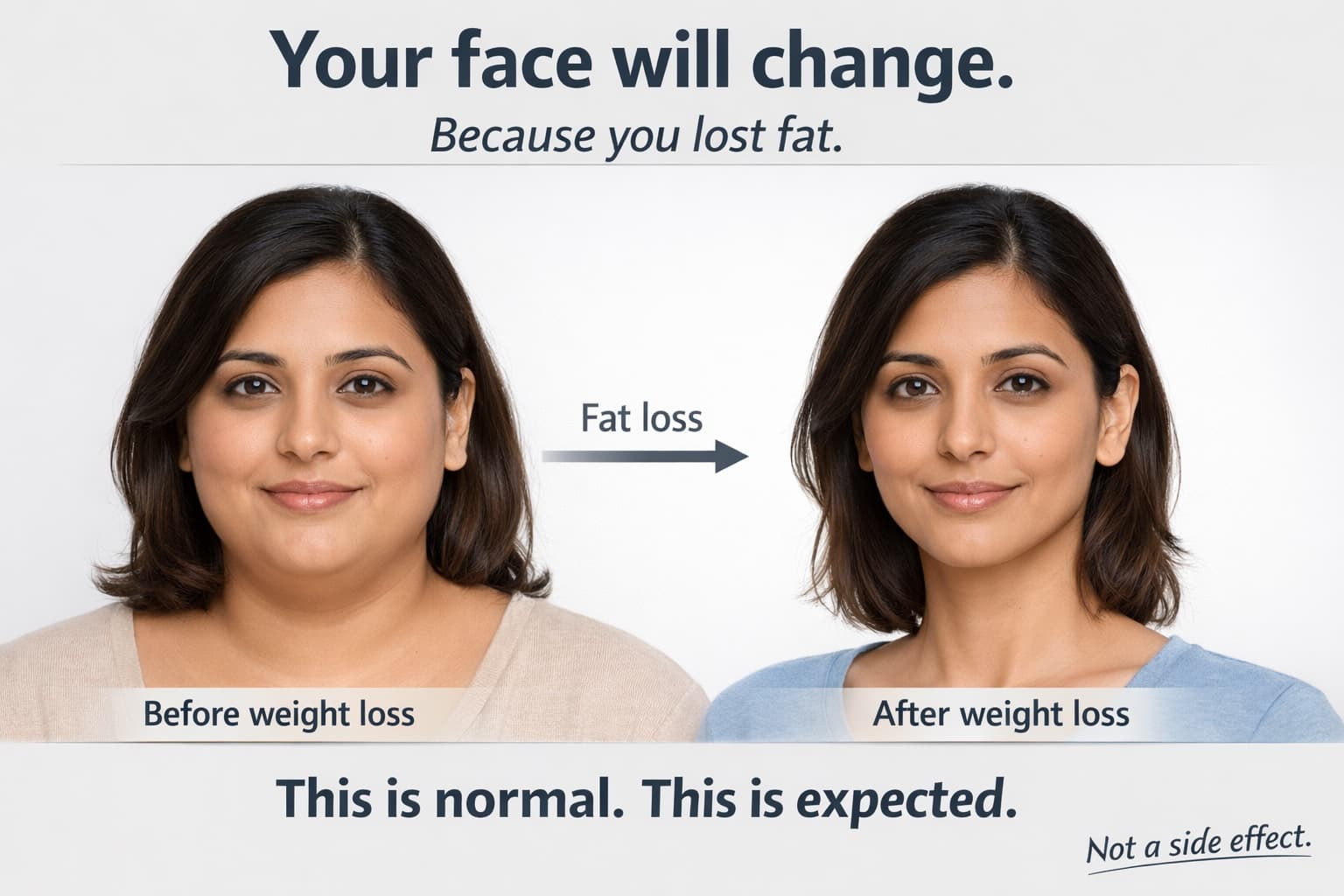
The term is used to describe a leaner, slightly hollowed facial appearance after weight loss.
And that’s exactly what it is:
👉 Fat loss from the face.
When the body loses fat, it doesn’t selectively choose areas.
It reduces fat everywhere — including:
Face
Arms
Abdomen
Thighs
So if someone had a fuller, rounder face before, weight loss will naturally make it appear sharper and leaner.
This Isn’t New. It’s Always Happened.
Long before GLP-1 medications existed, people who lost weight experienced the same thing.
Personally, during my own weight loss journey (losing ~20 kg), my face also became noticeably leaner.
No one called it a syndrome.
No one labeled it a side effect.
It was simply understood as part of the process.
So why the sudden panic now?

Because Fear Sells
In today’s content ecosystem:
Sensational terms spread faster
Negative framing drives more engagement
Half-truths become narratives
“Ozempic face” is a perfect example of this.
It reframes a normal physiological outcome into something that sounds like a problem.
“But Aren’t You Losing Facial Muscle?”
This is one of the most common claims.
Let’s break it down.
Weight loss can involve:
Fat loss
Some muscle loss (if poorly managed)
But the idea that GLP-1 specifically causes facial muscle loss is misleading.
Ask a simple question:
👉 Which facial muscle exercise do you do in the gym to preserve facial muscle?
The face doesn’t have significant muscle mass in the way your body does.
What changes visually is primarily fat distribution, not muscle depletion.

GLP-1 Doesn’t Change the Rules of Weight Loss
At its core, weight loss still follows the same principle:
👉 Calorie deficit = weight loss
GLP-1 medications don’t bypass this.
They simply:
Reduce appetite
Improve satiety
Make it easier to sustain a calorie deficit
The key difference?
👉 It reduces dependence on willpower.
Instead of relying on constant discipline and motivation,
GLP-1 works with your biology to make consistency easier.
So Why Do Some People Look “Too Lean”?
There are two real reasons:
1. Significant Fat Loss
If someone loses a large amount of weight quickly, facial fat reduces noticeably.
2. Lack of Muscle Preservation
If protein intake is low and strength training is absent, overall body composition may suffer.
👉 This is not a GLP-1 problem.
👉 This is a nutrition and lifestyle problem.
How to Avoid an “Overly Gaunt” Look
The solution is simple — and the same as any healthy weight loss approach:
✅ Adequate Protein Intake
Helps preserve lean muscle
Supports better body composition
✅ Fiber-Rich Diet
Supports digestion
Improves satiety
✅ Hydration
Maintains skin health
Reduces fatigue
✅ Strength Training
Preserves muscle mass
Improves overall appearance
The Bigger Problem: Mislabeling Outcomes as Side Effects
Calling normal weight loss changes a “side effect” creates:
Unnecessary fear
Confusion among patients
Hesitation toward effective treatments
It shifts focus away from the real conversation:
👉 How do we support people better during weight loss?
GLP-1 Needs Better Support, Not Better Headlines
GLP-1 medications are a powerful tool.
But they are not a complete solution on their own.
Patients still need:
Nutrition guidance
Meal planning support
Side-effect management
Long-term habit building
Because:
👉 GLP-1 helps you eat less.
But it doesn’t automatically help you eat right.

Final Takeaway
“Ozempic face” is not a side effect.
It’s not a disease.
It’s not something to fear.
👉 It’s simply what happens when the body loses fat — including from the face.
Closing Thought
We need to stop turning expected outcomes into scary headlines.
And start focusing on what actually matters:
👉 Sustainable weight loss
👉 Better health
👉 Smarter support systems
If you’re navigating weight loss — with or without GLP-1 —
focus less on the noise, and more on the fundamentals.