
Natural Foods Are Also Full of Chemicals. Some of Them Will Kill You.
Written by Rishi Bhojnagarwala
Nutrition Reviewed by Dr. Hetal Pal, PhD in Nutrition Science
Influencers have made "chemicals" into a scare word. Here's what they forgot to mention.
The Word That Replaced an Argument
Somewhere in the last decade, the wellness industry discovered that the word "chemicals" did a lot of work without requiring any evidence. Post a photo of an ingredient label, circle a compound name that sounds unfamiliar, add a caption about "what they're putting in your food" — and engagement follows, every time.
The problem is that "this food has chemicals" is not actually a fact about processed food. It is a fact about all matter. Every substance that has ever existed is made of chemicals. The argument, as stated, describes everything including the foods on every clean-eating list ever published.
Let's be precise about what chemicals are — and then let's look at what's actually in the foods the influencers are eating.

Everything Is a Chemical. Including Your Clean Diet.
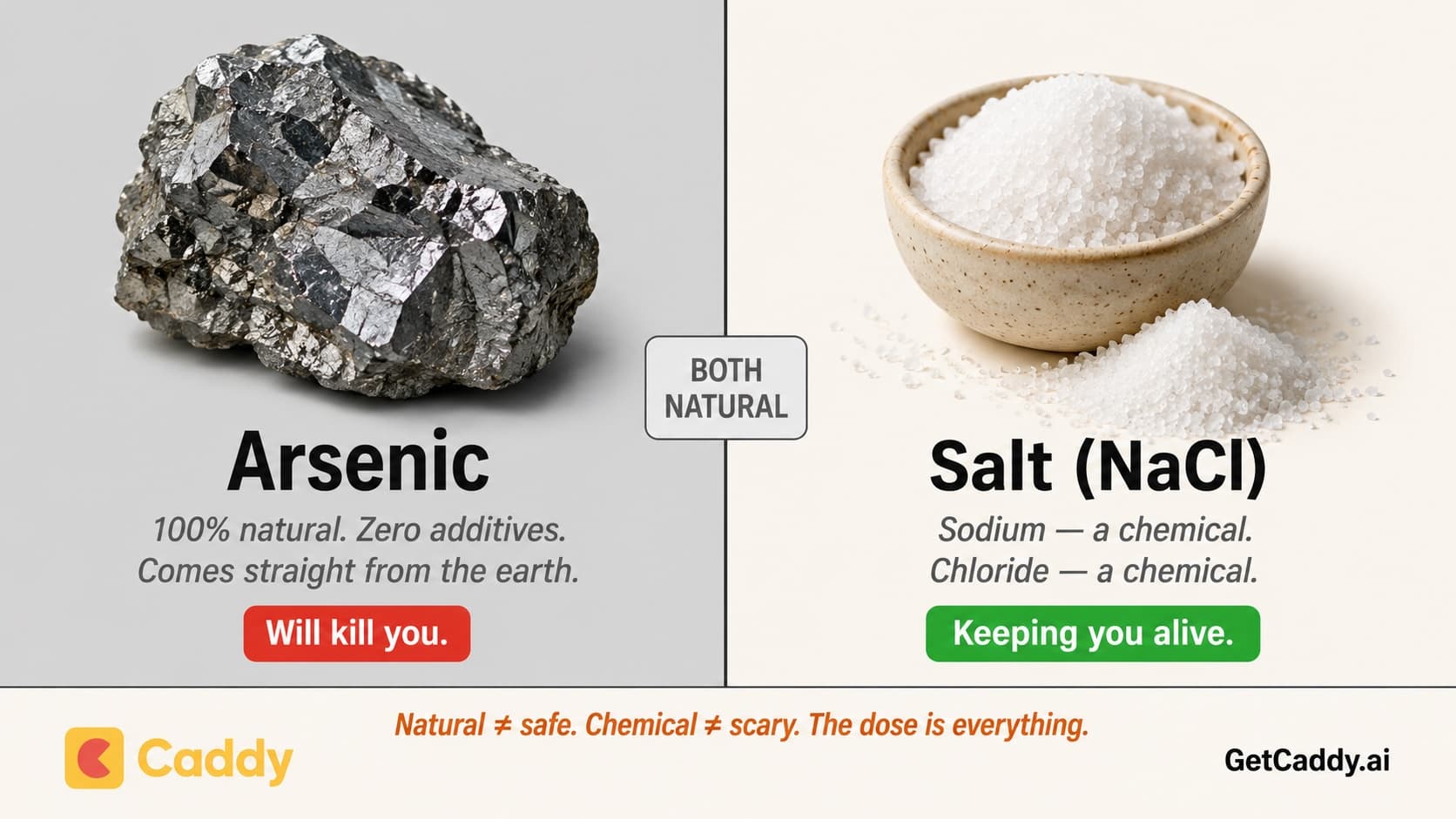
Salt is sodium chloride — NaCl. Sodium is a chemical. Chloride is a chemical. Combined, they form table salt, which your body requires to maintain fluid balance, nerve function, and muscle contraction. You cannot live without it, and it is entirely made of chemicals.
Water is H₂O. Two hydrogen atoms, one oxygen atom. A chemical. In large enough quantities, water causes hyponatremia — a dilution of blood sodium that can be fatal. Completely natural, completely lethal at the wrong dose.
A banana contains fructose, sucrose, glucose, tryptophan, dopamine, serotonin, and potassium — every one of them a distinct chemical compound, every one of them naturally occurring, every one of them doing something specific in your body. An avocado contains oleic acid, beta-sitosterol, glutathione, and lutein. All chemicals. All "clean." All the things people point to when they argue avocado is a superfood.
The distinction the "chemicals" argument is trying to draw — between natural and artificial, between clean and processed — doesn't map onto the word "chemical" at all. Everything is made of chemicals. The relevant questions are which ones, at what dose, and in what context.
Now Let's Talk About What's in Natural Foods
If the goal is to find alarming-sounding compounds in food, natural foods are a much richer hunting ground than the ingredient label on a packet of biscuits.
Apple seeds contain amygdalin — a compound that your digestive enzymes convert into hydrogen cyanide. This is documented by the FDA. The seeds of a single apple don't contain enough amygdalin to cause poisoning — but that's a dose argument, not a natural-versus-artificial argument.
Cherry pits contain the same compound — amygdalin converts to prussic acid, another name for hydrogen cyanide. Natural, untouched by any factory, and chemically capable of cyanide poisoning in sufficient quantity.
Bitter almonds have the highest amygdalin content of any commonly consumed food. Sweet almonds are safe; bitter almonds, consumed in quantity, can cause cramps, nausea, and in significant doses, cyanide toxicity. Both grow on trees. Neither came from a laboratory.

Spinach contains oxalic acid, which binds to calcium and iron in your gut, reducing their absorption. In large quantities, oxalic acid intake is associated with kidney stone formation. Rhubarb leaves contain enough oxalic acid to cause severe toxicity — they're not eaten precisely because of this, despite being entirely plant-based.
Green potatoes contain solanine — a natural toxin produced by the potato plant as a defence against insects. The WHO documents solanine as a food safety concern. Symptoms of solanine poisoning include nausea, vomiting, and neurological effects. Potatoes become green when exposed to light, increasing solanine concentration. Tomatoes and brinjal (eggplant) also belong to the same plant family — Solanaceae — and contain related compounds at lower levels.
And then there is arsenic. Arsenic is a naturally occurring element found in soil, groundwater, and rock. It requires no processing, no factory, no additives. It is about as natural as any substance can be. It is also acutely toxic and has been used as a poison throughout human history precisely because of its natural availability. Nobody labels it "100% natural, no artificial ingredients" — but technically, they could.
The Indian Food Punchline
The most pointed example for an Indian audience isn't arsenic — it's sabudana.
Sabudana is temple food, fasting food, the thing people eat on Navratri and Ekadashi when they want to eat "clean" and "natural" and "pure." It's also derived from cassava, a root crop whose raw form contains cyanogenic glycosides — compounds that your digestive system breaks down into hydrogen cyanide.
This isn't a fringe concern. This is documented by the WHO, which recognises cassava as a major dietary source of cyanogenic glycosides. Traditional processing methods — soaking, fermenting, and drying — reduce these compounds to safe levels. This is why sabudana is safe to eat. The processing is what makes it food.
Without the processing that influencers are afraid of, sabudana is a health risk. With it, it's your fasting khichdi. The thing people fear is the thing keeping them safe.

This is also true of many legumes — raw kidney beans contain phytohaemagglutinin, a compound that causes severe gastroenteritis. Cooking destroys it. Cassava soaking removes cyanogenic compounds. Rhubarb leaves contain levels of oxalic acid that make them inedible; the stalks, after appropriate preparation, are fine. Processing — broadly defined — has been making natural foods safe for human consumption since before humans had a word for it.
Paracelsus Figured This Out in 1538
The founding principle of modern toxicology was stated by a 16th-century Swiss-German chemist named Paracelsus: "Sola dosis facit venenum" — the dose alone makes the poison.
Not the name. Not the source. Not whether the compound was synthesised in a laboratory or extracted from a plant. Every substance on earth is toxic at some dose and safe at another. Water causes fatal hyponatremia at very high intake. Vitamin D causes toxicity at sustained megadoses. Oxygen, breathed at elevated pressure, causes seizures. Salt, consumed in enormous quantity, is acutely toxic.
The question that has always mattered is not "is this a chemical" — everything is a chemical — but: what dose, what frequency, in what combination, and in what individual context?
This is the question that food safety regulators, toxicologists, and nutritional scientists ask when they evaluate any compound — natural or synthetic. It is why the acceptable daily intake for any additive or preservative is calculated using dose-response data, not ingredient name. And it is why "this product contains X" — without context about quantity, frequency, and individual tolerance — is marketing language, not nutritional science.
What This Actually Means for How You Eat
None of this means processed food is uniformly fine, or that the quality and source of food don't matter. They do. Nutrient density, fibre content, protein quality, and the presence of added sugar and refined carbohydrates in packaged foods are all genuinely relevant variables.
What it means is that "this has chemicals" is not an argument, and "this is natural" is not a safety guarantee. Apple seeds and arsenic are natural. Paracetamol and rehydration salts are processed. The relevant question about any of them is always the same: what dose, what context, what does the evidence show.
The solanine in your occasional green potato is not harming you. The oxalic acid in your spinach smoothie, at normal quantities, is not harming you. The amygdalin in the small quantity of apple seeds you accidentally swallowed is not harming you. What is worth paying attention to — for most people, most of the time — is total intake, overall dietary pattern, and whether what you're eating fits within your energy needs.
How Caddy Fits Into This
We're not tracking which compounds are in your food. The science on that is more complicated than any label or viral post makes it look, and it varies enormously by dose and context.
What Caddy tracks is one number — how much of everything you actually ate today. Take a picture of your plate. Get your Score out of 10. Score 8 means you're in a calorie deficit — the metric that predicts weight outcomes for most people, regardless of which specific foods are on the plate, and regardless of how many compound names are on the label.
The enemy was never the ingredient list. It was always the portion.
Know what you ate. Know how much.
Score 8. Lose weight. That's it.
Sources
[1] FDA Issues Warning About Toxic Amygdalin Found in Apricot Seeds. U.S. Food and Drug Administration, 2024. https://www.fda.gov/food/alerts-advisories-safety-information/fda-issues-warning-about-toxic-amygdalin-found-apricot-seeds
[2] Amygdalin: Toxicity, Anticancer Activity and Analytical Procedures for Its Determination in Plant Seeds. PMC. https://www.ncbi.nlm.nih.gov/pmc/articles/PMC8069783/
[3] Oxalate in Foods: Extraction Conditions, Analytical Methods, Occurrence, and Health Implications. PMC. https://pmc.ncbi.nlm.nih.gov/articles/PMC10486698/
[4] Solanine and Chaconine. WHO Food Additives Series 30 (JECFA). https://www.inchem.org/documents/jecfa/jecmono/v30je19.htm
[5] Cyanogenic Glycosides. WHO Food Additives Series 30 (JECFA). https://www.inchem.org/documents/jecfa/jecmono/v30je18.htm
[6] Severe Red Kidney Beans Toxicity in an 8-Year-Old Girl: A Rare Case of Hypovolemic Shock and Prerenal Acute Kidney Injury. International Journal of Emergency Medicine, PMC. https://pmc.ncbi.nlm.nih.gov/articles/PMC12922287
Frequently Asked Questions
- Are "chemicals" in food actually dangerous?
- Not inherently. Everything — including water, salt, and every nutrient in a banana — is made of chemicals. What determines danger is the specific compound, the dose, and the context, not whether something is labelled a "chemical."
- Is arsenic really natural?
- Yes. Arsenic is a naturally occurring element found in soil, groundwater, and rock — it requires no processing or factory. It's also acutely toxic. Natural and safe are not the same claim.
- Why is sabudana safe if cassava contains cyanide-producing compounds?
- Traditional processing — soaking, fermenting, and drying — breaks down the cyanogenic glycosides in raw cassava to safe levels. The processing that people fear is actually what makes sabudana safe to eat.
- Are green potatoes dangerous to eat?
- In large amounts, yes. Green potatoes contain elevated solanine, a natural toxin, and cooking does not destroy it. Small green patches can be cut away, but heavily green or bitter-tasting potatoes should be discarded.
- What does "the dose makes the poison" mean?
- It's the founding principle of toxicology, first stated by Paracelsus in the 16th century: every substance is toxic at some dose and safe at another, regardless of whether it's natural or synthetic. The relevant question is always how much, not what.
- Does this mean processed food is automatically fine?
- No. Food quality, nutrient density, and added sugar still matter. The point isn't that "natural" is bad or "processed" is good — it's that neither label tells you anything about safety on its own. Dose and context do.
Get Caddy
Your simplest way to eat smarter with Indian food
Download