
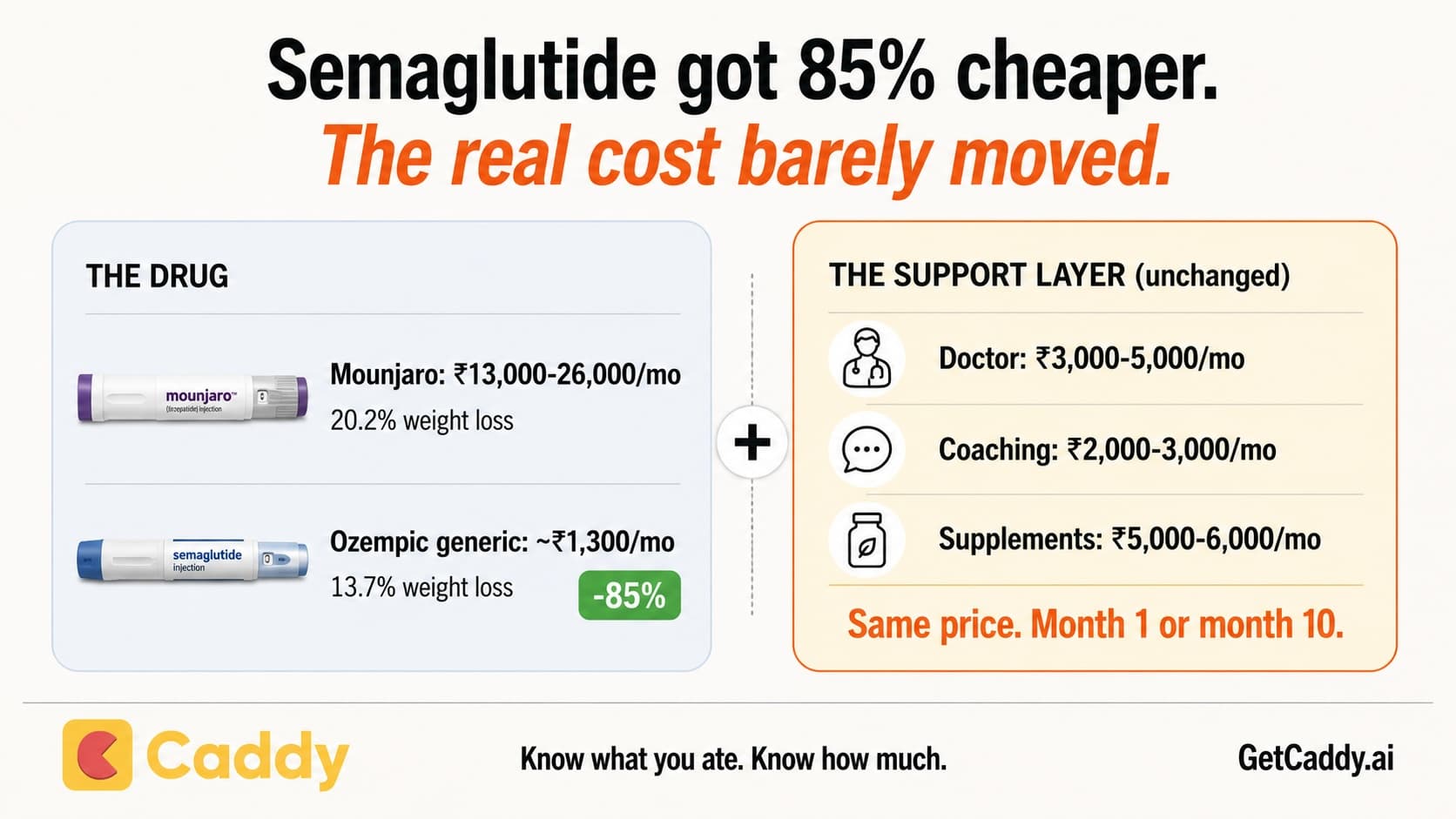
Mounjaro vs Ozempic: The Real Cost Isn't the Drug
Semaglutide just got 85% cheaper in India. Mounjaro's price hasn't moved. Here's why that headline matters less than you'd think — and what's actually driving the total bill.
Two Good Drugs, One Honest Comparison
Tirzepatide (Mounjaro) and semaglutide (Ozempic, and now its generics) are both genuinely effective GLP-1 medications. Neither deserves to be framed as the "bad" option in this comparison — that's worth saying upfront, because most online discussion collapses into one drug being right and the other being wrong.
The data tells a more precise story. In the SURMOUNT-5 head-to-head trial, semaglutide produced 13.7% average weight loss. Tirzepatide produced 20.2% — a meaningful gap — and fewer patients on tirzepatide discontinued treatment due to GI side effects: 2.7%, compared to 5.6% on semaglutide.
Tirzepatide is the stronger performer on this data. But semaglutide isn't a weak drug — it's the slightly less effective option in a category where even the second-best choice changes lives for people managing obesity and related metabolic conditions.

The Part of the Story Everyone's Missing
Here's where the conversation usually stops, and where it should actually start.
Semaglutide's Indian patent expired on 20 March 2026. Generic manufacturers launched in volume, and the cheapest versions now run around ₹1,300 a month — roughly 85% lower than before. That's a genuinely significant access improvement, and it's the headline every publication ran with.
Mounjaro's price hasn't moved. Tirzepatide isn't off-patent, and it still costs somewhere in the range of ₹13,000 to ₹26,000 a month depending on dose.
So the natural assumption is: semaglutide got cheap, Mounjaro stayed expensive, therefore semaglutide became the accessible choice and Mounjaro became the premium one. That assumption turns out to be only half true — and the missing half is the more interesting part.

What Actually Happens in a Doctor's Office
We asked Dr. Harsha Moole, MD, MBBS, an internal medicine physician who runs a cash-pay GLP-1 telehealth program treating roughly 1,500 patients a year for diabetes and obesity, what he actually sees patients choose when the honest cost-versus-efficacy comparison is laid out:
On tirzepatide vs semaglutide: when people pay out of pocket, most choose tirzepatide because it tends to give more weight loss per dollar for many patients. Semaglutide still wins for people who are more cost sensitive or who feel better on it, often at lower doses. It usually comes down to budget and how they feel, not the paperwork.
— Dr. Harsha Moole, MD, MBBS
That's a more accurate picture than a clean "everyone picks Mounjaro" story — most do, when budget allows, but semaglutide remains the right call for a real share of patients on cost or tolerability grounds alone. What's consistent either way: the drug decision is rarely where the real budget conversation ends.
The Support Layer Nobody's Pricing Into the Conversation
GLP-1 treatment moves through three distinct phases, and they don't need the same level of support.
Titration, roughly month 1 to month 3, is genuinely high-need. The FDA-labelled schedules for semaglutide and tirzepatide both require a minimum of four weeks at each dose step, and this is where side effects show up, doses get adjusted, and a doctor's judgment actually matters week to week.
Stabilized, roughly month 3 to month 6, is where most patients land. The goal was never to reach the maximum dose — it's the lowest dose that controls appetite with manageable side effects — so once someone finds a dose that works for them, they typically stop climbing and settle into a routine.
Maintenance, month 6 onward, is monitoring, not management. A refill, a periodic check-in, occasional labs.

We asked Dr. Moole whether the support a patient needs genuinely drops off once they stabilize, or whether that's more of an outside impression:
On the support layer: yes, the intensity drops off after a patient stabilizes, but it does not disappear. Refill logistics, insurance and coupon wrangling, side effects, checks and labs, coaching. That hidden work keeps paying for itself long after the first few months.
— Dr. Harsha Moole, MD, MBBS
What most GLP-1 programs actually charge doesn't reflect any of this curve. The support structure runs at close to full price from month 1 through month 12, whether a patient is mid-titration in month two or fully stable in month ten.
A typical monthly breakdown looks something like this:
Doctor consultations: ₹3,000–5,000
Nutrition coaching: ₹2,000–3,000
Supplements: ₹5,000–6,000
That's a conservative estimate. Several full-service Indian GLP-1 clinics charge ₹25,000–50,000+ a month once consultation, monitoring and coaching are bundled in — several times the generic semaglutide price on its own. This is the part of the total cost equation that stayed completely untouched by the semaglutide patent expiry, and it's the part almost nobody accounts for when they say "GLP-1s just got affordable in India."

Why This Changes the Actual Question
If the support layer costs roughly the same whether a patient is on the cheaper drug or the more effective one, the framing of "which drug can I afford" starts to look incomplete. The more useful question becomes: what is the total monthly cost of the entire program, and how much of that is actually justified by what the patient needs at their current stage?
We asked Dr. Moole, in his own experience, what actually determines whether a patient stays on GLP-1 treatment long-term — the price of the drug, or everything built around it:
On staying on long term: the biggest killer in my own program is the support layer, not the shot price. I have seen patients who could afford the drug drop the whole thing because the visits, coaching, and monitoring stacked on top got too expensive. The drug becomes the cheaper part once people are used to it.
— Dr. Harsha Moole, MD, MBBS
That's the pattern this piece is built around, from someone watching it happen in his own patient panel rather than estimating it from outside.
Whether a specific patient should be on tirzepatide or semaglutide is a decision between them and their doctor, based on their individual health profile, response, and goals — that's not a decision Caddy makes or should make. What Caddy can genuinely influence is the economics of everything sitting around that drug decision: the consultations, the coaching, the ongoing monitoring.
Built With Endocrinologists, Designed for Month Six — Not Just Month One
Working alongside leading endocrinologists, Caddy's approach is built around a simple observation: a patient's actual support needs at month six look very different from their needs during titration, and a program's pricing should reflect that difference rather than charging a flat rate indefinitely.
Because a meaningful share of the ongoing support-layer cost — regular check-ins, dose confirmation, basic nutrition guidance, supplement recommendations — is work that can be handled accurately and consistently through structured, personalized tracking once a patient has stabilized, Caddy is designed to bring the doctor-and-coach layer down to roughly ₹6,000–8,000 a year for a stable patient. Not a month.
That difference is what actually determines whether choosing the better-performing drug — Mounjaro, with its stronger efficacy and lower GI discontinuation rate — is financially realistic for a given patient, rather than something only accessible to a narrow segment who can absorb both a premium drug price and an uncapped support bill.
The Real Affordability Problem
The headline story was always "semaglutide got cheaper." The more accurate story is that the drug's price was never the main constraint for most patients pursuing sustained GLP-1 treatment — the support system around it was, and that part of the bill didn't move when the patent expired.
Whether a patient ends up on tirzepatide or semaglutide, the actual lever for making a full year of supervised GLP-1 treatment affordable isn't which molecule they're prescribed. It's what the program built around that molecule costs — every single month, for as long as they stay on it.

How Caddy Fits Into This
This is the specific gap Caddy is built to close. Not by influencing which drug a doctor prescribes, but by making the ongoing support layer — consultations, coaching, monitoring — proportional to what a patient actually needs at their current stage, rather than a flat, indefinite monthly charge.
Built specifically around Indian meals and GLP-1 patient needs, with an in-app option to consult a doctor when something genuinely requires one, Caddy is designed so that choosing the medication your doctor recommends as more effective doesn't automatically mean absorbing an uncapped support bill on top of it.
Know what you ate. Know how much.
Score 8. Lose weight. That's it.
Sources
Mounjaro (Tirzepatide) Injection for Weight Loss India — DermaVue
Dr. Harsha Moole, MD, MBBS — internal medicine physician, FindMyDirectDoctor
Frequently Asked Questions
- Is Mounjaro really better than Ozempic for weight loss?
- Based on the SURMOUNT-5 head-to-head trial, yes — tirzepatide (Mounjaro) produced 20.2% average weight loss compared to 13.7% for semaglutide (Ozempic), and fewer patients discontinued tirzepatide due to GI side effects (2.7% vs 5.6%). Semaglutide is still a genuinely effective medication; tirzepatide simply performed better on both efficacy and tolerability in this trial.
- Why is Mounjaro so much more expensive than Ozempic in India?
- Tirzepatide (Mounjaro) is not off-patent in India, so it's still sold at its original price — roughly ₹13,000-26,000 a month depending on dose. Semaglutide's patent has expired, allowing generic manufacturers to enter the market, which brought the cheapest semaglutide options down to around ₹1,300 a month.
- If Ozempic generics are now affordable, why do doctors still recommend Mounjaro?
- When doctors present patients with an honest choice — Mounjaro if budget allows, a more affordable option otherwise — patients frequently choose Mounjaro because of its stronger efficacy data and lower rate of GI-related discontinuation. It reflects genuine clinical confidence in the drug's performance, not just habit or brand preference.
- What are the actual costs of a GLP-1 weight loss program in India, beyond the medication?
- Beyond the drug itself, most supervised programs include doctor consultations (₹3,000-5,000/month), nutrition coaching (₹2,000-3,000/month), and supplements (₹5,000-6,000/month). Combined, this support layer often costs more than the medication itself, and typically stays at full price whether a patient is newly starting or has been stable for months.
- How does Caddy make Mounjaro more affordable?
- Caddy doesn't change the price of the medication itself. It reduces the cost of the support layer around it — doctor consultations, coaching, and monitoring — by calibrating that support to what a stable patient actually needs rather than charging a flat rate indefinitely, bringing the doctor-and-coach cost down to roughly ₹6,000-8,000 a year instead of that amount per month.
Get Caddy
Your simplest way to eat smarter with Indian food
Download