
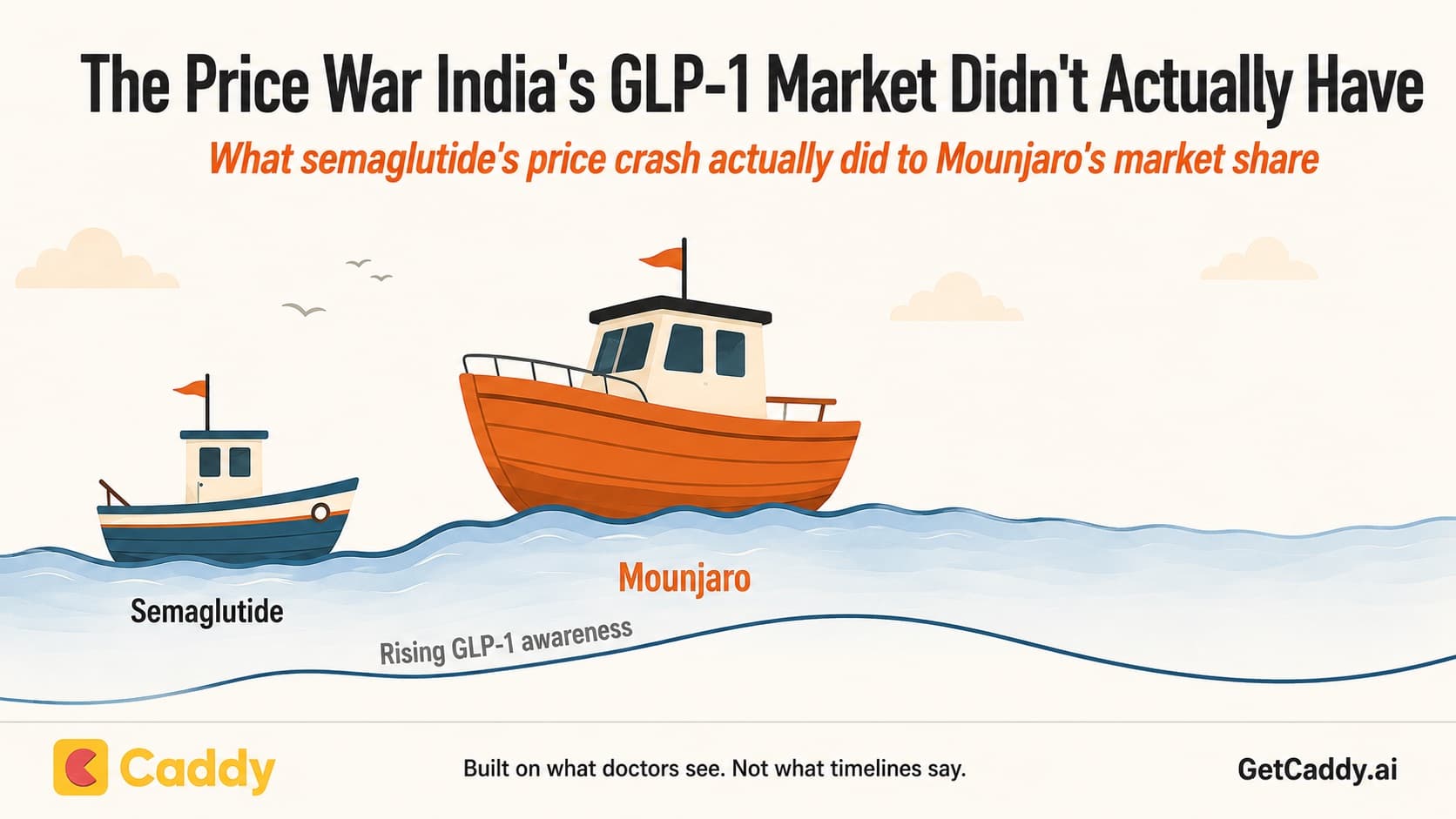
The Price War India's GLP-1 Market Didn't Actually Have
Written by Rishi Bhojnagarwala
Nutrition Reviewed by Dr. Hetal Pal, PhD in Nutrition Science
In March 2026, the consensus across Indian pharma was straightforward: semaglutide's patent expiry would flip the country's GLP-1 market. Generic versions were about to undercut the branded price by as much as 90%. How does anything compete with that?
Six months later, the data says something different happened.
What Actually Changed in March
Novo Nordisk's core Indian patent on semaglutide — the molecule behind Ozempic and Wegovy — expired on March 20, 2026. Within weeks, more than 40 Indian pharmaceutical companies had launched over 30 generic brands, and that count kept climbing — by May, 35 semaglutide brands from 17 companies were competing for shelf space. Branded semaglutide had been priced above ₹10,000 a month; generic versions landed as low as ₹1,290-4,200, a drop of up to 90%. Novo Nordisk itself cut branded prices further in response.
This was one of the sharpest price collapses a drug category has seen in India. The expectation across the industry was that semaglutide would absorb most of the resulting demand, simply because it was now dramatically more accessible than its rival, tirzepatide (sold as Mounjaro). Tirzepatide's core compound patent in India runs until 2036, with no generic competition realistically expected before then.

What the Market Share Data Actually Shows
It didn't play out that way. By MAT May 2026, Pharmarack data showed tirzepatide holding 63% of India's GLP-1 market by value, at ₹1,207 crore, while semaglutide held 31%, at ₹589 crore. A year earlier, semaglutide hadn't even launched as a generic yet, and tirzepatide's own base was a fraction of that size.
By June, the pattern sharpened. Semaglutide's sales growth fell to 12% month-on-month in May, down from 88% in April, and generic brands were carrying 45 days of unsold inventory. Doctors who had prescribing access to both molecules largely didn't switch existing patients to the cheaper option; some increased tirzepatide prescriptions instead.
That trend has held into the most recent data available. As of MAT August 2026, Mounjaro's 12-month revenue reached ₹1,256 crore — 54% of the ₹2,333 crore domestic GLP-1 market on its own, a 502% year-on-year sales increase, with tirzepatide overall still commanding roughly 62% of the category.
Why Doctors Are Choosing the More Expensive Option
The clinical reasoning is well documented. In the SURMOUNT-5 head-to-head trial, tirzepatide produced average weight loss of roughly 20.2% at 72 weeks, compared to 13.7% for semaglutide — a meaningful efficacy gap tied to tirzepatide's dual GIP/GLP-1 mechanism versus semaglutide's single-pathway action.

Real-world Indian data backs this up. A retrospective analysis of GLP-1/GIP therapy outcomes in India, published in the Indian Journal of Endocrinology and Metabolism, found a median weight loss of 8.2% across both drugs — lower than trial figures, as real-world results usually are — but tirzepatide still outperformed semaglutide meaningfully within that same population: 8.60% versus 5.62% (p=0.023), with tirzepatide patients reaching 10%+ weight loss nearly three times faster.
When cost is the primary variable, semaglutide's advantage should be decisive. But GLP-1 prescribing isn't a typical price-sensitive consumer decision — a doctor is making the call, not the patient doing independent price comparison, and in that room, efficacy data is outweighing a genuinely enormous cost gap.
A Theory Worth Testing
Here's where the data runs out and interpretation has to start.
The price crash didn't obviously create a semaglutide wave. It's more consistent with the price crash creating a general GLP-1 awareness wave. Headlines about ₹1,290 generic injections don't specify a molecule to the average reader — they specify a category. That kind of coverage plausibly sent a much larger population than before into a doctor's office, curious and at the consideration stage, many of whom had never seriously looked into GLP-1 medication before the price story broke.
Once inside that consultation, though, the deciding factor shifts. It's no longer about which option a patient found cheaper on their own; it's about which option their doctor considers clinically superior. If that's the actual mechanism, semaglutide's price collapse functioned less like a competitive threat to tirzepatide and more like a demand-generation campaign for the entire category — one that tirzepatide, with the stronger efficacy data, was positioned to capture a disproportionate share of.
This is not something the trade data confirms directly. It's a pattern that fits the numbers, worth testing against further quarters as the market matures.

Industry Perspective: Dr. Akhilesh Vats, Founder & Editor, Witfire
Is this demand-generation theory — semaglutide's price crash growing the whole category rather than stealing share — borne out by what you're seeing in the market?
Largely demand generation. After semaglutide's patent expired, money was no longer the reason not to use the drug, and many people who had never used a GLP-1 began taking one. Some of those who were in a doctor's office discussing weight were redirected to tirzepatide because it has a more potent effect. The affordable semaglutide became a funnel for the higher-priced drug. Whether that lasts depends on persistence. India is a cash-pay market, and once the scale doesn't move or the side effects outweigh the result, the patient is no longer in the system. Tirzepatide continues to get more patients only as long as cheaper semaglutide brings in new ones faster than they drop out.
With 35 semaglutide brands competing on price alone, how stable is that field likely to be?
Far from stable. I'd expect a shake-out over the next 18 to 24 months. The ones left standing will be the companies that make their own peptide API, control their pen supply, and already have diabetes field forces. Contract-manufactured brands with no cost advantage will be phased out, become marketers for bigger brands, or be acquired for their distribution. The second filter will be quality: peptide impurities and device failures are where regulators and hospital buyers will begin to differentiate brands.
Tirzepatide's patent runs to 2036 — what happens to its market share before and after that?
First, a point on terminology: tirzepatide is a synthetic peptide, not a biologic, so what comes after 2036 will be a generic, not a biosimilar. That matters because Indian manufacturers excel in peptide synthesis, so entry will be swift and prices will drop sharply, as they did with semaglutide this year. Before 2036, the bigger threats are next-generation molecules like retatrutide and the oral agent orforglipron. I wouldn't put a fixed ceiling on tirzepatide's share — that depends more on how Lilly prices against generic semaglutide than on any one competitor.
Dr. Akhilesh Vats is Founder & Editor of Witfire, covering pharma earnings and the Indian market, and runs ACME Research Solutions, a formulation development lab.
What This Means for Anyone Building in This Space
The practical takeaway: the molecule that wins a price war and the molecule that wins a prescription are not guaranteed to be the same molecule, particularly in a physician-led category where the person setting the price and the person making the clinical decision are different people entirely. Pricing strategy in this market has to account for the fact that awareness and adoption can move independently — and that a competitor's price cut can, in the right conditions, end up growing your own category rather than shrinking it.
About Caddy
Caddy is a nutrition and weight-loss companion built for Indians on the GLP-1 journey. We don't weigh in on which drug is clinically right for a patient — that decision belongs to a doctor, and it should stay there. What Caddy is built for is everything that happens after the prescription: adherence, catching side effects early enough to bring back to a doctor, and eating right around the medication so results actually hold. That work runs on scalable, human-in-the-loop AI rather than a dietitian retainer on every account, which is also why Caddy is priced at ₹999/year instead of a monthly coaching fee — sometimes the difference between affording a semaglutide plan and a tirzepatide one isn't the drug price at all, it's everything built around it.
Sources
Frequently Asked Questions
- Why is Mounjaro more popular than cheaper semaglutide generics in India?
- Doctors and patients with access to both molecules have largely stayed with tirzepatide (Mounjaro) despite semaglutide generics costing up to 90% less, primarily citing stronger clinical efficacy data — tirzepatide's dual GIP/GLP-1 mechanism produces greater average weight loss in both clinical trials and real-world Indian data.
- When did semaglutide's patent expire in India?
- Semaglutide's core Indian patent expired on March 20, 2026, after which more than 40 companies launched generic brands within weeks, cutting prices by up to 90%.
- Is tirzepatide (Mounjaro) available as a generic in India?
- No. Tirzepatide's core compound patent in India runs until 2036, so Mounjaro remains a single-brand product with no low-cost generic realistically expected before then.
- Does a cheaper semaglutide price mean it's the better choice for weight loss?
- Not necessarily. Both clinical trial and real-world Indian data show tirzepatide produces greater average weight loss than semaglutide, and the right medication for any individual should be decided with a doctor based on clinical factors, not price alone.
- How does Caddy fit into the GLP-1 treatment journey?
- Caddy doesn't recommend which GLP-1 medication to take — that's a doctor's decision. It supports patients after that decision is made, with adherence tracking, side-effect monitoring, and nutrition guidance built around whichever medication a doctor has prescribed.
Score 8 to lose weight
Your simplest way to eat smarter with Indian food
Get Caddy