
MOTIVATION IS OVERRATED. HERE'S THE SYSTEM THAT ACTUALLY MAKES INDIANS LOSE WEIGHT.
Written by Rishi Bhojnagarwala
Medically Reviewed by Dr. Hetal Pal, PhD in Nutrition Science
The ₹10,000 Insight
Every year, millions of Indians sign up for structured weight loss programs — nutritionist plans, diet coaches, wellness packages — at anywhere from ₹5,000 to ₹20,000 a month. And many of them lose weight.
Not because the coach has special knowledge. Not because the food is magic. But because the plan has a calorie deficit built into it — typically 400–500 calories below what the individual burns daily — and the person follows it because they've spent money.
The motivation is financial. The mechanism is arithmetic.
This is not a criticism of diet coaches. Accountability and structure have real value for many people. But the insight buried inside this dynamic is more useful than the plan itself: the entire result comes from one thing — a consistent daily calorie deficit — and that thing does not require a coach to achieve.
What it requires is a system.

Why Motivation Fails
Motivation is a feeling. It peaks at the beginning of any new effort and declines predictably over time. The research on this is consistent across exercise, diet, financial goals, and learning. Initial enthusiasm produces early action. Sustained behaviour change requires something that works whether you feel motivated or not.
Systems work where motivation doesn't. They remove the decision from the moment and replace it with a default. You don't decide whether to track your food — you track your food. You don't decide whether to have one scoop of rice or two — your system already made that call.
The difference between someone who loses weight sustainably and someone who doesn't is almost never motivation. It is almost always whether they have built a system calibrated to their specific eating patterns.
The challenge is that most people try to build the system in the abstract — based on what they should eat, not what they actually eat. And what they should eat and what they actually eat are usually different enough that the abstract plan fails within two weeks.
The 2–3 Week Data Collection Period
Here is the most practical weight loss advice available: before changing anything, track everything for 2–3 weeks exactly as you eat normally.
Don't try to eat well during this period. Don't avoid the gulab jamun or the Friday pizza. Eat as you normally would and log it accurately.
This matters because of a simple statistical reality: 80% of what you eat in any 2–3 week window is what you will eat for the rest of your life. The dal, the roti, the particular snacks, the chai ritual, the weekend patterns — these are not random. They are your eating life. The weight loss system that works is the one built on understanding this eating life and making specific, targeted adjustments to it.
Research consistently shows that people who track their meals lose significantly more weight than those who don't — and that the effect is stronger when the tracking is personalised to the individual's actual food rather than a generic plan. A decent calorie tracker will estimate your daily calorie target for weight loss for free — based on your height, weight, age, and activity level. Caddy does this on the back of 10 years of research and 6 million Indian meals tracked, with an Indian food database accurate enough to know what's in your dal tadka and your ladle of sabji. It costs a fraction of what a monthly coaching program costs.
Track for 2–3 weeks. Then look at the data.

What the Data Will Show You
Across 50,000+ users and 6 million meal logs, Caddy has seen the same patterns emerge repeatedly. Here is what most people discover when they look at their own data honestly for the first time.
Main meals are often heavier than assumed. For weight loss, a main meal should typically sit in the 400–550 calorie range. Most people underestimate this by 100–200 calories consistently — because cooking fat is invisible and portions feel smaller than they are.
Protein and fiber are almost always below target. The average Indian diet is carbohydrate-heavy and protein-light. Most people tracking for the first time discover they're hitting 30–50% of their protein target from food alone, with the gap often made up by nothing at all. Fiber is similarly low, which drives hunger and makes the deficit harder to sustain.

The deficit is being broken by fat — usually invisible fat. As discussed in our post on hidden fat in Indian diets, the average health-conscious Indian diet contains approximately 80–100 grams of fat daily — nearly double the 50–60 grams sufficient for biology. In a 1,500-calorie weight loss budget, fat alone can consume 60–70% of the total. Carbohydrates — usually a smaller culprit than assumed — often take the blame for a problem created by invisible fat in cooking oil, ghee, nuts, and dairy.
Snacks are the hidden deficit-breaker. This one surprises most people. The meals look fine. The main food choices are reasonable. But a handful of mixed nuts (250+ calories), a biscuit with three cups of chai (300+ calories across the day), a handful of chips, a spoonful of peanut butter — these accumulate outside the attention that meals receive and quietly erase the deficit that meals created.
Weekdays are fine. Weekends undo everything. This is the single most common pattern observed in the Caddy user base. Monday through Friday, the deficit is real — 300–500 calories below maintenance on average. Saturday and Sunday, social eating, restaurant meals, alcohol, and relaxed portion control produce a surplus of similar or greater magnitude. The net result over seven days: approximately zero. No deficit. No weight change. Perfect compliance on weekdays creating the illusion of effort with none of the result.

Building Your System
After 2–3 weeks of honest tracking, the data will tell you something a generic diet plan cannot: exactly where your calories are going and where the simplest adjustments live.
This is specific to you. Not to the standard Indian diet. Not to what a coach recommends. To your food, your patterns, your week.
For most people, the system that emerges looks like a small set of specific, personal adjustments:
One fewer slice of toast at breakfast. Boiled or poached eggs instead of fried on most days. Oil reduced in one or two cooking preparations. The biscuit with chai skipped, or replaced with nothing. A single serving of rice or pasta instead of a second helping.
These are not dramatic changes. They do not require willpower in the moment because they are decided in advance, based on data, not feelings. They become defaults. The system runs without motivation because it does not ask for motivation — it asks only for the small adjustments that the data identified as highest impact.
The occasional gulab jamun doesn't break this system. The Friday pizza doesn't break this system. The system is built around your real eating life, with specific targets and specific adjustments. Exceptions are exceptions. They fit within the framework rather than derailing it.

The Score
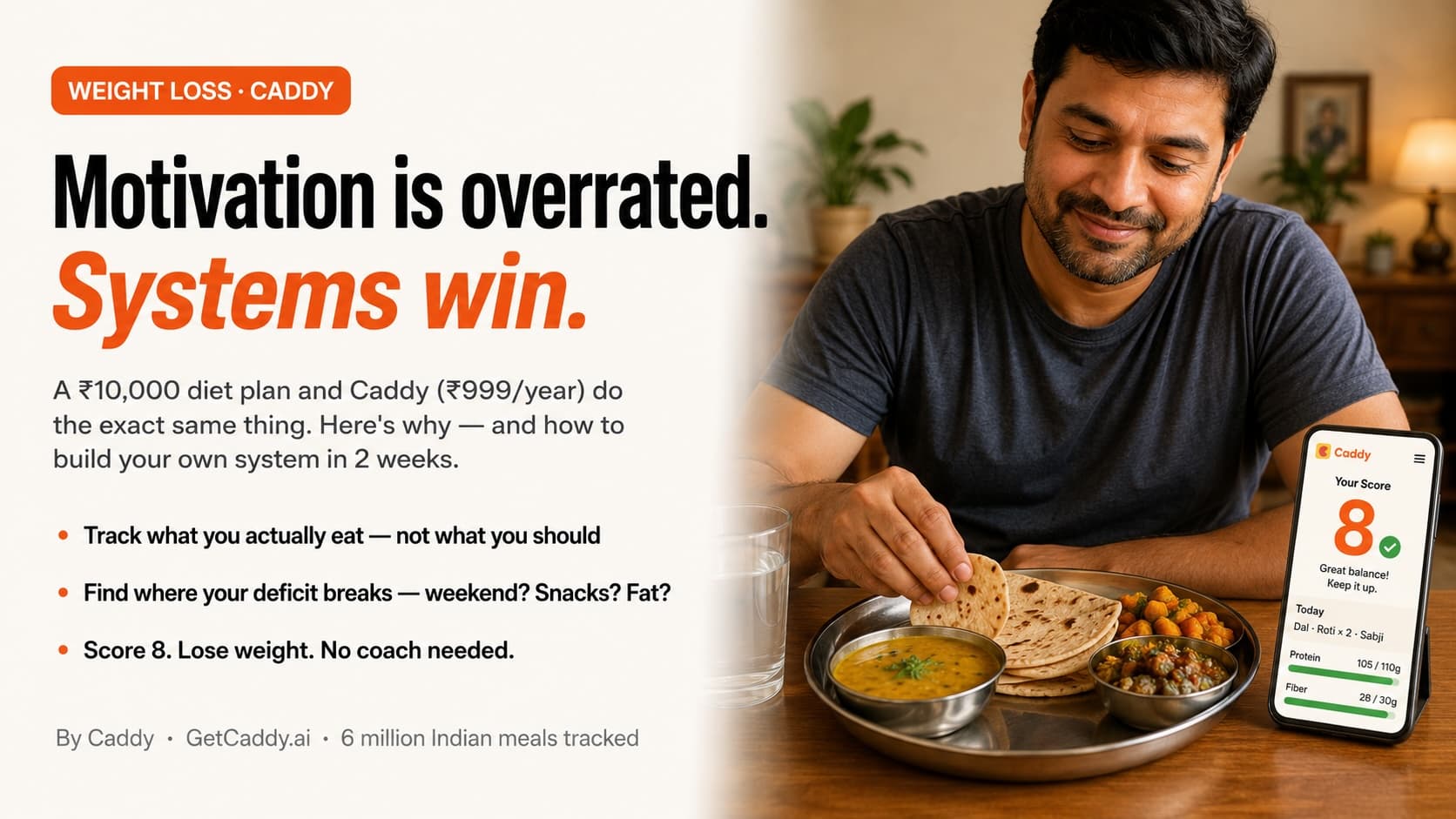
Caddy's Score 8 mechanism is the daily check-in the system runs on. Every day, your eating generates a score out of 10. Score 8 means you're in calorie deficit. That's the signal you're looking for.
Not a perfect diet. Not a restricted food list. Not a coach's approval. One number, daily, that tells you whether the system is working.
The ₹10,000 coach gives you a plan and accountability. The system gives you understanding. Understanding is what scales. Understanding is what stays when the motivation is gone, when the coaching program ends, when life gets complicated.
Build the system. Score 8. Lose weight. That's it.
GetCaddy.ai — India's smartest weight loss companion, built for Indian food.

Frequently Asked Questions
- 1. Is motivation really not important for weight loss?
- Motivation helps you start, but it is a poor engine for sustaining weight loss over weeks and months. Research on behaviour change consistently shows that motivation fluctuates and declines regardless of how committed someone feels at the beginning. What sustains weight loss is a system — specific defaults built around your real food and real patterns — that works even on days when you feel nothing in particular.
- 2. How long should I track before making any changes to my diet?
- Two to three weeks of honest tracking before making any changes gives you a statistically meaningful picture of your actual eating patterns. Tracking for less than this captures too much noise and too little signal — the data will reflect an unusual week rather than your real life. The goal is to understand your eating life first, then make targeted adjustments.
- 3. Why do my weekday efforts not seem to produce results?
- The most common reason is weekend eating. A 400-calorie daily deficit across five weekdays — a total of 2,000 calories — can be completely erased by two days of social eating, restaurant meals, or simply relaxed portions. When tracked honestly, most people discover their net weekly deficit is close to zero. The fix is not perfect weekends — it is awareness of the pattern and one or two specific weekend adjustments.
- 4. I eat healthy Indian home food. Why am I still not losing weight?
- Healthy Indian food is not automatically low in calories. Ghee, cooking oil across multiple preparations, nuts, paneer, and full-fat dairy are all nutritious foods that are also calorie-dense. Dietary tracking studies consistently show that people significantly underestimate calories from added fats and cooking methods. Tracking accurately for 2–3 weeks almost always identifies where the hidden calories are coming from in your specific diet.
- 5. Does protein actually matter that much during weight loss?
- Yes — significantly. Higher protein intake during a calorie deficit preserves lean muscle mass that would otherwise be lost alongside fat, increases satiety so the deficit feels more manageable, and raises the thermic effect of eating — meaning your body burns more calories digesting protein than it does digesting fat or carbohydrates. Most Indian diets are protein-light, which makes the deficit harder to sustain and results in a higher proportion of muscle loss relative to fat loss.
Get Caddy
Your simplest way to eat smarter with Indian food
Download