
Maida vs Whole Wheat: What Culinary Science Knew That Fad Diets Forgot
Written by Rishi Bhojnagarwala
Nutrition Reviewed by Dr. Hetal Pal, PhD in Nutrition Science
Maida is villainized. Atta is sainted. Neither claim survives contact with how either flour is actually used.
Two Flours, Two Jobs
Maida and atta aren't competing products. They're different tools, built for different jobs, by centuries of culinary practice that had nothing to do with calorie counting.
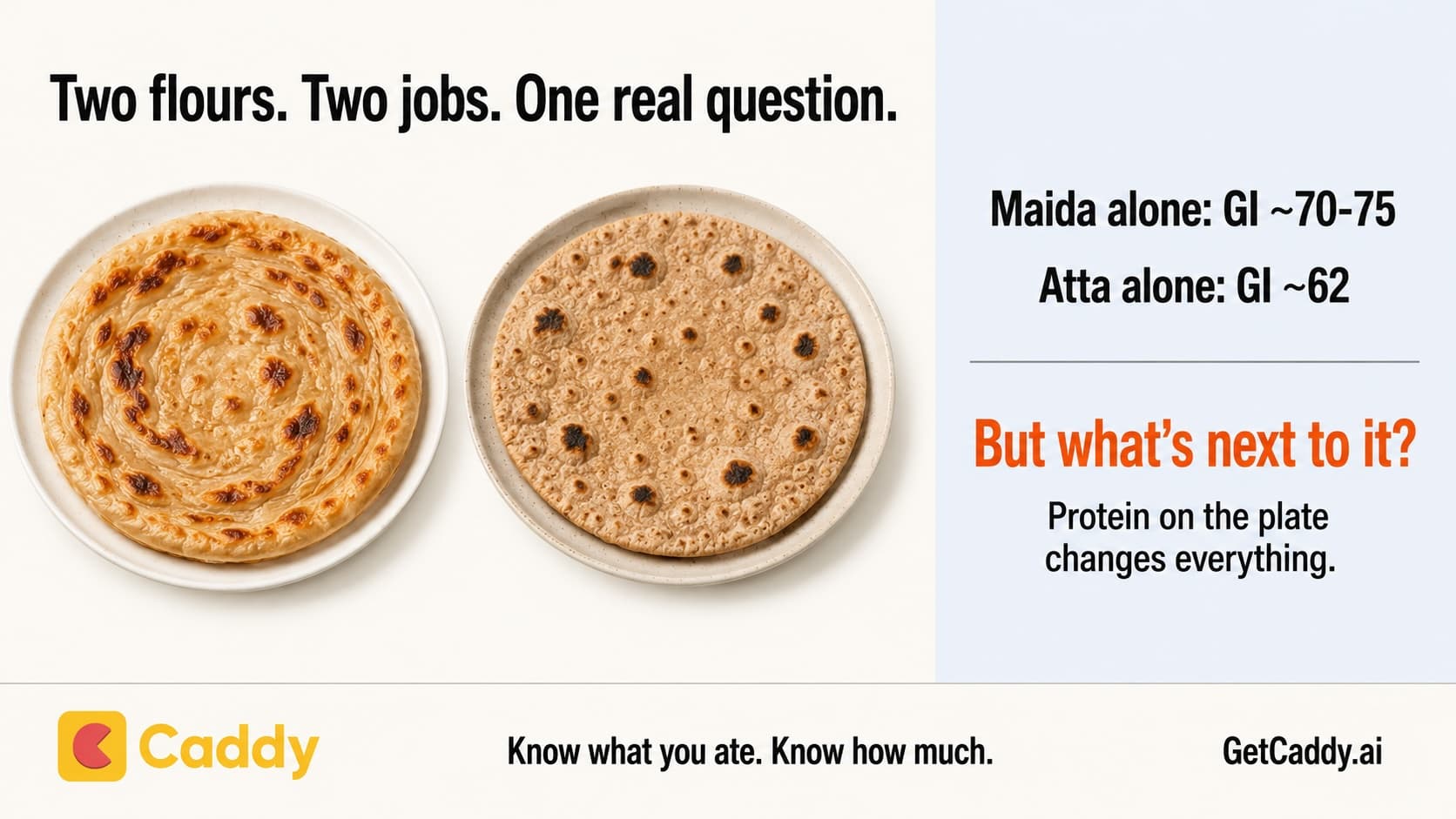
Maida is wheat flour stripped of its bran and germ — pure starch and gluten. That composition is exactly why it produces flaky parathas, crisp bhature, and soft pastries: there's no fibrous bran interrupting the gluten network as it stretches and traps air. Atta keeps the bran intact, which is exactly why it produces a roti that's denser, nuttier, and sturdy enough to eat daily without feeling like a treat.
Culinary tradition picked maida for texture-sensitive frying and baking, and atta for everyday flatbread, long before anyone had a glycemic index chart to consult. The "fad" version of this story collapses two ingredients with different jobs into a single morality tale — one flour good, one flour bad — and loses the actual reason both exist.

The "Whole Wheat Fried" Trap
Here's where the fad logic actively misleads people. Swap whole wheat flour into a recipe built for maida — a whole wheat bhatura, a whole wheat samosa — and the dish gets relabeled "healthier," because atta carries that reputation.
It's worth being precise about a related claim that gets repeated often: that whole wheat absorbs meaningfully more oil than maida during frying, making the "healthy" version secretly worse. The actual food science here is genuinely mixed. A peer-reviewed review of oil absorption mechanisms found that higher protein content promotes a tighter gluten network that reduces oil uptake, and that adequate dietary fibre can also reduce oil absorption by improving structure. A separate measured study found refined wheat flour — low in protein and fibre, mostly starch and gluten — absorbed considerably more oil than flours rich in protein and fibre. If anything, the directional evidence leans toward maida absorbing comparable or even more oil in some contexts, not less.
So the "whole wheat secretly absorbs more oil" claim doesn't hold up as a clean, confident fact. But there's a sharper, fully defensible point sitting right next to it: a deep-fried item is still deep-fried. Whichever flour technically absorbs marginally more or less oil, frying itself is what dominates the calorie and fat load of the finished dish — not an 8% fibre difference between two flours milled from the same grain. A whole wheat bhatura earns its health halo from the flour's name, while the cooking method does nearly all the actual caloric work, unaffected by which flour went in.
Other Places Fads Override Culinary Science
This pattern shows up well beyond flour.
Extra virgin olive oil in a hot kadhai. EVOO gets poured into Indian cooking for tadka because "olive oil is healthy" — but EVOO has a relatively low smoke point, suited to drizzling and low-heat Mediterranean use, not the high-heat frying common in Indian kitchens. Mustard oil, ghee, and refined groundnut oil were traditionally chosen here partly because their smoke points actually suit the cooking method. Heating an oil past its smoke point doesn't just waste the "health" benefit people are reaching for — it can degrade the oil itself.
"Multigrain" labeling. Multigrain sounds like an automatic fibre upgrade. In practice, a meaningful share of commercial "multigrain" atta and bread on the shelf is mostly refined maida with a handful of seeds or grains added for branding and texture, not nutritional substance. The label does the convincing; the ingredient panel tells a different story.
None of the ingredients in any of these examples are villains. The fad is the part where a single word — maida, multigrain, olive oil — gets to stand in for the whole picture, replacing an actual look at the dish.
Now, the GI Angle: Maida vs Roti, On Paper
Strip away the frying confusion, and there's a genuinely real, well-supported difference between these two flours: glycemic index. Whole wheat roti tests in the medium-GI range, generally cited between 52 and 62 depending on the study. Maida-based flatbreads test considerably higher — naan comes in around 71, and other maida-based flatbreads sit in a similarly high range. On this specific measure, tested alone, atta is the lower-GI choice. That part of the conventional wisdom holds up.

But Nobody Eats Flour Alone
Here's the question that conventional "maida bad, atta good" advice never asks: when do you ever eat maida, or atta, completely alone? As the only thing on the plate, with nothing else?
Never. So the more useful comparison isn't flour versus flour — it's meal versus meal.
Meal A: maida paratha with chole, or maida paratha with chicken curry. Chickpeas carry a glycemic index of around 30, and bring substantial protein and fibre with them. Chicken carries essentially zero carbohydrate. Either pairing brings real, meaningful protein to the table — and protein meaningfully blunts a carbohydrate's glucose response, with the effect scaling with the amount of protein added.
Meal B: whole wheat roti with aloo sabzi. Potato is one of the higher-GI foods on any chart — around 78. Pair roti with potato sabzi, and the meal stacks two carbohydrate-heavy, glucose-raising foods together, with comparatively little protein in the mix to do any blunting work.
It's worth being precise about what is and isn't proven here: no published study has tested "maida paratha with chole" head-to-head against "roti with aloo sabzi" and reported an exact comparative number. What's being applied is the well-established, separately verified mechanism — protein meaningfully blunting a carbohydrate's glycemic impact — extended logically to a familiar Indian meal pairing, not a statistic pulled from a specific trial measuring these two exact combinations.
With that caveat in place, the direction is solid: the "scarier" maida paratha, paired with real protein, can plausibly land at a lower overall meal glycemic impact than the "safer" whole wheat roti, paired with another starchy carbohydrate and little protein.
The Actual Takeaway
Stop sorting meals by which flour sounds scarier. The flour you started with explains a fraction of a meal's actual impact — what's sitting next to it on the plate usually explains more.
This holds across both halves of this piece. Frying decides a fried dish's calorie load far more than which flour went into the dough. Protein decides a carb-heavy meal's glycemic impact far more than which flour the carb came from. In both cases, the headline ingredient gets blamed or praised for outcomes mostly driven by something else entirely.
If You're on a GLP-1
This matters more, not less, if you're managing your eating on a GLP-1 medication. Appetite is already reduced, which means every bite needs to do real nutritional work. A smaller plate that pairs a carbohydrate with genuine protein — chole, chicken, paneer, dal — is doing considerably more for you than the same smaller plate built around flour choice alone.
How Caddy Fits Into This
This is exactly the kind of complexity Caddy is built to skip past. Instead of asking you to track which flour is "safer," calculate glycemic index, or remember which pairings blunt which spikes, Caddy works off one mechanic: take a picture of your plate, and get your Score out of 10.
Score 8 means you're in a calorie deficit — true whether tonight's roti is maida or atta, fried or not, paired with chole, chicken, or aloo sabzi. Built specifically around Indian meals, at under ₹83/month, Caddy replaces the flour war with the one number that actually predicts the outcome.
You don't need to pick a side between maida and atta. You need to look at the whole plate — and that's a much simpler problem to solve than refighting a flour war that was never really about flour.
Know what you ate. Know how much.
Score 8. Lose weight. That's it.
GetCaddy.ai
Sources
[1] A review of reducing oil absorption in flour-based fried foods using wheat protein, starch, and dietary fiber: mechanisms and applications. ScienceDirect. https://www.sciencedirect.com/science/article/abs/pii/S014181302505545X
[2] Influence of flour type on physico-chemical characteristics during deep frying. PMC. https://pmc.ncbi.nlm.nih.gov/articles/PMC6582034/
[3] International Tables of Glycemic Index and Glycemic Load Values: 2021 (systematic review). American Journal of Clinical Nutrition. https://www.sciencedirect.com/science/article/pii/S0002916522004944
[4] The Effect of Adding Protein to a Carbohydrate Meal on Postprandial Glucose and Insulin Responses: A Systematic Review and Meta-Analysis of Acute Controlled Feeding Trials. PubMed, 2024. https://pubmed.ncbi.nlm.nih.gov/39019167/
Frequently Asked Questions
- Is maida really bad for your health?
- Not inherently. Maida's downside comes from how it's typically used — deep-fried, or eaten in low-protein meals — not from the flour itself. The cooking method and what's on your plate alongside it matter more than the flour choice.
- Which has a lower glycemic index, roti or naan?
- Roti, on average. Whole wheat roti tests around 52–62 on the glycemic index, while maida-based naan tests higher, around 71. But GI measures the flour eaten alone — what you pair it with changes the real-world impact.
- Does whole wheat flour absorb less oil than maida when fried?
- Not necessarily. Research on frying shows flours higher in protein and fibre tend to absorb less oil due to a tighter gluten network, and maida is comparatively low in both. A whole wheat bhatura isn't automatically lower-oil than a maida one — frying itself still drives most of the calorie load.
- Is "multigrain" bread or atta actually healthier?
- Only if the ingredient list backs it up. Many multigrain products on Indian shelves are mostly refined maida with a few added seeds for branding, not meaningfully higher in fibre. Check the ingredient panel, not the front-of-pack label.
- Does protein really lower a meal's glycemic impact?
- Yes — this is well established. Adding protein to a carbohydrate meal reduces the glucose spike, with the effect scaling with how much protein is added, shown across a 2024 meta-analysis of 154 controlled feeding trials. Pairing a carb with real protein — dal, paneer, chicken, eggs — does more for blood sugar than swapping which flour the carb came from.
- Is a maida paratha with chole worse than a roti with aloo sabzi?
- Not necessarily. Chole brings protein and fibre that blunt the meal's glycemic impact, while potato is itself high-GI (~78) with little protein to offset it. The pairing can matter more than the flour choice.
Get Caddy
Your simplest way to eat smarter with Indian food
Download