
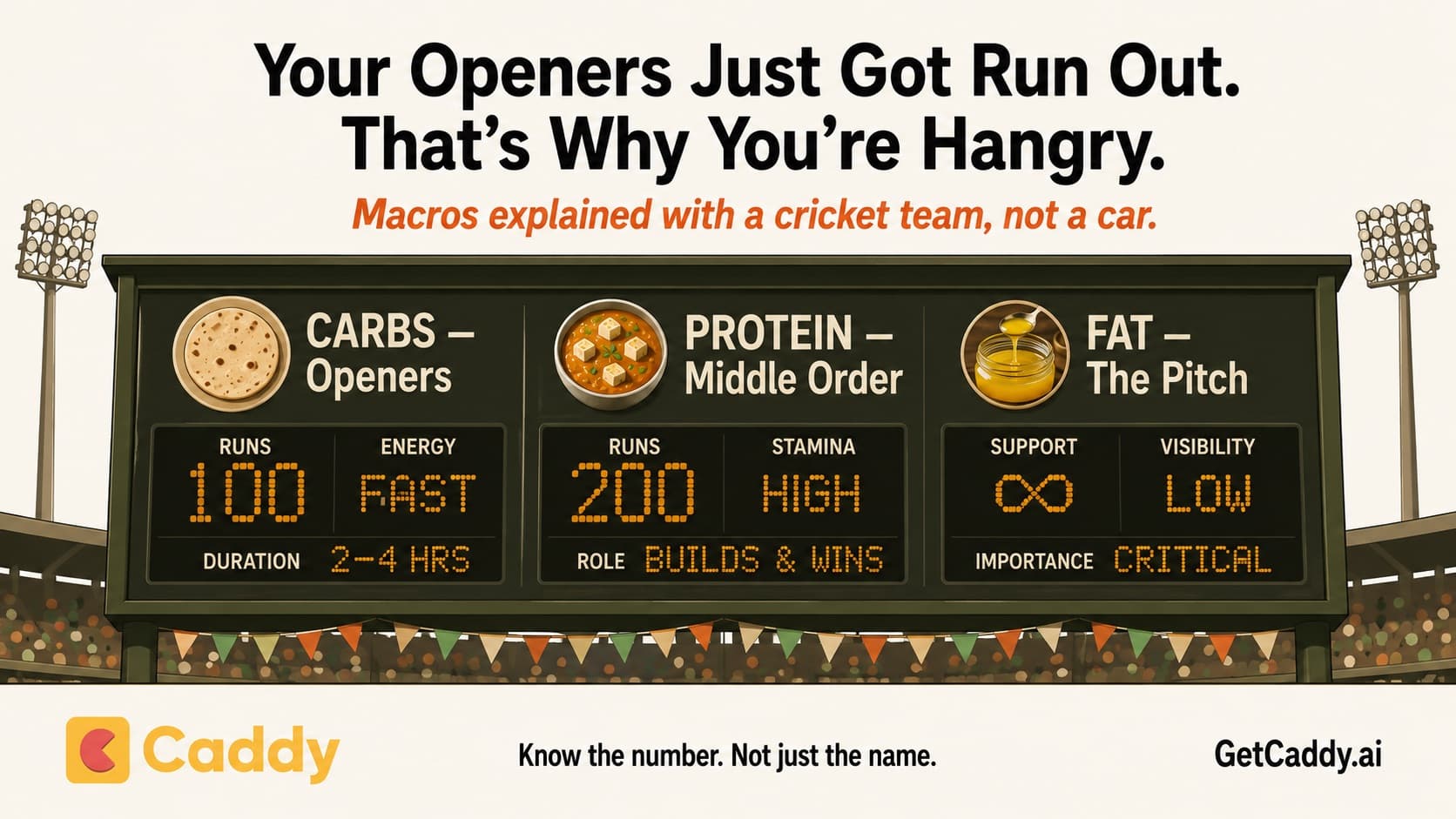
Your Openers Just Got Run Out. That's Why You're Hangry.
Written by Rishi Bhojnagarwala
Nutrition Reviewed by Dr. Hetal Pal, PhD in Nutrition Science
Every nutrition explainer on the internet uses the same metaphor: carbs are the fuel, protein is the repair crew, fat is the lubricant, your body is a car. It's not wrong. It's also been said fifteen thousand times and explains nothing about why you feel the way you feel.
Here's a better one. Your body isn't a car. It's a cricket team.
Carbs Are Your Openers
Carbohydrates are broken down into glucose, and glucose is your body and brain's preferred, fastest-access fuel source — the body stores a working supply of it as glycogen in the liver and muscles specifically because it needs to be available immediately, not slowly assembled.
That's your opening batsmen. Fast, aggressive, gets the innings moving the second it starts. And exactly like an opening partnership, it doesn't last the full match — glycogen stores are limited, and once they're drawn down, energy availability drops with them.
This is the actual mechanism behind "no carbs = hangry." It's not a personality flaw. Your openers got run out early, and now there's nobody at the crease generating quick runs. Your brain, which relies heavily on glucose, notices immediately — which is why low-carb irritability is such a widely reported, entirely real phenomenon, not an excuse.

Protein Is Your Middle Order
Protein doesn't do the flashy part. It doesn't show up on a highlights reel. What it does is build and repair the actual structure of the innings — your muscle tissue, primarily, along with enzymes, antibodies, and the hormones your body runs on.
It's also, gram for gram, the most filling of the three macronutrients. Research ranking common foods by how full they keep you per calorie — the landmark Holt et al. satiety index study — found protein content positively correlated with fullness, while fat content was negatively correlated, a meaningful margin in the opposite direction. That's the middle order doing its job — not spectacular, but it's what actually wins you the match, long after the openers are gone.
Fat Is the Pitch
Nobody thinks about the pitch until it's a disaster. Same with fat — it gets blamed constantly and understood rarely.
Dietary fat helps your body absorb vitamins A, D, E, and K, and supports skin and hair health — but that hair-and-skin benefit is a side effect, not the headline. The actual job is more structural: fat supplies essential fatty acids your body cannot manufacture on its own, and it's foundational to hormone production. Skip it entirely, and the pitch — the thing the entire match depends on — starts falling apart in ways that don't show up immediately but absolutely show up eventually.
This doesn't mean "eat unlimited fat." It means treating it as necessary infrastructure, not an optional extra you can zero out because a headline told you to.

The Twist Nobody Mentions
Here's the detail that changes how you should actually think about your day-to-day eating: your body has no protein storage tank.
Carbohydrate gets stored as glycogen. Fat gets stored as, well, fat. Protein has no equivalent dedicated reserve — your body doesn't maintain an official protein bank to draw from later. Amino acids not immediately used get converted into glucose or fat instead of being banked for a rainy day.
Practically, this means a low-protein day isn't something you can quietly make up tomorrow the way you might tell yourself you'll "catch up on calories." Today's shortfall is today's shortfall. There's no bench player warming up.
Lisa Spriet, MSc, RD, Co-Owner of NutriProCan Dietitians, sees the real-world cost of this play out in her practice: "Consistently inadequate protein can make it more difficult to maintain lean muscle mass, particularly when someone is intentionally losing weight. Even when someone is eating an appropriate number of calories, insufficient protein can make it harder to maintain muscle and may leave them less satisfied between meals. This becomes especially important as we age or when someone is losing weight more rapidly."
Why "Just Eat Chicken Breast All Day" Isn't the Flex You Think It Is
This is the classic overcorrection — someone learns protein matters, decides more is unambiguously better, and builds an entire diet around plain chicken breast.
The problem isn't the chicken. It's the absence of everything else. No fibre. No carbohydrate to fuel the muscle you're supposedly building. Missing a meaningful share of the vitamins and minerals your body needs to actually use that protein for repair in the first place. It's like fielding a team of eleven middle-order batsmen and wondering why nobody's scoring quickly and nobody's bowling.
Balance isn't a soft, feel-good suggestion in nutrition content. It's the literal mechanism by which any of these three macronutrients does its job properly.
What This Means for How You Actually Eat
If you're tracking total calories and ignoring macros, you're watching the scoreboard without knowing who's actually batting. The number can look fine while the composition underneath it is quietly working against you — too little protein to preserve muscle in a deficit, too little fat to keep your hormones functioning, or carbs so low your brain is running on fumes by 4pm.
As Ilana Schachter, RDN, a registered dietitian and nutritionist for Consumer Health Digest, puts it: "One of the biggest mistakes I see is treating calories as the only number that matters. Someone can technically stay within their calorie target while eating relatively little protein and fiber and a large proportion of highly refined carbohydrates — they may lose weight, but they may also feel hungrier between meals and have a harder time maintaining muscle mass. That said, the goal isn't to make every meal mathematically perfect. I encourage people to prioritize adequate protein and fiber, include unsaturated fats, and choose mostly minimally processed carbohydrate sources — while still leaving room for foods they enjoy."
A plate that works has grains, vegetables, a real protein source, and yes, some fat — not because "balance" is a nice word, but because each of the three is doing a job the other two can't do for it.

Making This Work on an Indian Plate
None of this means rice or roti needs to come off the plate. Schachter's practical approach: "Rice and roti don't need to be removed from the meal. Instead, I'd look at what protein source can be added or increased alongside them — dal, chana, rajma, yogurt, paneer, eggs, chicken, or fish. I often recommend thinking of the plate as a combination of carbohydrate + protein + vegetables/fiber + some fat, rather than viewing rice or roti as something to avoid. For vegetarian clients especially, it's worth being intentional about protein, since some traditional meals provide plenty of carbohydrate but less protein than the person realizes."
Spriet makes the same point from her own practice: she doesn't recommend taking rice or roti off the plate simply because they're carbohydrates — instead, she looks at what can be added around them, since increasing protein and vegetables can make a familiar meal more balanced without asking someone to change the way they eat.
As Spriet puts it: "In my experience, the most sustainable changes are rarely about making a diet more restrictive. They're about helping people build meals that are satisfying, nutritionally balanced and culturally familiar, so the changes can actually become part of their everyday lives."
About Caddy
We turned all of this into one number. Score 8 on Caddy means your calories are in deficit and your protein and fibre are in the right range — the macro balance is already built into the score, so you're not doing separate math for calories and composition. Track your plate, hit 8 consistently, and the openers, the middle order, and the pitch are all covered without you needing to think about any of them individually.
Visit GetCaddy.ai
Sources
Frequently Asked Questions
- Why do I get hangry when I cut carbs?
- Carbohydrates break down into glucose, your body and brain's fastest-access fuel source. When carb intake drops, glucose availability drops with it, which your brain registers quickly — irritability and low mood are a well-documented, real response, not just a lack of willpower.
- Does the body store extra protein for later use?
- No. Unlike carbohydrate (stored as glycogen) and fat (stored as body fat), protein has no dedicated storage reserve. Amino acids not used immediately are converted into glucose or fat rather than banked, which is why consistent daily protein intake matters more than people assume.
- Is it enough to just eat a lot of chicken breast for protein?
- Not on its own. A diet built around chicken breast alone is typically low in fibre and carbohydrate, and can miss out on micronutrients that support how your body actually uses that protein. Protein needs to sit alongside a balanced plate, not replace it.
- What does dietary fat actually do besides add calories?
- Fat supplies essential fatty acids your body can't produce itself, supports hormone production, and helps you absorb fat-soluble vitamins A, D, E, and K. Skin and hair benefits are a downstream effect of these processes working properly, not the primary function.
- Do I need to track macros separately from calories?
- It helps. Two days with identical calorie totals can look very different depending on protein, fat, and carb composition — which affects fullness, muscle maintenance, and energy levels. Caddy's Score 8 factors in protein and fibre alongside your calorie deficit, so you get the macro balance without tracking it manually.
Score 8 to lose weight
Your simplest way to eat smarter with Indian food
Get Caddy