
Ego vs. Ecosystem: Why India's Health Experts Are Making You Sicker
Written by Rishi Bhojnagarwala
Medically Reviewed by Dr. Hetal Pal, PhD in Nutrition Science
The biggest threat to your health in 2026 isn't a disease. It's the war between the people who are supposed to help you fight it.
The War You Didn't Ask to Be In the Middle Of
Open any health-focused social media feed in India today and within sixty seconds you will encounter a contradiction.
A fitness coach with 1.4 million followers explaining why GLP-1 medications like Ozempic and Mounjaro will destroy your muscle mass and make you dependent on a needle for life. Scroll down. A doctor with equal credentials and equal followers explaining why GLP-1 medications are a landmark breakthrough in metabolic medicine and why delaying them costs lives. Scroll further. A nutritionist telling you that both of them are missing the point and that without a proper meal plan, nothing will work. And somewhere in the mix, an Ayurveda practitioner asking why we are medicating a problem that proper lifestyle and herbal protocols have addressed for thousands of years.
Same topic. Four completely opposing positions. All delivered with complete conviction, clinical vocabulary, and the social proof of massive followings.
Now you — the person who just wants to lose weight, manage their blood sugar, and feel better in their body — are supposed to make a decision.
This is not a car buying decision where picking the wrong option costs you money. This is your metabolism. Your hormones. Your next decade of health. And the people most qualified to guide you are too busy debunking each other to actually help you.
The Root Cause Nobody in the Industry Wants to Name
This is not fundamentally a scientific disagreement. Scientific disagreements are healthy, necessary, and ultimately self-correcting through evidence.
What is happening across India's health and wellness content ecosystem is something more corrosive. It is professional insecurity dressed up as concern for public health.
When a fitness coach makes a viral reel warning their audience that GLP-1 medications will make them weak and dependent, the subtext is rarely purely clinical. It is: if you go on medication, you don't need my training programme. When a nutritionist insists that Ayurveda has no evidence base, the subtext is rarely purely scientific. It is: my credential system is more legitimate than theirs, and therefore my consultation is more valuable.
This is what can be called the Ego vs. Ecosystem problem.
In health technology, there is constant conversation about the interoperability of data — systems communicating seamlessly, records flowing between providers, APIs connecting platforms to create a complete picture of a patient's health. It is considered a foundational requirement for modern healthcare.
But there is almost no conversation about the interoperability of expertise.
A doctor, a nutritionist, a certified fitness coach, and an Ayurveda practitioner are not four competitors fighting for the same customer. They are four different instruments in the same orchestra. A patient managing Type 2 diabetes while navigating a GLP-1 protocol, restructuring their diet, rebuilding their relationship with exercise, and managing stress does not need one of these professionals. They need all of them — coordinated, communicating, and working from a shared understanding of that patient's goals and history.
Instead, what most Indians get is four separate performances, each optimised for engagement, each subtly designed to make the others look inadequate.
What Analysis Paralysis Actually Costs
The term analysis paralysis sounds almost benign — like a productivity problem, the kind of thing that makes you spend too long choosing a Netflix show.
In health, it is not benign. It is dangerous.
When a person spends six months consuming contradictory content about whether they should try a GLP-1 medication, they spend six months in a state of metabolic decline that could have been addressed. When someone abandons a nutritionist-guided protocol because a fitness influencer told them it was wrong, and then abandons the fitness programme because a doctor said it was insufficient without medication, and then avoids medication because an Ayurveda practitioner said it was unnatural — they are not making an informed choice. They are being paralysed by the noise of professionals who prioritised their narrative over their patient's outcome.
The stakes in India are not abstract. The ICMR–INDIAB study, one of the largest dietary surveys ever conducted in this country, found that 83% of Indian adults have at least one metabolic risk factor. India has the second largest diabetic population in the world. Prediabetes prevalence is climbing steeply in urban populations. The window for intervention — the period where lifestyle, nutrition, and if necessary medication can genuinely reverse metabolic decline — is finite.
Every month a person spends in analysis paralysis because their health feed is a warzone is a month of that window closing.
The Protein Wars: A Case Study in Expert Fragmentation
Take one of the most basic questions in nutrition: how much protein should an adult Indian eat per day?
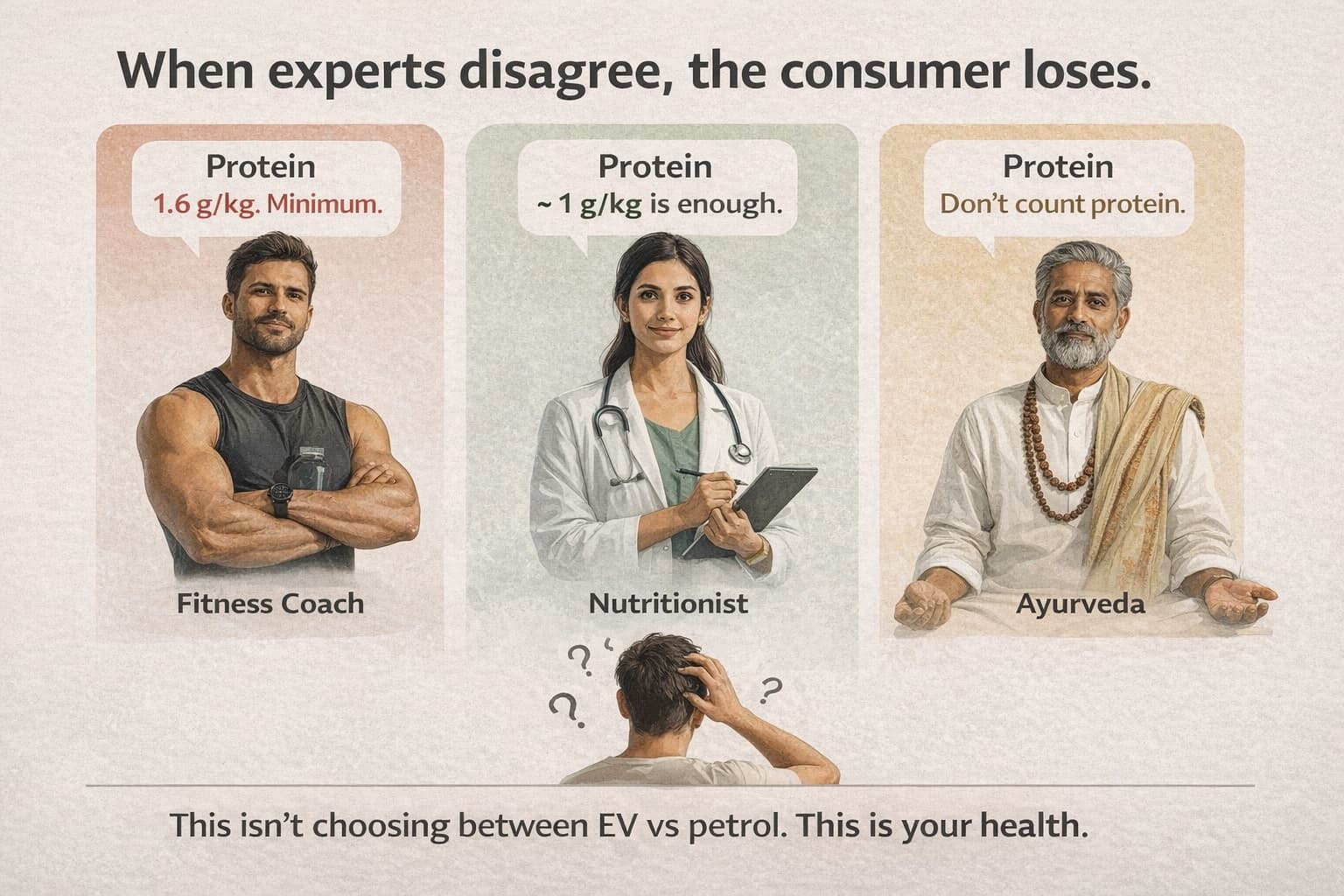
A fitness coach will tell you 1.6 grams per kilogram of body weight, citing muscle protein synthesis research and the anabolic benefits of higher protein intake. A clinical nutritionist will recommend closer to 1 gram per kilogram, citing population-level dietary guidelines and the risks of excess protein for individuals with kidney concerns. An Ayurveda practitioner will tell you to stop counting macronutrients entirely and eat according to your prakriti, season, and digestive capacity.
Each of these positions has a legitimate evidence base within its own framework. Each practitioner is drawing on real knowledge and real experience. The problem is not that they disagree. The problem is that their disagreement is performed publicly, at scale, with the implicit message that the other positions are not just different but dangerous.
The Indian consumer watching this unfold does not have the clinical training to evaluate which framework applies to their specific situation. They have a body, a set of symptoms, a lifestyle, and a desperate need for coherent guidance. What they receive instead is a turf war.

The GLP-1 Battlefield
Nowhere is this more visible — or more consequential — than in the discourse around GLP-1 receptor agonists in India.
Medications like Ozempic, Wegovy, and Mounjaro represent arguably the most significant shift in metabolic medicine in a generation. Their efficacy for weight loss and Type 2 diabetes management is supported by some of the largest and most rigorous clinical trials in pharmaceutical history. For the right patient, with the right diagnosis, under proper medical supervision, they can be genuinely life-changing.
And yet the content ecosystem around GLP-1s in India looks like this:
Endocrinologists and metabolic physicians — many of whom have seen dramatic improvements in their patients' health markers — advocate carefully for appropriate use under supervision. Fitness professionals — many of whom have built their entire business model around the premise that discipline and training are the only legitimate path to body transformation — warn loudly that GLP-1s are a shortcut that will cost you muscle, metabolism, and long-term health. Nutritionists position themselves as the essential bridge, insisting that medication without dietary guidance is incomplete at best and harmful at worst. Ayurveda practitioners, whose framework does not yet have a coherent position on a drug class that did not exist in classical texts, respond with varying degrees of scepticism.
Each of these voices reaches hundreds of thousands of Indians who are trying to make a serious health decision. Each voice is optimised for its own platform, its own audience, its own business model.
The patient in the middle is not served by this. They are confused by it.
The Business Case for Collaboration That Nobody Is Making
Here is the argument that should end this war but somehow never gets made.
There are over 8 billion people on this planet. The majority of them are metabolically struggling in some form — whether through obesity, diabetes, prediabetes, cardiovascular disease, or the chronic low-grade dysfunction that precedes all of these. In India alone, hundreds of millions of people need meaningful, sustained, personalised health support that they are currently not receiving.
There is not a scarcity of patients. There is a scarcity of good outcomes.
A fitness coach who refers a client to an endocrinologist for GLP-1 evaluation does not lose a client. They gain the trust of a client who now sees them as a genuine partner in their health rather than a service provider protecting their revenue. A nutritionist who acknowledges that Ayurvedic principles around digestive health have genuine merit does not dilute their credential. They expand their toolkit. A doctor who asks their patient about their fitness routine and refers them to a certified trainer does not abdicate clinical responsibility. They demonstrate that they understand health as a complete system.
Professional maturity in 2026 looks like a willingness to say: for this specific problem, you need someone else. Let me help you get there.
That sentence — said genuinely and acted upon — is the most powerful thing a health professional can do for their reputation, their patient outcomes, and ultimately their business. It is also, apparently, one of the rarest things in Indian health content today.
What the Consumer Deserves Instead
The person navigating India's health content landscape in 2026 deserves a few things that the current ecosystem is failing to provide.
They deserve clarity on what each type of professional is actually qualified and appropriate to address — and what falls outside that scope. They deserve a framework for evaluating conflicting advice that does not require a medical degree. They deserve a companion that connects the dots between their doctor's protocol, their nutritionist's guidance, their fitness approach, and their cultural food context — without having an agenda to protect.
They deserve to be treated as an intelligent adult who is capable of making good decisions when given coherent, honest, non-territorial information.
Most importantly, they deserve to have their health taken seriously as the genuinely complex, multi-dimensional, deeply personal challenge it is — not as a marketing opportunity for whichever professional tells the most convincing story.
Why Caddy Exists
Caddy was built in direct response to this problem.
Not as another expert voice in the war. Not as a platform that picks a side between modern medicine and traditional wisdom, between medication and lifestyle, between macros and mindful eating.
Caddy is the calm companion in the middle of the noise — built specifically for Indians, powered by one of India's most comprehensive food and nutrition databases, and designed to support people whether they are on a GLP-1 medication like Mounjaro or Ozempic, or approaching weight loss through nutrition and lifestyle alone.
The insight behind Caddy is simple: the consumer does not need another opinion. They need someone to help them navigate the opinions that already exist — to translate clinical guidance into daily decisions, to connect their doctor's protocol with their nutritionist's meal plan, to make Indian food work for their health goals rather than against them.
The ecosystem is broken. The war between health professionals is real, it is damaging, and it is unlikely to end on its own because the incentives that sustain it are too strong.
But the consumer does not have to be a casualty of it.
The Only Metric That Matters
There is one question worth asking of every health professional, influencer, coach, or practitioner whose content you consume:
When was the last time they referred their audience to someone in a different discipline — not because they had to, but because it was the right thing for the patient?
That answer tells you everything about whether their concern for your health is genuine or performed.
The real enemy is the disease. Not the professional in the next room.
Collaboration is not a threat to expertise. It is the only way expertise reaches its full value.
About Caddy Caddy is India's no-BS nutrition and weight loss companion, built for Indians on GLP-1 medications and anyone serious about sustainable weight loss. Caddy cuts through the noise of conflicting health advice and gives you guidance that is honest, practical, and designed around how Indians actually eat and live. Visit getcaddy.ai