
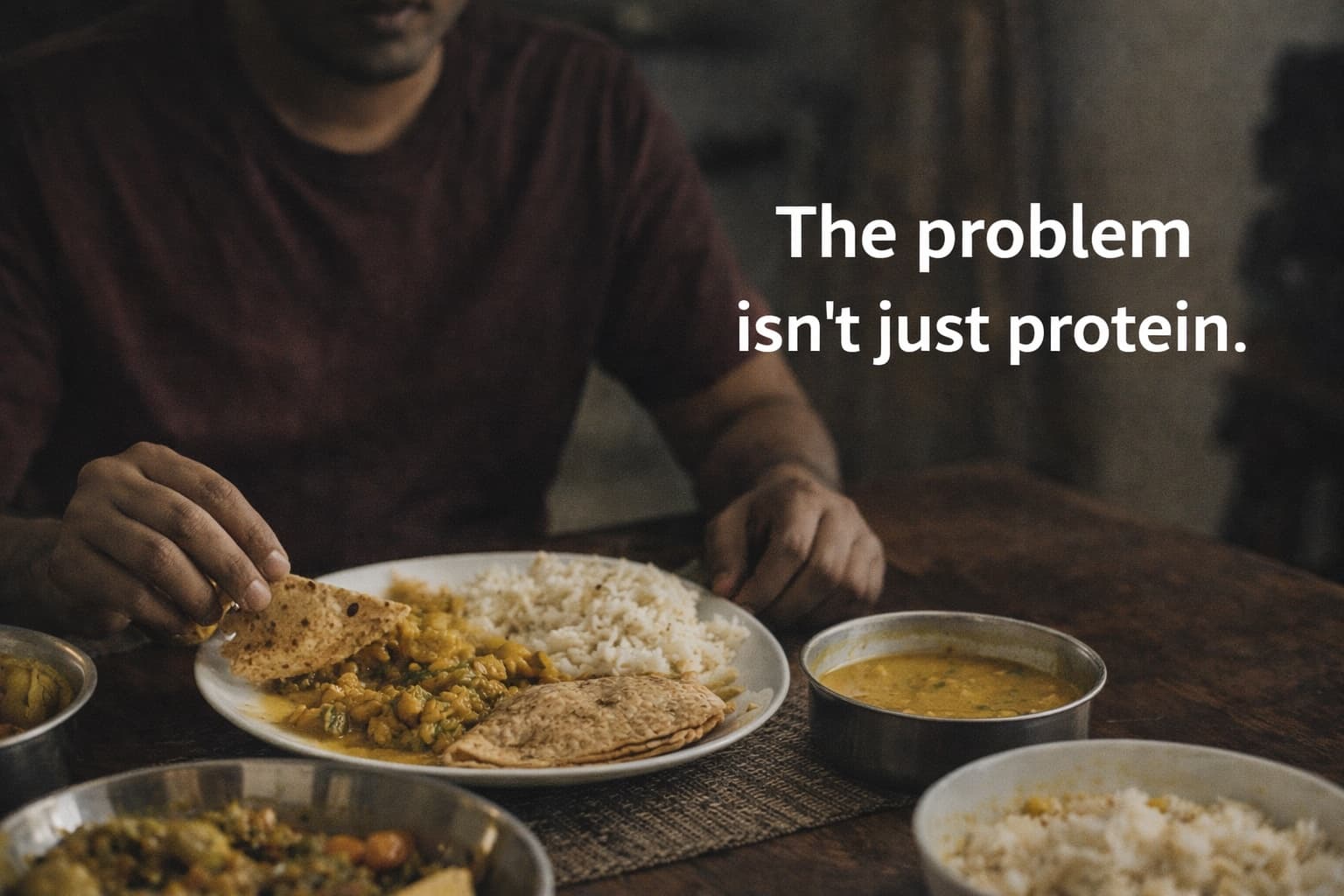
India's Diabetes Crisis Isn't Just a Protein Problem — It's an Overeating Problem
Written by Rishi Bhojnagarwala
Medically Reviewed by Dr. Hetal Pal, PhD in Nutrition Science
And a landmark government study may be pointing you in an incomplete direction.
The Study Everyone in Indian Health Is Talking About
In late 2025, the Indian Council of Medical Research published one of the most comprehensive dietary studies ever conducted in India. The ICMR–INDIAB survey covered 18,090 adults across 30 states, was published in Nature Medicine, and made headlines across the health and nutrition space.
The headline finding: Indians eat too many carbohydrates and not enough protein, and this is driving the country's Type 2 diabetes epidemic.
The recommendation: Replace a portion of carbohydrate calories with protein — specifically from plant sources, dairy, eggs, and fish — to lower diabetes and prediabetes risk.
On the surface, this sounds sensible. The data is real. The associations are statistically valid. The researchers are credible.
But the conclusion has a significant gap. And if you are an Indian trying to manage your weight, reverse prediabetes, or navigate life on a GLP-1 medication like Ozempic or Mounjaro, that gap matters enormously.
What the ICMR Study Actually Found
Before challenging the conclusion, it is worth understanding what the study genuinely established — because some of it is important and actionable.
The study found that Indians derive approximately 62% of their daily calories from carbohydrates, one of the highest rates in the world. The primary sources are white rice, milled whole grain flour used in chapati and roti, and added sugar. Protein intake sits at just 12% of daily energy — well below the national dietary guideline recommendation of 15%.
Perhaps more alarmingly, 83% of study participants had at least one metabolic risk factor — Type 2 diabetes, prediabetes, dyslipidaemia, obesity, or hypertension. That is not a statistic buried in a footnote. That is the metabolic reality of modern India.
The study also busted one popular myth worth highlighting: simply switching from white rice to whole wheat flour or millet flour — without reducing total carbohydrate quantity — showed no meaningful reduction in diabetes risk. The reason is that milling flour raises the glycemic index of whole grains to levels comparable to refined carbohydrates. Your chapati and your maida dosa are not as different metabolically as you might think.
These are valuable findings. They deserve attention.
The problem is what comes next.

Where the Conclusion Falls Short
The study's central policy recommendation is to replace carbohydrates with protein. Eat more dal. More paneer. More eggs. More fish. Fewer rotis. Less rice.
Here is the question the study does not answer: what if the quantity of food — total caloric intake — is a bigger driver of India's diabetes crisis than the ratio of protein to carbohydrate?
Consider this. The United States ranks in the top 10 globally for per capita protein consumption. Americans eat significantly more protein than Indians, by almost every metric. Yet the United States has a diabetes prevalence that rivals India's, and in several demographic groups, exceeds it.
If protein intake were the primary lever controlling diabetes risk, America should be winning. It is not winning. Not even close.
This does not mean protein is irrelevant. It means protein is one variable in a much more complex equation — and that equation has a factor that the ICMR study's conclusions quietly sidestep.

The Overeating Hypothesis Nobody Wants to Say Out Loud
Chronic caloric excess — eating more energy than your body requires, consistently, over years — is one of the most well-established drivers of insulin resistance in metabolic science. When your cells are perpetually flooded with more glucose than they can use, the insulin signalling pathway begins to break down. That is the biochemical foundation of Type 2 diabetes.
This is not a fringe theory. It is mainstream nutrition science.
The ICMR researchers did control for total energy intake in their statistical model. Their substitution analysis was isocaloric — meaning they mathematically modelled replacing carbohydrate calories with protein calories while holding total intake constant. That is methodologically appropriate for isolating a single variable.
But here is the disconnect: the policy conclusion — eat more protein — says nothing about eating less overall. You can follow the ICMR recommendation to the letter, double your protein intake, and still consume 500 excess calories a day. Your macronutrient ratio will look better on paper. Your insulin resistance may not budge.
Overeating is culturally normalised in India in ways that rarely get examined honestly. Second helpings are hospitality. Finishing your plate is respect. Festive eating is frequent and socially enforced. Portion sizes at home and in restaurants have expanded steadily over two decades. These are not footnotes. They are daily realities for hundreds of millions of people.
A government body recommending "eat more protein" without equally foregrounding "eat less overall" is an incomplete prescription. One could argue it is the more politically palatable prescription — because addressing overeating requires confronting food culture, subsidy structures, and behavioural habits in ways that recommending a nutrient swap does not.
What This Means If You Are on a GLP-1 Medication
This is where the conversation becomes directly relevant to anyone using Ozempic, Mounjaro, Wegovy, or any other GLP-1 receptor agonist for weight loss or diabetes management in India.
GLP-1 medications work primarily by suppressing appetite and slowing gastric emptying. They are, in essence, pharmaceutical tools that address the overeating problem directly. They make you feel full faster, stay full longer, and reduce the frequency and intensity of food cravings. For many patients, this is the first time in their lives that their relationship with hunger has felt manageable.
But GLP-1 medications create a new nutritional challenge that the ICMR study's protein recommendation becomes highly relevant to — just not in the way the study intended.
When you are eating significantly less food due to appetite suppression, the quality of every calorie you consume matters more than ever. If your reduced intake is still dominated by white rice, refined flour, and added sugar — the exact dietary pattern the ICMR study flags — you are compressing the same low-quality macronutrient profile into fewer calories. You lose weight. But you may also lose muscle mass, experience fatigue, and miss the metabolic benefits that adequate protein would provide.
On a GLP-1 medication, the ICMR protein recommendation makes sense — but for a completely different reason than the study implies. It is not that protein prevents diabetes by replacing carbohydrates in a vacuum. It is that when your total intake drops sharply, protecting muscle mass and satiety through adequate protein becomes critical.
This is a nuance that most generic dietary advice — including large-scale government studies — is not designed to address. It requires India-specific guidance that accounts for Indian food patterns, Indian portion norms, and the specific physiological context of GLP-1 use.
The Three Things Indians — GLP-1 Users or Not — Actually Need to Address
Based on the evidence, including but going beyond the ICMR study, here is what the data genuinely supports:
Total caloric intake matters more than macronutrient ratios in isolation. If you are overeating, reshuffling your macronutrients will have limited impact on your metabolic health. Addressing how much you eat is as important as addressing what you eat.
Carbohydrate quality and quantity both matter — but the form matters too. Switching from white rice to chapati is not the metabolic upgrade most Indians assume it to be. Truly reducing refined carbohydrate load means reducing total quantity, not just switching the grain. Intact whole grains, legumes, and vegetables are meaningfully different from milled flour products.
Protein adequacy becomes critical in a caloric deficit. Whether that deficit is self-imposed through dieting or medication-assisted through GLP-1s, eating enough protein protects muscle mass, supports satiety, and helps sustain weight loss. The ICMR's protein recommendation is valid — it just needs the right context to be actionable.
Why India Needs Nutrition Guidance Built for Indians
The ICMR study is valuable. It is the most comprehensive dietary dataset India has produced. But large population studies are designed to generate policy recommendations for the average — and you are not the average. You are navigating your specific food culture, your specific health history, your specific medication protocol, and your specific relationship with food.
Generic advice — whether from a government study or a global wellness brand — was not built for someone managing their weight on Mounjaro while trying to figure out how to make their dal and rice work for them rather than against them.
That is exactly the gap Caddy was built to close.
Caddy is a nutrition and lifestyle companion designed specifically for Indians — whether you are on a GLP-1 medication or approaching weight loss without one. Built on one of India's most comprehensive food nutrition databases, Caddy helps you understand your food in the context of your goals, your medication, and your reality — not a Western dietary template that has never heard of poha.
The Bottom Line
India's diabetes crisis is real. The ICMR data is sobering. But the solution is more complex than adding protein to a diet that already has a quantity problem.
The most honest thing the evidence points to is this: India has an overeating problem. A carbohydrate quality problem. And a protein adequacy problem. All three exist simultaneously. Solving only one of them — while ignoring the others — will move the needle less than the headlines suggest.
If you are serious about your metabolic health, the question is not just what to eat. It is how much, in what form, in what context, and with what support.
That is a harder question. But it is the right one.
About Caddy Caddy is India's no-BS nutrition and weight loss companion, built for Indians on GLP-1 medications and anyone serious about sustainable weight loss. Powered by a deep Indian food database and designed around Indian eating patterns, Caddy gives you guidance that actually fits your life. Visit getcaddy.ai