
Ice Cream vs Frozen Dessert: The Internet Is Wrong and the Labels Prove It
Written by Rishi Bhojnagarwala
Medically Reviewed by Dr. Hetal Pal, PhD in Nutrition Science
Millions of views. Zero label reading. Here is what the data actually shows.
The Viral Outrage Nobody Fact-Checked
Somewhere in the last few years, frozen desserts became the villain of Indian food Twitter, Instagram, and YouTube.
The narrative spread with the confidence and velocity that only health content on social media can achieve. Frozen desserts — products like Cornetto, Kwality Wall's, and similar — use palm oil instead of dairy cream. Palm oil is high in saturated fat. Therefore frozen desserts are dangerous. Therefore the brands making them are misleading consumers. Therefore you — health-conscious Indian adult — should choose real dairy ice cream instead.
This content got millions of views. It got shared in family WhatsApp groups. It convinced a genuinely significant number of people to change their purchasing decisions.
There is one problem.
Nobody making this content appears to have looked at the nutrition label of the dairy ice cream they were recommending as the alternative.
We did. And the data tells a story that is almost perfectly the opposite of the viral narrative.
What the Labels Actually Say
Let us start with the products at the centre of this debate and look at what their labels actually contain.
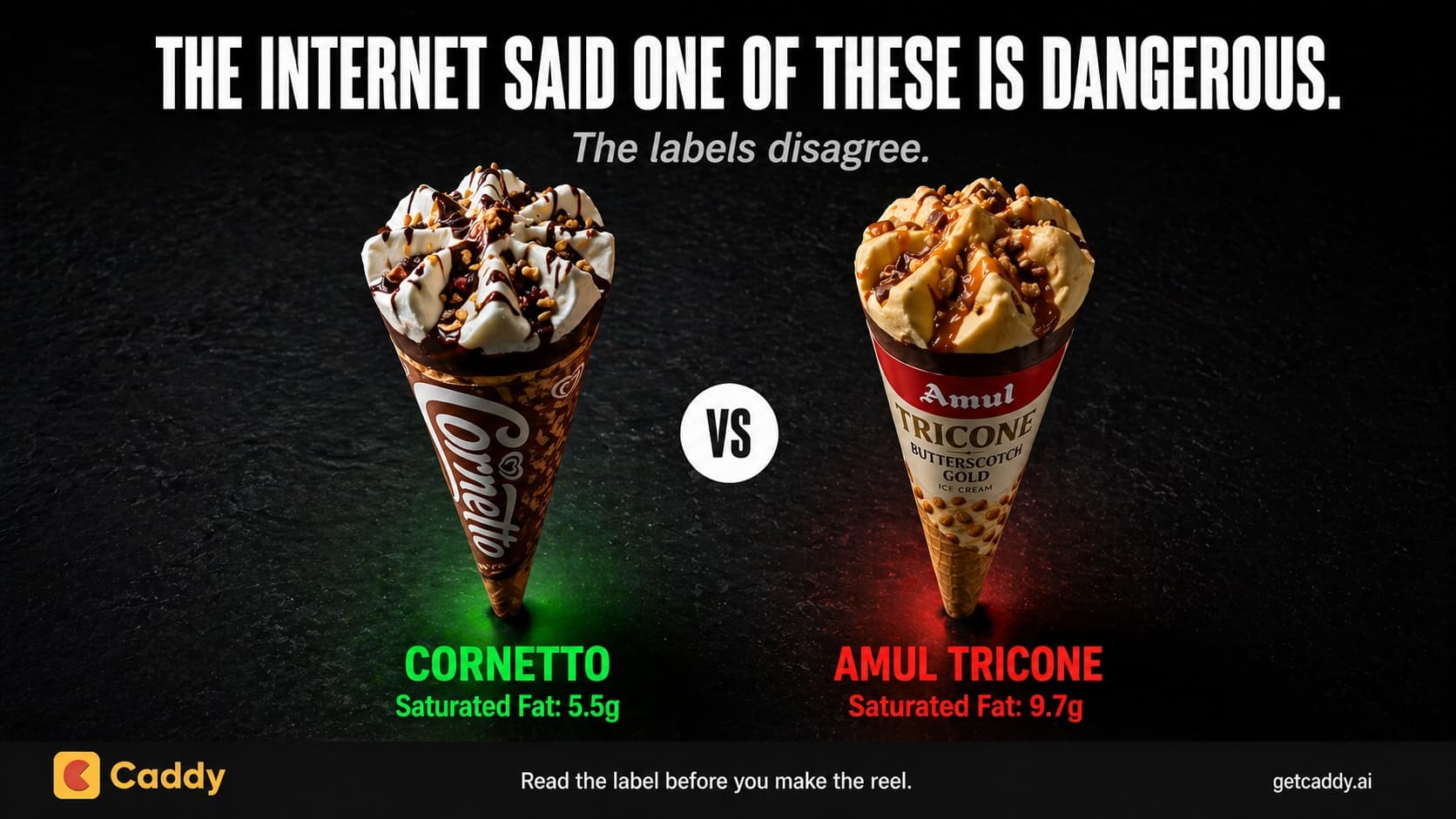
Cornetto frozen dessert cone — 72 gram serve: Calories: 250 kcal Protein: 3.2g Total carbohydrate: 31.3g Total sugars: 20.7g Added sugars: 17.1g Saturated fat: 5.5g Trans fat: 0.08g
Amul Tricone Butterscotch Gold — values scaled to 72 gram equivalent from per 100g data: Calories: approximately 239 kcal Protein: approximately 3.5g Total carbohydrate: approximately 23.7g Total sugars: approximately 12.8g Added sugars: approximately 12.8g Saturated fat: approximately 9.7g Trans fat: approximately 0.07g
Note: The Amul Tricone is sold as a 120ml product which is larger than the Cornetto serve, making it even more calorie and fat dense as a real-world consumption unit. The comparison above is deliberately scaled to the same 72 gram equivalent to give the fairest possible comparison — and the dairy ice cream still loses on saturated fat by a significant margin.
Now read those saturated fat numbers again.
The frozen dessert: 5.5 grams. The dairy ice cream: 9.7 grams.
The product being recommended as the healthier, safer alternative contains nearly double the saturated fat of the product being condemned.
The Palm Oil Argument Falls Apart Immediately
The central claim of the frozen dessert fear content is this: palm oil is high in saturated fat, therefore products containing palm oil are higher in saturated fat than products containing dairy cream, therefore dairy ice cream is better for your heart health.
The first part of that sentence is true. Palm oil is indeed high in saturated fat — approximately 50% saturated fat by composition.
The second and third parts of that sentence are demonstrably, measurably false — at least when applied to these specific products.
Dairy cream, which is the primary fat source in real ice cream, contains approximately 60 to 65% saturated fat by composition. It is more saturated than palm oil. Not marginally more. Meaningfully more.
When you translate this into actual product nutrition labels — which is the only number that matters for the person eating the product — the result is exactly what the data above shows. The dairy version ends up with significantly more saturated fat per serve than the palm oil version.
The influencers making this content compared palm oil in the abstract to dairy cream in the abstract, concluded that palm oil was worse, and stopped there. They did not check whether the formulation of the actual frozen dessert product resulted in higher saturated fat than the formulation of the actual dairy ice cream product.
It does not. By almost a factor of two, it does not.
The Protein Argument Is Even Weaker
A secondary claim in the frozen dessert versus ice cream content is that real dairy ice cream is superior because it contains protein — and that this protein content will reduce the glucose spike from the sugar in the product.
Let us examine this claim with the actual numbers.
Cornetto frozen dessert: 3.2 grams of protein per 72 gram serve. Amul Tricone dairy ice cream: approximately 3.5 grams of protein per 72 gram equivalent.
The difference is 0.3 grams of protein. In a product containing over 17 grams of added sugar.
The claim that 3.5 grams of protein meaningfully mitigates a glucose spike from 17 to 20 grams of added sugar is not supported by nutritional science. Protein does slow gastric emptying and can modestly reduce postprandial glucose response — but this effect is meaningful at protein quantities of 20 grams or more, not 3.5 grams, and certainly not the 0.3 gram difference between these two products.
The protein argument, presented as a meaningful health distinction between frozen desserts and dairy ice cream, is nutritionally irrelevant at the quantities present in either product.
Are the Brands Doing Anything Wrong?
This is an important question that the viral content rarely addresses directly, and it deserves a clear answer.
No. The brands selling frozen desserts in India are not committing fraud. They are not misleading consumers. They are not hiding anything.
Indian food labelling regulations require products to accurately state their ingredients and nutritional information. Frozen dessert products comply with these regulations. They correctly list their ingredients including vegetable fat or palm oil. They correctly label themselves as frozen desserts rather than ice cream — a distinction that Indian food law actually mandates, because products that do not use dairy fat as the primary fat source cannot legally call themselves ice cream.
In other words, the regulatory framework specifically exists to make this distinction clear to consumers. The brands are following it. The labels are accurate. The products are exactly what they say they are.
The moral panic is directed at products that are in complete compliance with Indian food safety law, based on nutritional claims that do not hold up when you look at the actual labels.
What Fear-Mongering Content Gets Wrong About Nutrition
The frozen dessert debate is a particularly clear example of a pattern that has become endemic in Indian health and nutrition content on social media.
A single ingredient — palm oil — is identified as problematic based on a general nutritional principle. That principle is applied selectively, without comparison to the alternative being recommended. The conclusion is stated with total confidence and amplified by social proof and sharing mechanics that reward alarm over accuracy. The audience, lacking easy access to comparative nutritional data, accepts the framing.
Nobody checks the label of the recommended alternative.
This pattern appears repeatedly in Indian nutrition content. It is how specific ingredients become villains without contextual comparison. It is how entire product categories get condemned based on abstract ingredient concerns rather than actual nutritional data. It is how people end up making food choices that are, on the actual nutritional evidence, the opposite of what the content told them they were doing.
The problem is not that the content creators are malicious. Most of them are genuinely trying to help their audience make better food choices. The problem is that they are working from incomplete information, applying it without comparative context, and reaching conclusions that the data does not support.
The solution is embarrassingly simple: read the label of both products before comparing them.
What Both Products Actually Are
Here is the honest nutritional summary of both products that the viral content never provides.
Both Cornetto frozen dessert and Amul Tricone dairy ice cream are desserts. Occasional treats. Neither is health food. Neither is a meaningful source of nutrients your body requires. Both contain significant quantities of added sugar — 17 grams and approximately 13 grams respectively — that make them unsuitable for frequent consumption regardless of which fat source they use.
The frozen dessert has less saturated fat. The dairy ice cream has marginally more protein. Neither difference is large enough to meaningfully change the health calculus of occasional dessert consumption.
If you eat either product once or twice a week as a treat within an otherwise reasonable dietary pattern, the difference between them is nutritionally trivial. If you eat either product daily in large quantities, neither the palm oil nor the dairy fat is your primary problem — the total caloric excess and sugar load is.
The decision about which to eat should be based on taste preference, price, and availability — not on viral content that got the nutritional comparison backwards.
How to Actually Read a Food Label
Since the core failure in this debate was label reading, it seems worth providing a brief practical guide to what actually matters on an Indian packaged food label.
Serving size: always check this first. Nutritional information is meaningless without knowing the serving size it refers to. The Amul Tricone label gives values per 100 grams — the actual product is 120 grams, and most people eat the whole thing.
Total and added sugars: this is the most practically important number for most Indians, given the metabolic disease landscape. Both products have significant added sugar. This should inform consumption frequency more than the fat source.
Saturated fat: genuinely relevant for cardiovascular health, particularly for Indians who already have a genetic tendency toward dyslipidaemia. The frozen dessert wins this comparison clearly.
Protein: relevant for satiety and metabolic health but only meaningful at quantities above 15 to 20 grams per serve. Single-digit protein in a dessert product is not a meaningful health claim.
Trans fat: both products contain trace amounts. The frozen dessert shows 0.08 grams, the dairy ice cream shows 0.1 grams per 100 grams. Neither is a significant concern at these quantities.
The Bottom Line
The frozen dessert versus dairy ice cream debate has a clear answer when you look at the data.
The frozen dessert has less saturated fat — nearly half as much as the dairy alternative being recommended in its place. The protein difference is 0.3 grams — nutritionally irrelevant. Both products have significant sugar. Both are occasional treats. Neither is health food. Neither is poison.
The brands making frozen desserts are compliant, accurately labelled, and legally distinct from ice cream as required by Indian food law.
The viral content that condemned them was made without comparative label reading and reached conclusions that are directly contradicted by the nutrition data on the products being discussed.
Read the label before you make the reel. And before you share the reel.
About Caddy Caddy is India's no-BS nutrition companion — built on actual food data, designed for Indians who want to make informed choices without the fear, the mythology, or the viral misinformation. Whether you are managing your weight, on a GLP-1 medication, or just trying to understand what you are actually eating — Caddy gives you the truth, not the trend. Visit getcaddy.ai