
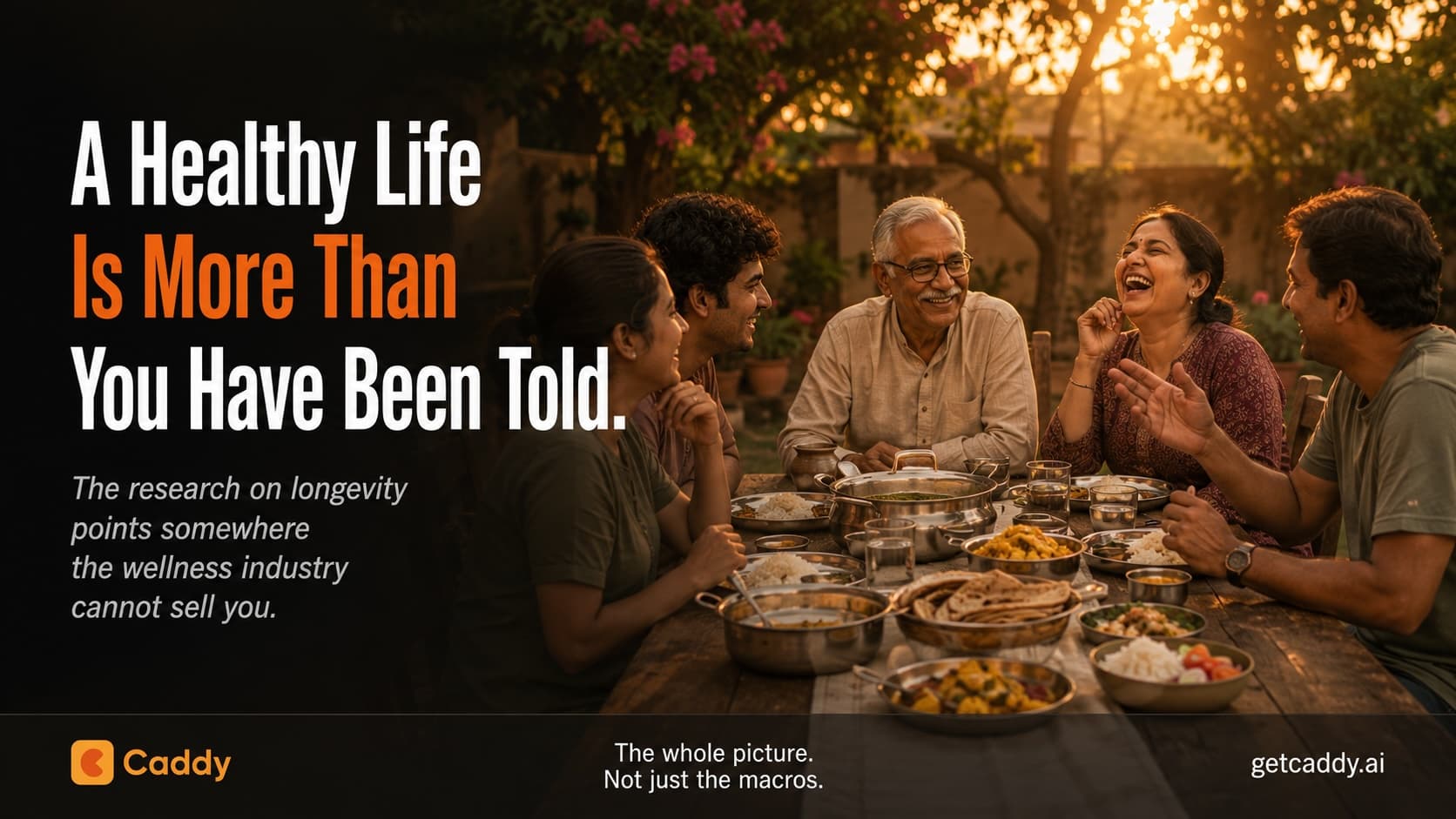
A Healthy Lifestyle Is More Than You Have Been Told It Is
Written by Rishi Bhojnagarwala
Medically Reviewed by Dr. Hetal Pal, PhD in Nutrition Science
Diet. Exercise. Sleep. These matter. But the research on who actually lives longest suggests the equation has variables nobody is talking about.
The Starting Point Most Wellness Content Skips
Open any health and wellness platform today — Indian or global — and the definition of a healthy lifestyle is remarkably consistent.
Eat well. Prioritise protein. Move your body, preferably with resistance training. Sleep seven to nine hours. Manage stress. Stay hydrated. Repeat.
This is not wrong advice. Every element of it has a legitimate evidence base. Every element of it genuinely contributes to better health outcomes for most people who adopt it consistently.
But it is incomplete advice. And the incompleteness is not random — it follows a pattern that is worth examining honestly.
The variables that dominate wellness content are almost entirely physical, almost entirely individual, and almost entirely measurable by a device or trackable in an app. They are also, not coincidentally, the variables that generate the most commercial activity — products, programmes, subscriptions, coaching relationships, supplements, and equipment.
The variables that are missing from most wellness conversations are harder to quantify, impossible to sell, and in some cases more strongly associated with long-term health and longevity than anything you are currently tracking.
This piece is an attempt to lay out the complete picture — not to dismiss the value of diet and exercise, but to expand the frame to include what the research actually shows about what makes people live long, healthy, meaningful lives.
What Conventional Healthy Lifestyle Gets Right
Before expanding the definition, it is worth being clear about what the conventional framework genuinely establishes.
Cardiovascular fitness — your body's aerobic capacity measured as VO2 max — is one of the strongest predictors of all-cause mortality in the research literature. Building and maintaining it through consistent movement genuinely extends healthy life expectancy. This is not marketing. It is one of the most replicated findings in exercise science.
Diet quality matters for metabolic health in ways that are well-established. Consistent overconsumption of calories drives insulin resistance. Excessive refined carbohydrate and trans fat intake worsens cardiovascular risk profiles. Adequate protein intake protects muscle mass during weight loss and aging. These relationships are real and clinically meaningful.
Sleep is genuinely important and genuinely undervalued in modern life. Chronic sleep restriction elevates cortisol, disrupts glucose metabolism, impairs immune function, and accelerates cognitive aging. The research on sleep deprivation's health consequences is sobering and consistent.
Stress management — through whatever mechanism works for a given individual — reduces chronic cortisol elevation that would otherwise damage cardiovascular, immune, and metabolic systems over time.
These are legitimate, well-evidenced pillars of health. The argument is not that they should be replaced. The argument is that they should be joined by a set of equally important factors that the wellness industry discusses far less frequently.

The Variables the Research Keeps Finding That Wellness Content Keeps Ignoring
Social Connection
The Harvard Study of Adult Development is one of the longest-running studies of human wellbeing ever conducted — tracking hundreds of individuals from youth through old age for over eighty years across multiple generations. Its headline finding is not about diet or exercise.
The quality of relationships at midlife, the research found, was a stronger predictor of physical health and cognitive function in late life than cholesterol levels, blood pressure, or any single lifestyle metric measured.
People with warm, close, reliable relationships lived longer and stayed healthier longer than people who were more isolated — regardless of their physical health metrics. The mechanism operates through multiple pathways simultaneously: lower chronic cortisol from having reliable social support, stronger immune function, lower inflammatory markers, and better health behaviours maintained through social accountability and shared norms.
This is not a peripheral finding in one study. It is among the most replicated results in social epidemiology. Loneliness and social isolation carry health risks comparable in magnitude to smoking fifteen cigarettes a day according to some analyses — a comparison that should make every wellness content creator reconsider what they prioritise discussing.
In the Indian context, this finding has particular relevance. Traditional Indian family and community structures have historically provided automatic social connection and belonging in ways that Western social architecture often does not. The rapid shift in urban India toward nuclear family living, longer working hours, and digitally-mediated social life may be eroding one of the most powerful health assets Indian culture has historically provided — without any wellness app registering the change.
Laughter and Genuine Joy
This sounds almost embarrassingly simple. It is not.
Research consistently shows that genuine positive affect — not performed contentment, not optimised mindfulness, but actual laughter and genuine joy experienced in the company of people you find funny — produces measurable reductions in cortisol, inflammatory cytokines, and cardiovascular stress responses.
The key word is genuine. The laughter that produces these effects is the unscripted, unoptimised, unexpected kind — the kind that happens when you are with people who know you well enough to make you genuinely laugh. It cannot be scheduled into a wellness routine. It cannot be generated by an app. It requires the kind of relationships described above and the kind of time — unstructured, unproductive time — that modern optimised life is systematically eliminating.
The Sardinians of the Blue Zones — one of the world's longest-lived populations — are noted not for their dietary sophistication but for their social architecture. Multi-hour meals. Regular unscheduled gathering. A cultural norm of spending time with people simply because it is pleasurable. These are not productivity-optimised behaviours. They may be profoundly health-protective ones.
Purpose and Meaning
Viktor Frankl observed in the most extreme circumstances imaginable that human beings with a reason to live demonstrate remarkable biological resilience. The research that has followed in the decades since has built a consistent picture of purpose as a genuine health variable.
People who report a strong sense of purpose — the feeling that their existence contributes something beyond their own immediate comfort — show lower rates of cardiovascular disease, dementia, and all-cause mortality in large prospective studies. The mechanism appears to operate through multiple pathways: better health behaviours, lower chronic stress, stronger immune function, and hormonal profiles associated with engagement rather than resignation.
In Japan, the concept of ikigai — a reason for being, a reason to get up in the morning — is considered a foundational element of healthy aging rather than a lifestyle luxury. In Okinawa, one of the world's longest-lived populations, ikigai is not a journaling exercise or a career coaching framework. It is woven into the daily structure of community life in ways that make it automatic rather than aspirational.
The question of whether your life has purpose is not a soft self-development question. It may be one of the most important health questions you can ask yourself — and the honest answer may require changes that no supplement or fitness programme can provide.

Mental Peace and Contentment
There is an important distinction between stress management — the active practice of reducing stress responses — and the deeper condition of mental peace and contentment that some people inhabit and others never quite reach despite following every recommended protocol.
Chronic psychological distress — the persistent background sense that life is not quite right, that threats are everywhere, that safety is conditional — maintains cortisol and inflammatory pathways in a state of low-grade activation that physical health practices cannot fully counteract. The person who meditates for twenty minutes every morning and spends the other sixteen waking hours in a state of low-grade anxiety is not receiving the full physiological benefit of their meditation practice.
Mental peace — a fundamental orientation of okayness with life, with its uncertainty and its imperfection — appears to operate through the same biological pathways that social connection and purpose do. It is not achievable through optimisation. It requires something more like acceptance, and the kind of relationships and community that make acceptance possible.
Belonging
The feeling of being genuinely known by other people — known in the full complexity of who you actually are, not who you perform yourself to be in professional or social contexts — creates physiological conditions that are difficult to replicate through any other means.
Research on the biological effects of belonging versus exclusion shows rapid and significant changes in immune function, inflammatory markers, and stress hormone profiles depending on whether individuals feel included or excluded by their social group. The human nervous system is exquisitely sensitive to social belonging in ways that reflect our evolutionary history as a profoundly social species — and it registers threats to belonging through the same pathways it registers physical threats.
The quality of belonging available to people — genuine belonging, not the performed belonging of curated social media presence — may be one of the most important determinants of long-term health that modern urban life is quietly degrading.

Why These Variables Are Missing From Wellness Content
The absence of these factors from most wellness content is not accidental and it is not malicious. It reflects a structural reality about how health information is created and distributed.
Content about diet, exercise, and sleep generates products. Protein supplements, gym memberships, sleep trackers, meal planning apps, coaching programmes — the physical lifestyle factors create entire commercial ecosystems that fund the content creation that discusses them.
Content about social connection, purpose, laughter, and belonging does not generate products in the same way. You cannot sell belonging. You cannot subscribe to genuine friendship. You cannot track your sense of purpose on a wearable. And so these variables receive a fraction of the content investment, the influencer attention, and the platform amplification that the monetisable health factors do.
This is not a conspiracy. It is the natural outcome of commercial incentives operating at scale. But the result is a definition of healthy lifestyle that is systematically skewed toward the interventions that can be sold rather than the interventions that the research most consistently identifies as important.
What a More Complete Definition of Healthy Lifestyle Looks Like
A genuinely complete healthy lifestyle — one that reflects the full range of factors associated with health and longevity in the research literature — looks something like this.
Physical foundation: consistent movement that maintains cardiovascular fitness and basic muscular strength, dietary patterns that support metabolic health without overconsumption, adequate sleep, and stress management practices that work for your individual psychology and circumstances.
Social architecture: genuine close relationships with people who know you well, regular unstructured time with people you enjoy, community belonging that does not depend on performance or productivity, and the kind of social support that is available when life becomes difficult.
Psychological ground: a sense of purpose that extends beyond your professional achievements and consumption choices, mental peace that is not contingent on everything going right, and a relationship with uncertainty that allows for genuine rest rather than chronic vigilance.
Temporal generosity: the willingness to spend time in ways that are not optimised — long meals, unscheduled conversations, spontaneous laughter, rest that is genuinely restful rather than strategically scheduled.
Most wellness content addresses the first category comprehensively and the other three barely at all. The research suggests all four are necessary for the outcomes the wellness industry promises.
Holding Both Things Together
The honest position is not that diet and exercise do not matter. They do. Significantly.
The honest position is that they are necessary but not sufficient — and that the factors that complete the equation are the ones least served by the current wellness content ecosystem.
Invest in your physical health with consistency and without obsession. And invest with equal seriousness in the quality of your relationships, the depth of your social belonging, the genuineness of your laughter, and the meaningfulness of how you spend your time.
These are not additions to a healthy lifestyle. According to the research on what actually predicts who lives longest and who stays healthiest, they may be the core of it.
The supplement stack is optional. The people who make you laugh until it hurts are not.
About Caddy Caddy was built on the understanding that health is more complex than any single metric can capture. We help Indians eat smarter, track what actually matters nutritionally, and navigate their health journey — whether on a GLP-1 medication or approaching wellness through nutrition and lifestyle — with clarity, honesty, and appropriate humility about how much we all still have to learn. Visit getcaddy.ai