
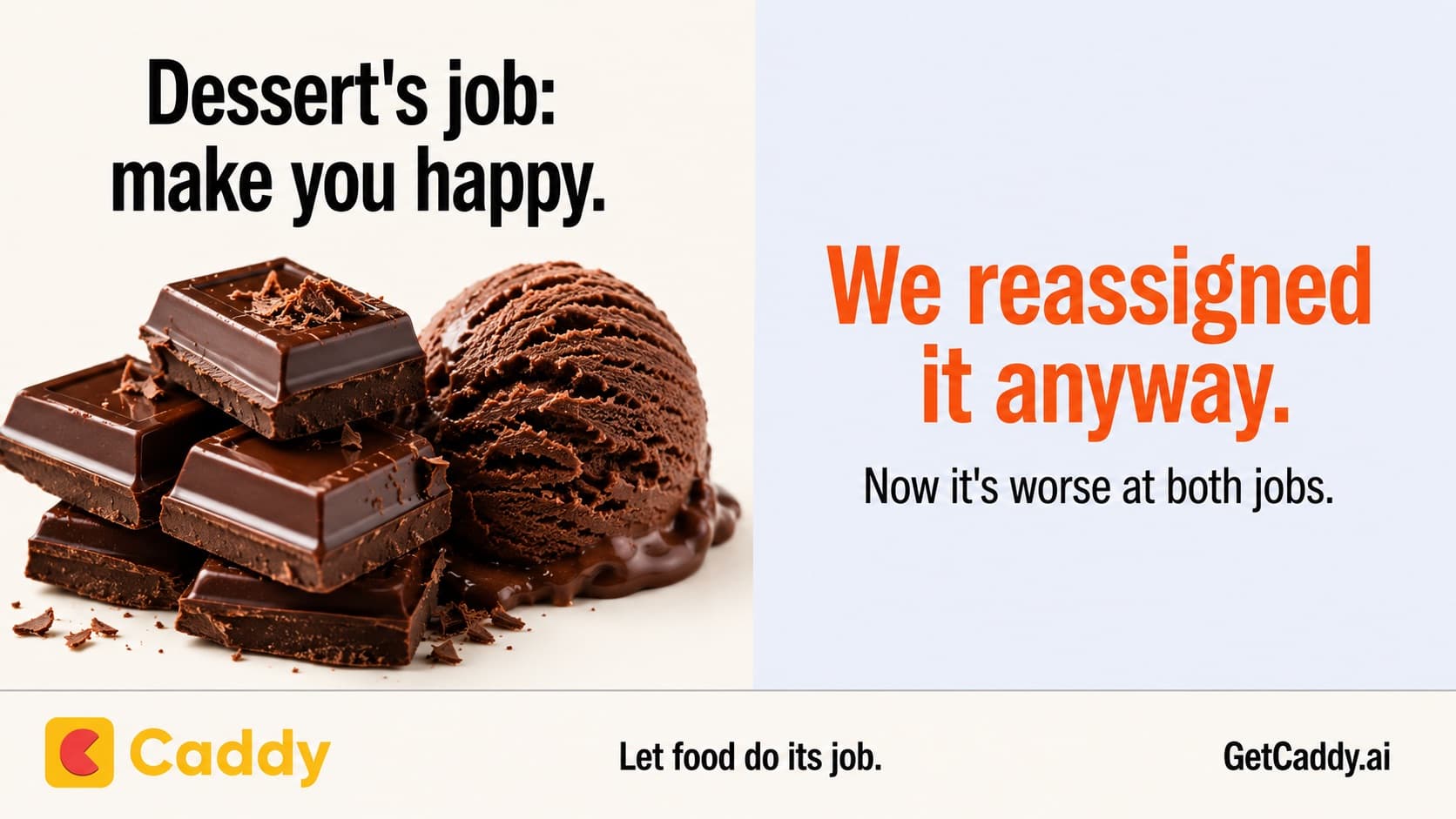
Every Food Has a Job. We Fired Dessert for Doing Its.
Written by Rishi Bhojnagarwala
Nutrition Reviewed by Dr. Hetal Pal, PhD in Nutrition Science
Protein builds muscle. Fiber runs your gut. Dessert's entire job was making you happy — and it was excellent at it. Here's what happened when we decided that wasn't enough.
The Organizational Chart of Food
Every food you eat has a job, whether you've thought about it that way or not. Protein builds and repairs muscle tissue. Carbohydrates supply usable energy. Fiber keeps digestion moving and feeds gut bacteria. Fat helps you absorb fat-soluble vitamins and supports hormone production. It's a genuinely coherent system — different foods, different roles, all contributing to a functioning body.
And then there's dessert. Chocolate, ice cream, cake, the entire category of food eaten at the end of a meal or as a treat during the day. Its job description has never been complicated: make you feel good. Deliver pleasure, satisfaction, a genuine emotional payoff. No metric beyond "did this make the moment better."
By any reasonable standard, dessert has been outstanding at this job. Arguably one of the best-performing categories in the entire food system, for as long as anyone can remember.
So, naturally, we decided that wasn't a real enough contribution, and put dessert on a performance improvement plan.

The Reassignment
Somewhere in the last several years, "tastes good and makes you happy" stopped being considered sufficient justification for a food's existence. Dessert needed to also be doing something functional. So the reformulation began: strip the sugar out, replace it with alternative sweeteners. Add whey protein isolate. Now walk down any packaged food aisle, and nearly every chocolate bar, ice cream tub, and dessert product has a "high protein" or "zero sugar" variant sitting next to the original — quietly implying the original was somehow insufficient.
The scale of this shift is real: the global market for protein-fortified food and beverage products has grown rapidly, driven substantially by the same reformulation logic applied to snacks and desserts that were never protein-first products to begin with.
This isn't inherently a bad idea in principle. Reformulation happens across the entire food industry, often for good reasons. The problem is specific to what happened here: dessert was reassigned to a job it was never hired for, and the reassignment came at the direct expense of the job it was actually good at.
Why the "Healthy" Version Often Fails at Being Dessert
Removing sugar and adding protein isn't a neutral substitution. Sugar contributes meaningfully to the texture, mouthfeel, and flavor profile that makes dessert satisfying in the first place — it's not simply "the bad part" sitting separately from "the good part." Food science research on sugar's functional role in food formulation confirms it affects texture, browning, freezing point, and preservation, not just sweetness — which is why sugar reduction is a genuinely difficult formulation problem, not a simple swap. Protein isolates, meanwhile, often carry their own flavor and texture characteristics that need to be masked or worked around, frequently at some cost to the final product's actual dessert experience.
The result, in a meaningful share of reformulated products, is a dessert that is measurably less satisfying than the original — chalkier, less rich, missing the specific sensory payoff that made the category worth having in the first place. It's doing a worse job at its actual function, in exchange for credentials in a function it was never meant to perform.
The Part That Should Actually Concern You
Here's where this stops being just a taste complaint and becomes a genuine nutrition problem.
This follows the exact same health-halo pattern documented in behavioral nutrition research. A foundational study by Chandon and Wansink found that health claims on food packaging lead consumers to systematically underestimate calorie content — by an average of 35% for "healthy"-branded options — and choose higher-calorie sides and desserts alongside them, an effect they termed the "health halo." We've written about this same mechanism before, comparing regular chocolate to dates-based chocolate: one piece of regular chocolate satisfies a craving. Hand someone the "healthy" version, and it's common to see two or three pieces disappear, because it mentally "doesn't count" the way the regular version does.

The exact same effect plays out with "high protein" and "zero sugar" desserts. The health-forward label lowers the psychological guardrails around portion size. People serve themselves more, snack on it more frequently between meals, and generally treat it with less caution than the "indulgent" original — even when the calorie difference between the two versions is modest, or in some cases, negligible once portion size is accounted for.
The result: a product marketed specifically to solve overconsumption can end up quietly causing more of it.
Why This Happens Psychologically
We asked Dr. Wildaliz Caro, PhD, a licensed clinical psychologist specializing in eating disorders and obesity care, why this bias persists even in people who know better.
Cognitive biases are difficult to get rid of, even if we understand the reasoning behind them. The health halo effect — viewing certain foods as healthier than they actually are due to positive nutrition marketing claims — is a perfect example of this. Many people are aware of the way certain foods are marketed to sell more, but as soon as they find a dessert that claims it's high in protein, sugar-free, keto-friendly, or guilt-free, consumer behaviors kick in. When desserts are associated with these labels, we give ourselves permission to eat more because it feels morally safe.
People who have dieted for years, or learned to assign morality to certain foods and eating behaviors, see it as a chance to indulge or "be bad" because the food is "healthy." If you're struggling with these types of food rules, I encourage you to separate the marketing and packaging of the product from your experience while eating it. Are you enjoying the food? Do you like the taste? Does it satisfy your cravings? How would your portion choices change if the food didn't come with positive health claims? If the "healthy" dessert doesn't satisfy you, it can ultimately lead to unhealthy food behaviors in the future. Eating a whole pint of low-calorie, low-fat ice cream, feeling unsatisfied, and then bingeing on other snacks to satiate the craving is ultimately more detrimental than letting yourself eat a bowl of normal ice cream.
Psychologically, the products that work best in the long run are the ones you personally enjoy and can eat without assigning moral value to yourself or the food. When working with patients who struggle with disordered eating behaviors, I try to avoid labeling foods as "good" or "bad," because arbitrary food rules can lead to restrictive and binge-eating patterns, disappointment, and difficulty feeling satisfied with your food choices. There's no single best food product for everyone — your choices should satisfy you and support your individual nutritional needs.
— Dr. Wildaliz Caro, PhD, Licensed Clinical Psychologist, The Healing Center Cherry Hill
What This Doesn't Mean
This isn't an argument against protein desserts or sugar-free products existing at all — some people genuinely prefer them, and for specific dietary needs, they serve a real purpose. It's an argument against the underlying assumption that a "healthier" label makes portion awareness optional. It doesn't, for any food, regardless of what's been added or removed from it.
The Simpler Fix
Dessert never needed a second job. If the goal is more protein in your day, eat a food that's genuinely good at delivering protein — dal, paneer, eggs, chicken — rather than asking chocolate to moonlight as a protein source at the expense of being good chocolate.
Let dessert do the one thing it has always done well: taste genuinely good, in a real, deliberate portion, enjoyed without the disguise of a second job it was never suited for.

How Caddy Fits Into This
Score 8 doesn't care whether your evening treat was regular chocolate or the "high protein" version — it cares about your total numbers for the day, tracked accurately, regardless of what's printed on the front of the wrapper. Caddy helps you see the real calorie and macro picture behind any dessert, "healthy" label or not, so portion decisions get made with actual data instead of marketing.
Know what you ate. Know how much.
Score 8. Lose weight. That's it.
Sources
Frequently Asked Questions
- Are protein desserts actually healthier than regular desserts?
- Not automatically. While they may offer more protein per serving, protein and sugar-free desserts often trigger a "health halo" effect where people eat larger portions or more frequent servings, sometimes offsetting or exceeding any nutritional benefit from the reformulation.
- Why do "healthy" desserts taste different from regular ones?
- Removing sugar and adding protein isolates changes the texture, mouthfeel, and flavor profile that made the original dessert satisfying — sugar plays a functional role in food formulation beyond sweetness. Many reformulated products end up less rich or satisfying than the original, which can paradoxically lead to eating more in search of the same satisfaction.
- What is the health halo effect?
- The health halo effect is a documented behavioral pattern, first studied by researchers Chandon and Wansink, where labeling a food as "healthy," "high protein," or "sugar-free" causes people to underestimate its calorie content and eat more of it than they would of an unlabeled equivalent, often eroding the intended benefit of the reformulation.
- Should I avoid protein or sugar-free desserts entirely?
- No — they can fit into a balanced diet and work well for people with specific dietary needs or preferences. The key is tracking actual portions and calories rather than assuming the "healthy" label makes portion size irrelevant.
- What's a better way to increase protein intake than eating protein desserts?
- Whole protein sources like dal, paneer, eggs, chicken, or fish generally deliver protein more efficiently and satisfyingly than a dessert reformulated to include it. Save dessert for what it does best — taste and enjoyment — in a measured portion.
Score 8 to lose weight
Your simplest way to eat smarter with Indian food
Get Caddy