
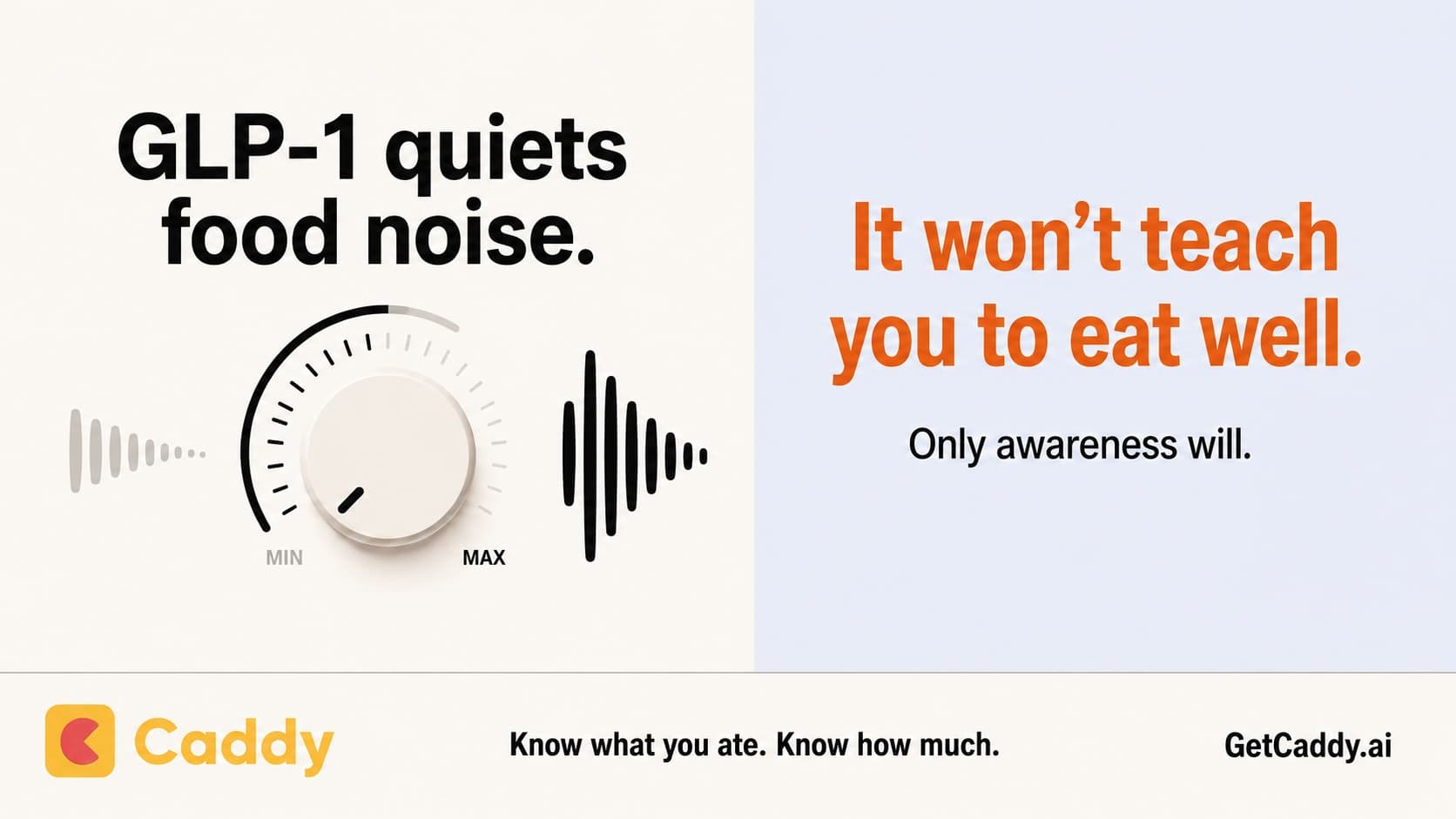
GLP-1 Won't Fix Your Relationship With Food. Only Awareness Will.
Appetite reduction is not the same thing as nutritional competence. Here's the honest answer to the three questions almost nobody asks before starting.
A Genuinely Good Decision, With Three Questions Attached
GLP-1 medications for weight loss are a smart, evidence-backed choice for a lot of people — particularly after cycling through traditional weight loss approaches without lasting results. This isn't a piece arguing against that decision. It's a piece about three questions that get skipped in almost every conversation about starting.
How long will you actually need to stay on it? How will you eventually taper off? And once you do, how do you keep the weight off without going back on it?
All three trace back to the same root: your relationship with food, as it existed before GLP-1 entered the picture.
What GLP-1 Actually Solved — And What It Didn't
Unexplained cravings. Never quite reaching a real calorie deficit. Constant food noise — the background hum of thinking about food that makes portion control feel like a fight. These were real, difficult problems before treatment started.
GLP-1 didn't solve them. It quieted them, temporarily, by suppressing appetite. That's a genuinely powerful mechanism — and it's also easy to mistake for something it isn't. Reduced appetite is not the same thing as nutritional competence. A quieter craving for food doesn't automatically teach anyone what a balanced plate looks like, how much protein they actually need, or how to eat well once that appetite suppression fades or ends.

The Window Most People Waste
Here's the part worth sitting with: the quiet GLP-1 creates is a genuine opportunity, not just a side effect to coast on. For as long as food noise is suppressed, there's a real window to learn what balanced eating actually feels like — without cravings actively working against every decision.
Waste that window by simply eating less of the same old patterns, and the underlying relationship with food never actually changes. That sets someone up to struggle the moment the noise returns — whether that's a plateau, a planned taper, or stopping treatment altogether.
Question 1: How Long Will You Need It?
Honestly — it varies enormously by individual, and it isn't linear. Clinical data shows meaningful weight loss compounds mostly across months 3 to 12, after dose escalation, not evenly from the first week. In the pivotal STEP 1 trial, semaglutide produced an average 14.9% weight loss over 68 weeks; tirzepatide trials showed even larger average losses over a similar timeframe — 15.0-20.9% at 72 weeks, depending on dose. A realistic, healthy weekly rate is generally cited around 1-2 pounds, dependent heavily on diet and activity — not a fixed monthly number any app or program can promise.
We asked Dr. Ben Shekhtman, MD, who treats GLP-1 patients through HeydayMD, how he actually answers this question in practice:
"The 'how long will I need this' question comes up in basically every follow-up visit, and honestly I don't love giving a hard number. What I tell patients is that we're watching two things — how their hunger cues behave off the medication and whether they've actually rebuilt the habits (protein first, resistance training, sleep) that made the appetite suppression useful in the first place. If those aren't solid, tapering just means the weight creeps back with none of the skill-building that was supposed to happen.
The clearest green light for a taper, for me, isn't a number on the scale — it's when a patient stops thinking about food constantly. When they can go to a birthday party and just... eat normally and move on. That's usually 6-9 months in for most of my patients. The ones who regain are almost always the ones who treated the drug as the whole plan instead of the window it actually is."
— Dr. Ben Shekhtman, MD, HeydayMD
Question 2: How Do You Taper Off?
This is a decision made with your doctor, based on your individual response — not something a nutrition app determines or accelerates on its own. Claims suggesting otherwise should be treated with real skepticism.
What genuinely helps: entering that conversation with your nutrition and habits already solid, rather than scrambling to build them after a dose reduction begins. If protein intake, portion awareness, and meal structure are already dialed in before a taper starts, the transition tends to be considerably smoother than trying to relearn eating patterns at the same time as a medication change.
Question 3: How Do You Maintain It Afterward?
This is the question with the least reassuring honest answer, and it deserves to be stated plainly rather than glossed over.
Real trial data shows weight regain after stopping is common, not rare. The SURMOUNT-4 extension study found patients on tirzepatide regained an average 14 percentage points of body weight within a year of stopping — against 5.5% further loss for those who stayed on it — and a later post-hoc analysis found most participants regained at least a quarter of their initial weight loss within that year. A dedicated STEP 1 extension study on semaglutide withdrawal documented a similar pattern: participants who'd lost 17.3% of body weight by week 68 regained 11.6 percentage points of it within a year of stopping, netting out to a 5.6% loss. Most clinicians actually recommend long-term use specifically because of this well-documented regain risk.
Built habits and genuine nutritional awareness meaningfully improve the odds of sustaining results — they don't eliminate the risk. Research on structured programs combining GLP-1 treatment with behavioral coaching and nutrition support shows stronger outcomes than medication alone. A UK-based digital obesity service study of over 106,000 patients found engaged patients achieved 21.5% weight loss versus 17.0% for non-engaged patients over 11 months — the same medication, a meaningfully different outcome, driven by the behavioral layer around it. That's the honest case for building awareness during treatment: not a guarantee, but a real, evidence-backed improvement in your odds.

Why This Matters More Than the Marketing Suggests
Any claim promising you'll "never need GLP-1 again" or guaranteeing permanent maintenance through an app feature alone isn't supported by the evidence, and it isn't something we'll claim either. What the evidence does support is that the window GLP-1 creates — appetite suppressed, food noise quiet — is a genuinely valuable opportunity to build skills that matter regardless of what happens next: staying on treatment long-term, tapering under medical guidance, or, if needed, returning to it later with a stronger foundation than before.

How Caddy Fits Into This
This is exactly why Caddy's GLP-1 companion is built around using this window well, not around promises the research can't back. Personalised macro and portion guidance to build genuine skill, not just short-term compliance. Nutrition tracking that keeps working whether you're titrating up, holding steady, or tapering down under your doctor's supervision. And continued support after treatment changes, so the awareness you built doesn't quietly disappear the moment appetite suppression does.
Science gave you a rare window. The goal isn't to coast through it — it's to use it.
Know what you ate. Know how much.
Score 8. Lose weight. That's it.

Sources
Frequently Asked Questions
- How long do most people need to stay on GLP-1 medication for weight loss?
- It varies significantly by individual, and weight loss isn't linear — most meaningful loss compounds across months 3 to 12, after dose escalation. Clinical trials generally track outcomes over 68-72 weeks, but actual duration of treatment depends on your individual response and your doctor's guidance.
- Can a nutrition app help me taper off GLP-1 medication faster?
- No — tapering is a medical decision made with your doctor based on your individual response, not something an app determines or accelerates. What a good nutrition companion can do is make sure your habits and nutrition are solid before a taper begins, so the transition is smoother when your doctor decides it's appropriate.
- Will I regain weight after stopping GLP-1 medication?
- Research shows this is common. The SURMOUNT-4 extension study found patients regained a significant share of lost weight within a year of stopping tirzepatide, and a similar pattern has been documented for semaglutide. Built habits and nutritional awareness meaningfully improve your odds of sustaining results, but they don't eliminate the risk.
- Does GLP-1 actually fix bad eating habits, or just suppress appetite?
- GLP-1 medications suppress appetite and reduce food noise — they don't teach portion control, nutritional balance, or food awareness. Appetite reduction is not the same as nutritional competence. Using the quieter appetite window to actively build these skills is what determines whether results last.
- Does combining GLP-1 with nutrition coaching or tracking actually improve outcomes?
- Yes — real-world data supports this. A UK digital obesity service study found engaged patients (using structured coaching and tracking) achieved 21.5% weight loss compared to 17.0% for non-engaged patients on the same medication, over 11 months.
Get Caddy
Your simplest way to eat smarter with Indian food
Download