
Most GLP-1 Side Effects Are Preventable. We Just Never Teach People How.
Written by Rishi Bhojnagarwala
Medically Reviewed by Dr. Hetal Pal, PhD in Nutrition Science
40 to 85% of people on GLP-1 medications experience nausea, vomiting, diarrhea, or constipation. Most of it is manageable — almost nobody explains the mechanism, or what actually helps.
The Scale of the Problem
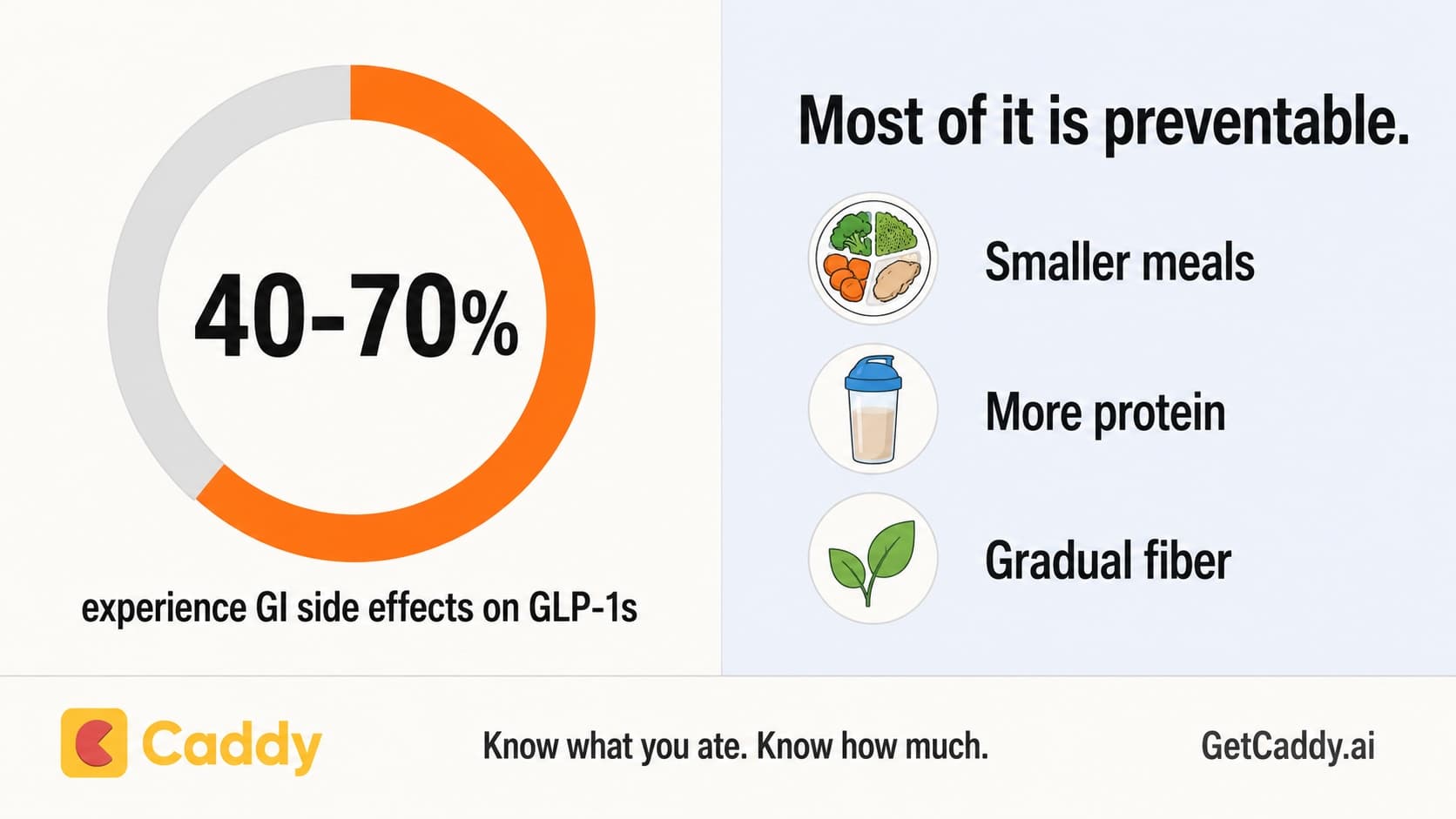
GI-related adverse events occur in roughly 40-70% of patients on GLP-1 receptor agonist therapy, according to a multidisciplinary clinical expert consensus review — and in some trials, that figure has reached as high as 85%. Nausea is consistently the most commonly reported symptom, followed by vomiting, diarrhea, and constipation.
This isn't a rare complication affecting a small minority. It's the default experience for a large share of people starting these medications — which makes it strange that so little practical guidance actually reaches patients.

Why This Happens: The Mechanism, Explained Simply
GLP-1 medications work partly by slowing down gastric emptying — the rate at which food moves from your stomach into your intestine. This is a core part of how they help you feel full longer and eat less overall.
But it has a direct downstream effect: a meal that felt completely normal before can suddenly feel like far too much, because it's sitting in your stomach longer than your body is used to. That's the direct mechanical cause of a lot of the nausea and discomfort people report, especially in the first weeks of treatment or right after a dose increase.
The same slowed digestion explains the constipation risk. And because GLP-1s suppress both appetite and thirst simultaneously, dehydration risk climbs quietly in the background — often without the person even feeling particularly thirsty.
None of this is random or unpredictable. It's a known mechanism with known, manageable countermeasures.

The Three Things That Actually Help
Meal size and frequency. Clinical guidance consistently recommends shifting toward 5-6 smaller meals across the day, rather than the traditional 2-3 large ones. Given the slowed gastric emptying, this isn't just a preference — it's a direct accommodation for how the medication changes digestion.
Protein. Target intake above 1.2 grams per kilogram of body weight daily, spread evenly across meals rather than loaded into one sitting. This matters more than it might seem: research indicates that up to 20-25% of the weight lost on a GLP-1 can come from muscle mass rather than fat if protein intake isn't prioritized. When solid food is hard to tolerate, a protein shake — ideally delivering at least 20 grams of protein for under 200 calories, with minimal added sugar — is a well-supported fallback.
Fiber. Genuinely useful for both constipation and satiety, but with an important caveat: it needs to increase gradually. Jumping straight to a high-fiber diet tends to worsen GI symptoms rather than help them. A reasonable target sits around 25-35 grams daily, ideally from food first — vegetables, whole grains, fruit — with a supplement like isabgol as a backup when food alone isn't closing the gap.
What We Hear From Endocrinologists: Mounjaro vs. Ozempic
In conversations with senior endocrinologists, a consistent pattern emerges around tirzepatide (Mounjaro) compared to semaglutide (Ozempic): fewer patients discontinue tirzepatide specifically because of GI side effects. The SURMOUNT-5 head-to-head trial backs this up directly — 2.7% of tirzepatide patients discontinued due to GI-related adverse events, compared to 5.6% on semaglutide, alongside stronger average weight loss (20.2% versus 13.7%).
It's worth being precise here: this isn't the same as saying tirzepatide has fewer side effects overall — some data suggests overall adverse event rates are broadly similar between the two drugs. What the data does support clearly is that fewer people are quitting tirzepatide specifically because of GI discomfort, which in practice matters just as much as the raw side-effect count.
The Quieter Risk: Nutritional Deficiency
Because GLP-1s suppress appetite so significantly, a common but underdiscussed side effect is simply eating too little overall — not just fewer calories, but less of everything, including nutrients the body still needs. This can lead to real deficiencies in fiber, calcium, iron, magnesium, potassium, and vitamins A, C, D, and E.
"Just eat less" was never the actual goal of these medications. The goal is eating an appropriately smaller amount that's still nutritionally complete — which is a much harder thing to track by feel alone, especially when appetite itself has changed so dramatically.

How Caddy Helps With Each of These, Specifically
This is exactly the gap Caddy's GLP-1 layer is built to close — not with generic advice, but with real-time, personalized guidance tied to what actually causes each side effect.
Meal scoring with real-time guidance. Rather than a blanket "eat smaller meals" instruction, Caddy's scoring is personalized to you — nudging you toward an appropriately sized portion for your body and your current dose, before you're mid-meal and already uncomfortable.
Accurate protein and fiber tracking. Both numbers that matter most for preventing muscle loss and managing constipation, tracked precisely rather than estimated — so "am I getting enough protein today" or "have I hit my fiber target" stops being a guess.
Symptom reporting with real-time feedback. Log nausea, constipation, or any other symptom as it happens, and get an immediate, practical fix rather than generic advice you have to go search for elsewhere. And when a symptom crosses from "manageable at home" into genuine medical concern — persistent vomiting, severe abdominal pain, signs of dehydration like dizziness or very dark urine — Caddy connects you to doctor support on call, without waiting for your next scheduled appointment.
What Doctors Are Telling Patients
We asked physicians who prescribe GLP-1s regularly what they tell patients directly.
The biggest mistake I see in the first month is patients eating the same big portions they always ate. GLP-1s slow down how fast your stomach empties. If you keep eating a big plate, the food sits there and makes you sick. I tell patients to eat smaller meals, cut portions early, and drink water. People also rush the dose too fast, which makes nausea worse. Go slow, stay ahead of it.
For nausea from slow emptying, I build up protein first, then fiber, and I add fiber slowly. Fiber can actually make bloating and gas worse if you add too much too soon. So, small protein at each meal first (eggs, chicken, Greek yogurt), then add fiber a little at a time over a couple weeks, with plenty of water. The order matters because fiber is harder to digest on a slowed stomach.
Mild nausea, queasiness, or mild constipation I usually manage at home with smaller meals, slower eating, more water, and a stool softener. But I tell patients to call me right away for severe vomiting they cannot keep down, bad belly pain, signs of dehydration, or if they feel like food is truly stuck. Those are not things to ride out at home.
— Dr. Harsha Moole, MD, MBBS, internal medicine physician and founder of FindMyDirectDoctor
The biggest mistake I see people make after they begin taking a GLP-1 medication for weight loss is eating the same portions of food in the same amount of time that they were eating before beginning their treatment. GLP-1 medications will cause your stomach to take longer to empty. Additionally, many individuals report feeling less hungry than prior to beginning their treatments. Therefore, when you do eat, it may be best to eat smaller portions of foods.
I normally put enough protein in for your body to use first, then add smaller amounts of fiber that are easy to digest and spaced out during the day. After you begin to feel better and are able to eat consistently without experiencing nausea, I will slowly add more fiber over time as opposed to increasing it all at once. The addition of large quantities of both protein and fiber can cause meals to be much more satiating, therefore potentially worsening gastrointestinal slowing and related discomforts.
Generally, mild nausea, temporary bloating, or minor constipation are manageable through eating smaller meals, taking in enough fluids, and making gradual changes to your diet. Contact your doctor immediately for persistent vomiting, severe or worsening abdominal pain, inability to keep fluids down, or signs of dehydration. These symptoms require medical evaluation and should not be allowed to ride themselves out.
— Dr. Paul Gross, MD, Co-Founder and Medical Advisor at LIV3 Health, Clinical Assistant Professor, Department of Family Practice, University of British Columbia
The Bottom Line
Most GLP-1 side effects don't need to be quietly endured for weeks until they resolve on their own. They're mechanically explainable, genuinely manageable with the right meal size, protein, and fiber approach — and worth tracking properly rather than guessing at.
Know what you ate. Know how much.
Score 8. Lose weight. That's it.
Frequently Asked Questions
- What are the most common GLP-1 side effects?
- The most common side effects are gastrointestinal — nausea, vomiting, diarrhea, and constipation. Nausea tends to be the most frequently reported, especially when starting the medication or right after a dose increase. These affect roughly 40-70% of patients, and up to 85% in some clinical trials.
- Can eating more protein really reduce GLP-1 nausea and side effects?
- Protein doesn't directly reduce nausea, but it plays a critical supporting role: it helps preserve muscle mass (which GLP-1s can otherwise reduce significantly) and supports satiety, making it easier to eat appropriately sized meals. Aim for above 1.2g per kg of body weight daily, spread across meals, using a protein shake as backup when solid food is hard to manage.
- How much fiber should I eat while on a GLP-1 medication?
- Roughly 25-35 grams daily is a reasonable target, but the increase needs to be gradual — jumping to high fiber intake too quickly can actually worsen GI symptoms rather than help. Prioritize food sources first, and use a supplement like isabgol only when food alone isn't sufficient.
- Does Mounjaro have fewer side effects than Ozempic?
- Not exactly — but fewer patients discontinue Mounjaro (tirzepatide) specifically because of GI side effects compared to Ozempic (semaglutide): 2.7% versus 5.6% in the SURMOUNT-5 head-to-head trial. Mounjaro also showed stronger average weight loss in the same trial. Overall side effect rates between the two drugs are broadly similar.
- When should I actually call a doctor about GLP-1 side effects?
- Contact a doctor immediately for persistent vomiting, severe or escalating abdominal pain, or signs of dehydration such as dizziness or very dark urine. Mild nausea, occasional constipation, or discomfort after a dose increase are common and usually manageable with meal size, protein, and fiber adjustments — but anything severe or ongoing warrants medical attention.
Get Caddy
Your simplest way to eat smarter with Indian food
Download