
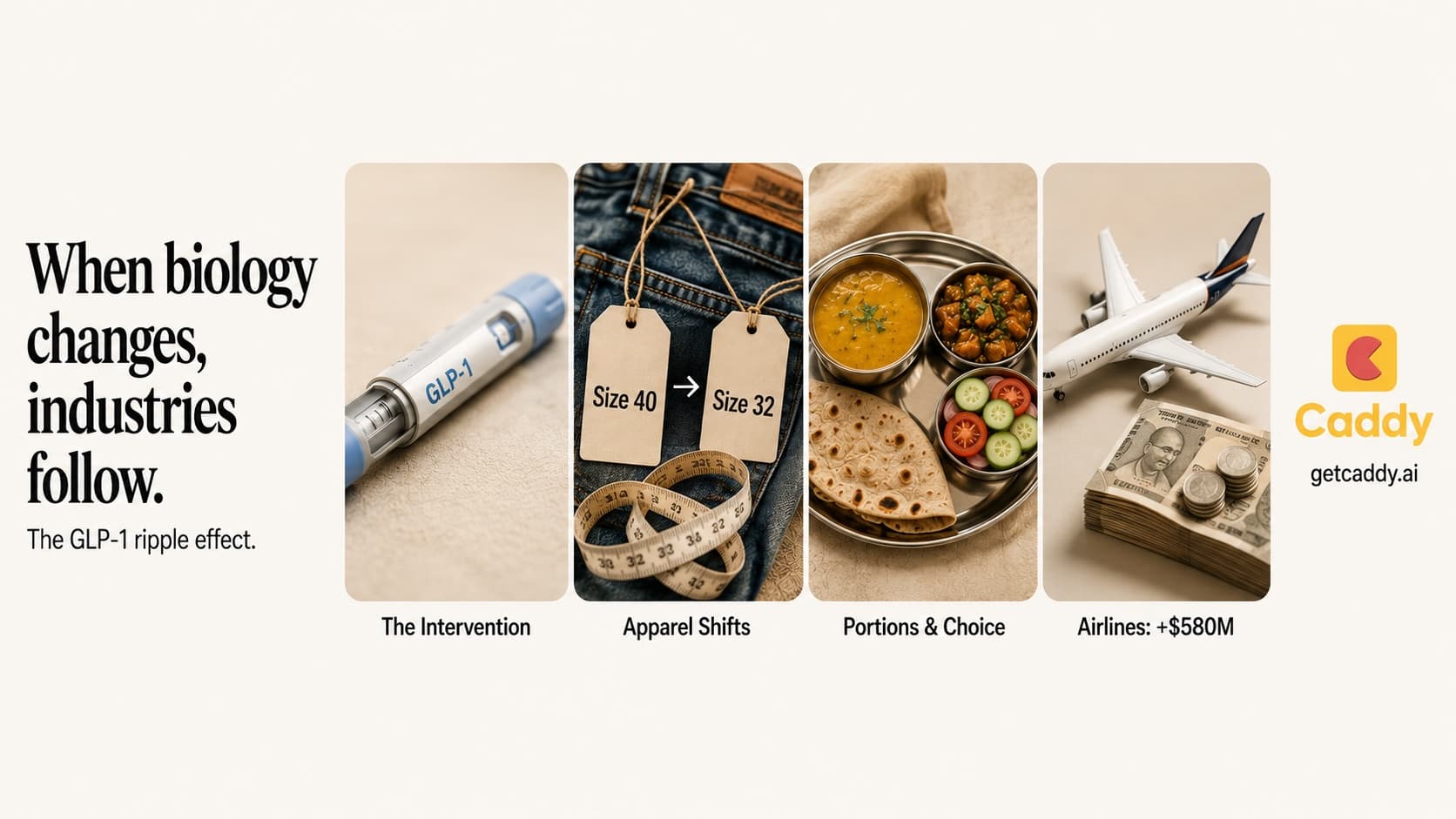
When Biology Changes, Industries Follow — The GLP-1 Ripple Effect Across Five Sectors
Airlines could save hundreds of millions of dollars a year in fuel simply because their passengers weigh less. That number alone would be a good headline. The stranger part is how many other industries are quietly recalibrating around the same biological shift.
The Number That Made Wall Street Pay Attention
Equity analysts at Jefferies have been tracking a simple mechanical relationship: fuel burn scales with total weight carried. As GLP-1 adoption spreads across the population, average passenger weight is edging down — and at airline-scale volumes, that adds up. Jefferies analyst Sheila Kahyaoglu's research found that if average passenger weight fell by around 10%, the four largest US carriers — American, Delta, Southwest, and United — could see roughly 1.5% lower fuel costs, translating to about $580 million in annual savings and a potential 4% lift to earnings per share. Those four carriers are projected to spend close to $38.6 billion on jet fuel this year, so even a small percentage shift moves real money.
This is one data point in a pattern showing up across a growing list of unrelated industries — each discovering, often without anticipating it, that a hormone-based medical intervention has become a measurable input into its business model.

The Primary Intervention
To understand why the ripple effects are happening, it helps to understand what GLP-1 medications actually do.
GLP-1 — glucagon-like peptide-1 — is a hormone the body already produces. It signals satiety, slows gastric emptying, and regulates appetite. GLP-1 receptor agonist medications amplify and extend that hormonal signal, producing sustained appetite suppression and reduced food intake.
The clinical results are substantial. In a head-to-head Phase 3 trial comparing the two most widely used GLP-1 medications, tirzepatide produced average weight loss of just over 20% at 72 weeks, while semaglutide produced about 14% — both well beyond what older weight-loss drugs achieved. At population scale, with an estimated one in eight US adults having used a GLP-1 medication at some point, this single biological recalibration is producing second-order effects across industries that had no reason to plan for this scale of change when they built their current business models.
Ripple One — Apparel and Retail
The most visually obvious ripple effect is in clothing sizing.
Apparel brands typically place orders six to nine months in advance using "size curves" — fixed ratios of how many small, medium, large, and extra-large garments to stock. Those curves are now shifting. Retail executives and industry analysts have described the effect as the size curve "moving left" — with demand for smaller sizes rising faster than inventory models were built to anticipate, while resale platforms report a parallel rise in customers selling off clothing that no longer fits.
The dollar impact isn't trivial either. Equity research firm Bernstein has estimated that GLP-1-driven wardrobe turnover could add $3 billion to $13 billion in annual apparel spending as consumers replace clothing across multiple size changes during their weight-loss journey — a trend that off-price retailers, discounters, and personal-styling services are positioned to capture.
Ripple Two — Food and Beverage
GLP-1's appetite-suppressing mechanism produces a physiological reduction in hunger — not a dieting choice, but an actual change in how much food the body is signalling it wants.
That shows up in portion preference and ordering behaviour: smaller plates, reduced impulse snacking, and a shift away from large combo-style meals toward smaller, protein-focused options. Food and beverage companies serving populations with meaningful GLP-1 adoption are seeing changes in average order size and composition that look distinct from general health-consciousness trends — this is appetite-driven, not willpower-driven.
Ripple Three — Fast Food and Quick Service Restaurants
Fast food chains have been among the most visible participants in this shift, because their business model depends heavily on volume and portion economics.
Several major US chains have restructured menus around it. Olive Garden added a "lighter portion" section with smaller servings at lower prices, Chipotle rolled out a high-protein menu item, Subway introduced snack-sized "Protein Pockets," and Smoothie King built out a dedicated GLP-1 support menu. A customer base that is, on average, less hungry and more protein-conscious requires a different menu economics model than one optimised purely for volume — and chains that move early are shaping the category rather than reacting to it.
Ripple Four — Airlines
Which brings the chain back to where this analysis started.
Lighter average passenger weight reduces total aircraft weight, which reduces fuel burn. At the margins airlines operate on, a roughly 1.5% fuel reduction is a meaningful earnings lever. No airline fuel model was built five years ago anticipating that a diabetes and weight-loss medication would become a measurable input into long-term fuel cost projections. It now appears to be exactly that.

The Pattern Underneath the Pattern
What connects all four ripples is the same underlying mechanism: a biological intervention at sufficient population scale eventually shows up in the financial models of industries with no direct connection to healthcare.
Something similar happened with the decline in smoking rates, which reshaped airline cabin design, insurance actuarial models, and hospitality ventilation standards over several decades. GLP-1 adoption appears to be compressing a comparable scale of population-level change into a much shorter window.
Building Caddy in this space has highlighted a crucial reality: this isn't simply a medical trend. It's a fundamental shift in consumer behaviour, and the ripple effects of a changing population will keep forcing adaptation across sectors that haven't started planning for it yet.
What Comes Next
The four ripples documented here — apparel, food and beverage, fast food, and airlines — are unlikely to be the final list.
Healthcare insurance actuarial models will need to account for reduced obesity-related claims over time. Pharmaceutical supply chains are already under visible strain from demand. Furniture and fixture design in public spaces, gym and fitness business models, and even pharmacy retail real estate strategy are plausible candidates for the next wave of adjustment as the population-level effect continues to compound.
The throughline is the same across every example: industries that planned for a relatively stable distribution of body weight in their customer base are now operating in a period of measurable, ongoing change — and the ones tracking this shift early are better positioned than the ones discovering it through declining margins.
When biology changes, industries follow. The only open question is which industry recognises it next.
About Caddy
Caddy is a nutrition and weight-loss companion built for Indians navigating exactly this shift — including GLP1 Buddy, built specifically for the GLP-1 journey.
Frequently Asked Questions
- What is the GLP-1 "ripple effect"?
- It's the term analysts use for the second-order business impact of widespread GLP-1 weight-loss drug adoption — industries like airlines, apparel, and fast food adjusting their models as average consumer weight and appetite shift at population scale.
- How much could GLP-1 drugs save airlines on fuel?
- Jefferies estimates the four largest US airlines could save around $580 million a year in fuel costs if average passenger weight falls by about 10%, mainly through reduced total aircraft weight.
- Why are clothing brands changing their sizing because of GLP-1?
- As users lose 15-20% of body weight, demand is shifting toward smaller sizes faster than traditional six-to-nine-month inventory planning cycles can track, pushing brands to rework their size curves.
- Are fast food chains changing menus because of GLP-1 drugs?
- Yes. Chains including Olive Garden, Chipotle, Subway, and Smoothie King have introduced smaller-portion or high-protein menu items aimed at customers with reduced appetite.
- How much weight do people typically lose on GLP-1 medications?
- In clinical trials, semaglutide users lost around 14% of body weight and tirzepatide users lost just over 20%, though real-world results vary based on dosing and how long people stay on treatment.
Get Caddy
Your simplest way to eat smarter with Indian food
Download