
Will GLP-1 Adoption in India Explode After Semaglutide Goes Off Patent?
Written by Rishi Bhojnagarwala
Medically Reviewed by Dr. Hetal Pal, PhD in Nutrition Science
The global buzz around GLP-1 medications is hard to ignore.
With semaglutide expected to go off patent in the coming years, a common assumption is emerging:
Lower prices will lead to massive adoption in India.
But is price really the biggest barrier?
Or are we oversimplifying a much more complex problem?
The Reality Check: It’s Not Just About Price
If affordability was the only constraint, we would already be seeing a different market trend.
Over the last 12–18 months, GLP-1 drugs have become more accessible in India.
Yet:
The top-selling drug is Tirzepatide (Mounjaro) and not Semaglutide which is off patent and cheaper
Tirzepatide is not going off patent anytime soon
Early trends suggest higher adoption of Tirzepatide than semaglutide-based options like Ozempic and Wegovy
This tells us something important:
👉 People are willing to pay for effectiveness.
Which means:
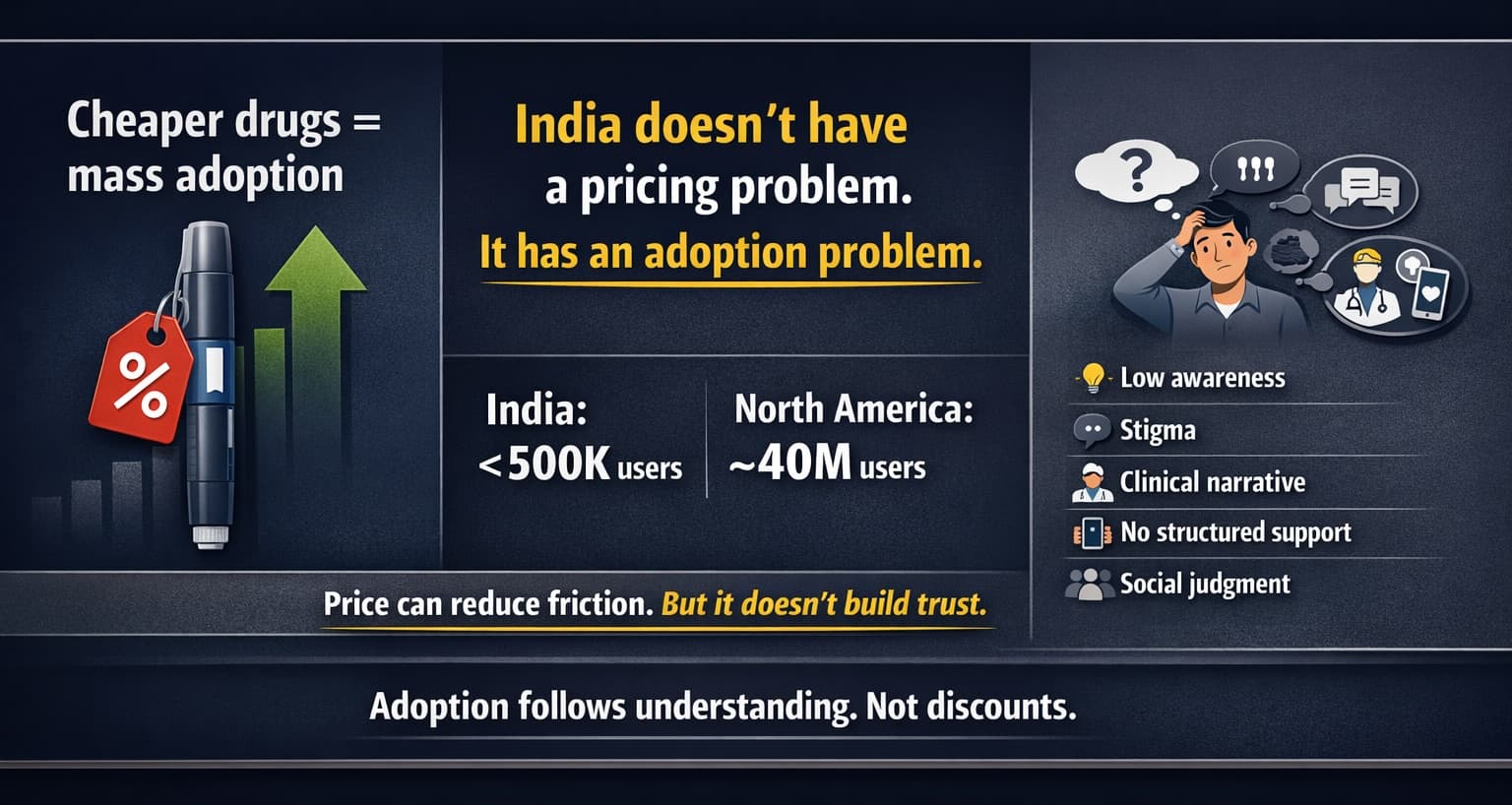
Price is not the primary barrier to adoption.

India vs North America: The Real Gap
Let’s look at the numbers.
India: <500,000 GLP-1 users
North America: ~40 million users in ~5 years
This is not a pricing gap.
This is an adoption gap.
The Real Barriers to GLP-1 Adoption in India
1. Low Awareness
Most people still don’t fully understand:
how GLP-1 works
who it is for
what outcomes to expect
For many, it’s still seen as:
“Some new injection for weight loss.”
2. Stigma Around Injections
In India, injections carry a strong psychological barrier.
They are often associated with:
serious illness
last-resort treatment
dependency
This makes GLP-1 feel intimidating, even before understanding its benefits.

3. An Overly Clinical Narrative
Current communication around GLP-1 is:
highly medical
difficult to relate to
disconnected from real life
It lacks:
empathy
simplicity
practical guidance
4. Fragmented Patient Experience
Today’s GLP-1 journey looks like this:
doctor prescribes medication
patient starts injections
then… they are on their own
What’s missing:
what to eat
how to manage side effects
how to sustain results
5. Judgment and Social Perception
Perhaps the biggest barrier is cultural.
An overweight individual is often judged as:
lazy
undisciplined
And when they choose GLP-1:
“shortcut”
“easy way out”
This creates a double stigma.
6. Negative and Conflicting Information
The market is filled with:
influencer opinions
biased narratives
fear-driven content
Some intentional. Some not.
But the result is the same:
👉 Confusion and hesitation

Why Price Alone Won’t Drive Adoption
Even if semaglutide becomes significantly cheaper:
awareness won’t automatically improve
stigma won’t disappear
patient experience won’t fix itself
Which means:
👉 Lower prices ≠ higher adoption (at scale)
What GLP-1 Actually Needs to Scale in India
For this category to grow meaningfully, three things need to change:
1. A Simpler, Human Narrative
From:
clinical explanations
fear-based messaging
To:
relatable communication
real-world use cases
everyday language
2. Support Beyond Prescription
Medication alone is not enough.
Patients need:
nutrition guidance
side-effect management
habit building
3. Shift from Judgment to Understanding
The conversation must move from:
“Why can’t you control yourself?”
to:
“How can we support your biology?”
GLP-1 Helps You Eat Less. But What Next?
GLP-1 medications reduce appetite.
But they also introduce new challenges:
lower protein intake
nutrient gaps
digestive issues (nausea, bloating, constipation)
risk of muscle loss
Without proper support, patients may:
lose weight unsustainably
drop off treatment
struggle to maintain results
How Caddy Is Solving This Missing Layer
This is where Caddy comes in.
Caddy is designed as a GLP-1 companion, focused on making weight loss:
simple, safe, and sustainable.
1. One Score. Clear Guidance.
Caddy simplifies nutrition into a single metric:
Score 8 → you’re on track
No calorie math. No confusion.
2. Built for Indian Food
Caddy understands:
dal in a katori
roti, sabzi, thali
real Indian eating patterns
This makes guidance practical and relatable.

3. Real-Time Meal Intelligence
Caddy helps users:
understand what they’re eating
improve meal quality
make better next-meal decisions
4. GLP-Specific Support
Caddy addresses key GLP challenges:
protein tracking → prevent muscle loss
symptom tracking → manage side effects
meal adjustments → improve tolerance

5. Consistency Over Perfection
Instead of strict diets:
Caddy focuses on small, consistent improvements
The Bigger Shift: From Willpower to Systems
For decades, weight loss has been framed as:
discipline
control
restriction
GLP-1 changes that by addressing biology.
Caddy completes that shift by adding:
👉 structure and support
Final Takeaway
Semaglutide going off patent will help.
But it won’t be the trigger for mass adoption.
Because the real barriers are not economic.
They are:
psychological
cultural
behavioral
The Future of Weight Loss in India
The next phase of growth will not be driven by:
cheaper drugs
aggressive marketing
It will be driven by:
👉 better patient experience
Closing Thought
GLP-1 helps you eat less.
Caddy helps you eat right.
👉 If you’re starting your weight loss journey, start with clarity — not confusion.