
Stop Blaming the Packaged Food Brand. The Problem Is the Policy.
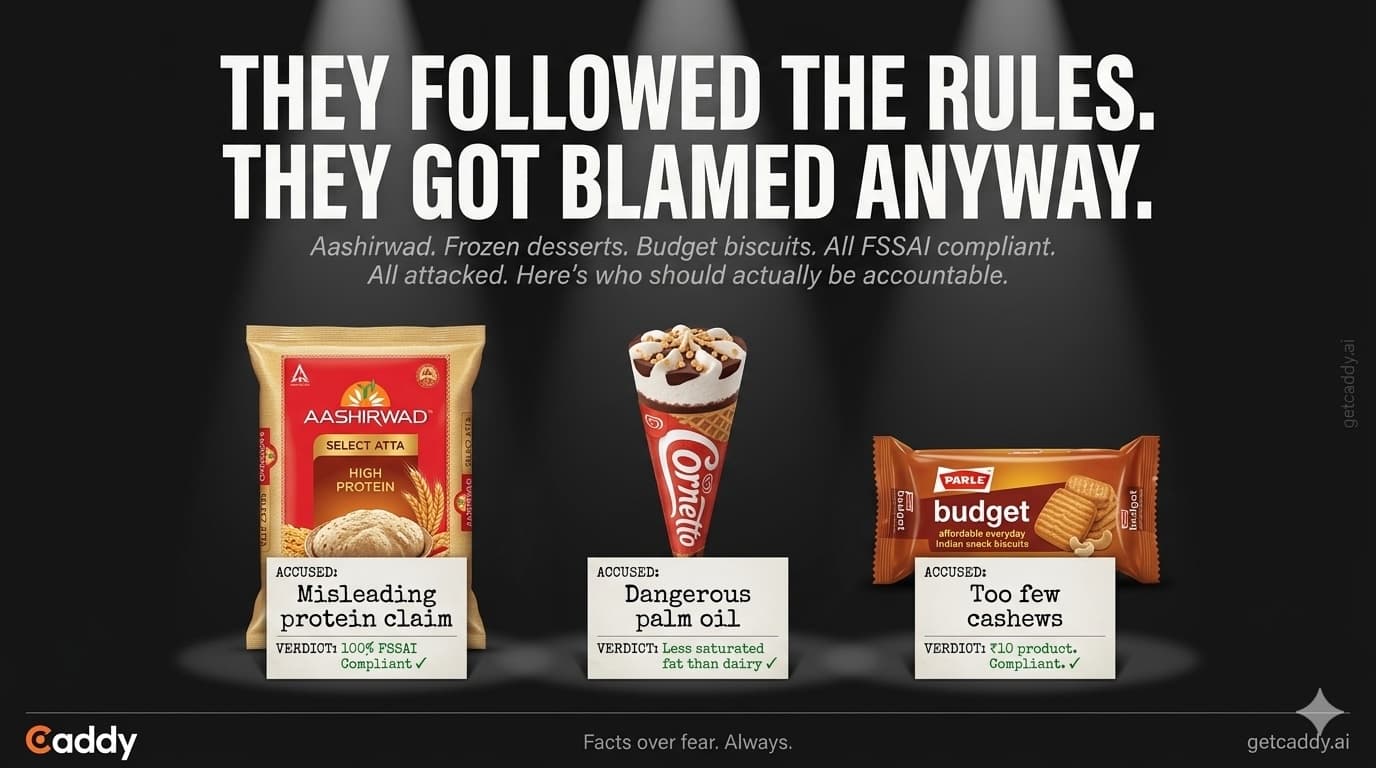
Aashirwad atta. Frozen desserts. A ₹10 cashew biscuit. All attacked. All compliant. All innocent.
The Viral Outrage Formula Nobody Is Questioning
There is a content format that has become enormously reliable in Indian nutrition and food influencing.
Find a well-known packaged food brand. Zoom in on a claim on the label. Express shock and outrage. Explain to your audience why this brand is misleading them. Watch the views accumulate.
It works every time. It generates comments, shares, saves. It positions the creator as a vigilant consumer advocate. It builds an audience that trusts them to decode the deceptive food industry on their behalf.
There is one significant problem with this formula.
In the overwhelming majority of cases, the brand being publicly shamed is in complete compliance with Indian food regulation. Every claim on the label was reviewed and approved under FSSAI guidelines. The brand did nothing wrong. It followed the rules exactly as written by the government body responsible for setting them.
The outrage is real. The audience concern is genuine. The target is wrong.
This piece is about three specific examples that illustrate this pattern clearly — and about what should actually change, and who should actually be held accountable for changing it.

Example 1: Aashirwad Atta and the "High Protein" Controversy
Aashirwad Select Sharbati Atta became the subject of significant viral criticism for its "high protein" claim. The content followed the familiar pattern — screenshot of the label, shocked reaction, implication that the brand was misleading health-conscious consumers about protein content.
Here is what the content almost universally failed to mention.
Under FSSAI regulations, a food product can carry a "high protein" claim if it provides 20% or more of the Recommended Dietary Allowance of protein per 100 grams. Aashirwad Atta meets this threshold. The claim is not just technically permitted — it was reviewed, approved, and is fully compliant with the regulatory standard that the Indian government established.
Now let us talk about what is actually reasonable to expect from atta.
Atta is a carbohydrate source. It is the foundation of roti — a staple that a billion Indians eat multiple times a day. The primary nutritional contribution of atta is energy from carbohydrates, with protein as a secondary macronutrient. The idea that atta should provide the same protein density as chicken breast or paneer reflects a fundamental misunderstanding of what the ingredient is and what role it plays in the Indian diet.
What Aashirwad's high protein atta actually delivers is approximately 50% more protein than standard atta varieties. In the context of a food that is consumed in large quantities by hundreds of millions of Indians daily, that incremental improvement is genuinely meaningful. If every roti a family eats delivers slightly more protein than it did before, the cumulative effect across a week, a month, a year is real and measurable.
This is how population-level nutrition actually improves. Not through one dramatic intervention. Through modest, consistent upgrades across the everyday staples that people actually eat. Shaming a brand for delivering exactly this — while being fully compliant — does not protect consumers. It confuses them and discourages the very product innovation that could meaningfully shift India's protein intake over time.
The conversation worth having is whether 20% of RDA per 100 grams is a sufficiently rigorous threshold for a "high protein" claim in India. That is a legitimate policy question. But it is a question for FSSAI — not for Aashirwad's marketing team, and certainly not for a reel that generates views by making a compliant brand look like a bad actor.
Example 2: Frozen Desserts and the Palm Oil Panic
We have written about this before on the Caddy blog, but it bears repeating in the context of the broader pattern because it is the clearest example of how the wrong target gets attacked.
Frozen desserts — products like Cornetto that use vegetable fat rather than dairy cream — became the subject of sustained viral content warning consumers that they were being deceived. The brands were accused of passing off an inferior, harmful product as ice cream. The palm oil content was cited as a health danger.
Here is the regulatory reality.

Indian food law specifically requires products that use vegetable fat rather than dairy fat to be labelled as "frozen desserts" rather than "ice cream." This distinction exists precisely to protect consumers. The brands comply with it. They correctly label their products. They list their ingredients accurately. They do not call themselves ice cream because the law does not allow them to.
And here is the nutritional reality that almost no piece of viral content on this topic mentioned.
A Cornetto frozen dessert cone at 72 grams contains 5.5 grams of saturated fat. The equivalent Amul Tricone dairy ice cream contains approximately 9.7 grams of saturated fat at the same serving size. The "dangerous" palm oil product has nearly half the saturated fat of the "safe" dairy alternative that the content was implicitly recommending.
The brands were compliant. The labels were accurate. The regulatory distinction existed specifically to help consumers make informed choices. The viral content got the nutritional comparison completely backwards.
If you want to argue that Indian consumers should be better educated about the difference between frozen desserts and ice cream — that is a reasonable position. But the mechanism for that education is clearer regulatory communication and better consumer literacy programmes, not brand shaming of companies that are following the rules correctly.
Example 3: The ₹10 Cashew Biscuit and the Expectation Problem
This example is perhaps the most revealing of all because it exposes the most fundamental confusion at the heart of Indian food influencer content — the confusion between what a product claims and what a consumer assumes.
A popular affordable biscuit brand produces a cashew-flavoured variety priced at approximately ₹10. It is designed to be accessible to the mass market — a product that brings the flavour and some nutritional benefit of cashews to consumers who cannot afford premium cashew-heavy products.
Predictably, it became the subject of viral content criticising the brand for containing "too few cashews." The implication was that the brand was misleading consumers by calling it a cashew biscuit when cashews were not a primary ingredient.
Let us examine this claim against reality.
The product is priced at ₹10. Premium cashews cost approximately ₹800 to ₹1200 per kilogram depending on grade. A biscuit that contained cashews as a primary ingredient at that price point would either be nutritionally negligible in serving size, manufactured at a loss, or simply not exist. The economics are not complicated.
The brand does not claim that cashews are the primary ingredient. It does not claim to be a health food or a high-cashew product. It is an affordable mass-market biscuit with cashew flavouring and some cashew content — positioned and priced accordingly. Under FSSAI labelling requirements, the ingredients are listed in descending order by weight. The cashew content is correctly represented.
More importantly, this product serves a genuine social purpose. It makes cashew nutrition — even in modest quantities — accessible to Indian consumers across income levels who would not otherwise afford cashew-containing products. The incremental nutritional benefit, multiplied across the enormous volume of Indian consumers in this price bracket, is not trivial.
Criticising a ₹10 biscuit for not containing the cashew density of a ₹200 premium product is not consumer protection. It is a fundamental misunderstanding of how mass-market food economics work and what role affordable products play in Indian nutrition at scale.
The Pattern Behind All Three Examples
These three cases — Aashirwad atta, frozen desserts, the ₹10 cashew biscuit — share a common structure.
A food product makes a claim or contains an ingredient. A content creator presents the claim or ingredient as misleading without checking regulatory compliance. The brand takes reputational damage in front of an audience of hundreds of thousands. The creator gains views and credibility as a consumer advocate. The regulatory body whose guidelines govern the claim is never mentioned.
The brands are following FSSAI rules. The rules are the issue — not the brands.
If "high protein" should mean something more rigorous in India, FSSAI should raise the threshold. If frozen dessert labelling should be more prominently communicated to consumers, FSSAI should mandate clearer disclosure. If cashew content claims require minimum ingredient percentages, FSSAI should legislate them.
These are solvable policy problems. They require engagement with the regulatory process — submissions, advocacy, public pressure on the right institutions. They do not require viral content that damages compliant businesses and confuses consumers without producing a single change in the rules that actually govern food labelling.
What Genuine Nutrition Advocacy Looks Like
This is not an argument that the food industry is beyond criticism. Genuine misleading claims exist. Genuine regulatory gaps create genuine consumer harm. These are worth investigating, exposing, and campaigning against.
But genuine nutrition advocacy starts with checking compliance before making accusations. It distinguishes between a brand that is breaking the rules and a rule that is insufficiently rigorous. It directs consumer pressure at the regulatory body with the power to make systemic change rather than at the brand that is following the existing system correctly.
It also requires understanding the economics and context of the products being criticised. A ₹10 biscuit and a ₹200 premium product exist in different worlds for good reasons. A carbohydrate staple and a protein supplement serve different nutritional functions for good reasons. A frozen dessert and a dairy ice cream have different cost structures for good reasons.
Flattening these differences in the interest of a compelling content hook is not public service. It is a simplification that makes the creator look knowledgeable while leaving the audience less equipped to make genuinely informed choices.
The Real Change That Would Actually Help
If Indian nutrition influencers directed even a fraction of the energy currently spent on brand shaming toward regulatory advocacy, the impact on Indian consumer health would be significantly greater.
Specific changes worth campaigning for at FSSAI include raising the threshold for "high protein" claims to reflect more meaningful protein density, requiring clearer front-of-pack nutrition labelling in plain language, mandating ingredient percentage disclosure for key claimed ingredients, improving the consumer communication around frozen dessert versus ice cream labelling, and strengthening the evidence requirements for health claims across all food categories.
These are changes that would produce real, lasting improvement in Indian consumer nutrition literacy and food quality. They require pressure on the right institution — the one with the actual power to change the rules.
In the meantime, the brands following those rules deserve to be judged by them — not by a content format that has found a reliable audience in outrage and found its villain in the wrong place.
About Caddy Caddy is built on the belief that informed choices beat fearful ones. We give Indians the actual nutritional data — accurate, contextual, built around Indian food — so that every food decision is based on facts, not viral content. Whether you are tracking a roti, a frozen dessert, or a ₹10 biscuit, Caddy tells you what is actually in it. Visit getcaddy.ai
Legal note: All regulatory claims in this piece refer to publicly available FSSAI guidelines. All brand references are factual and based on publicly available product information. The piece makes no claims about specific brands being harmful — it explicitly states they are compliant. This is an opinion piece about regulatory policy and content responsibility, not a product review.