
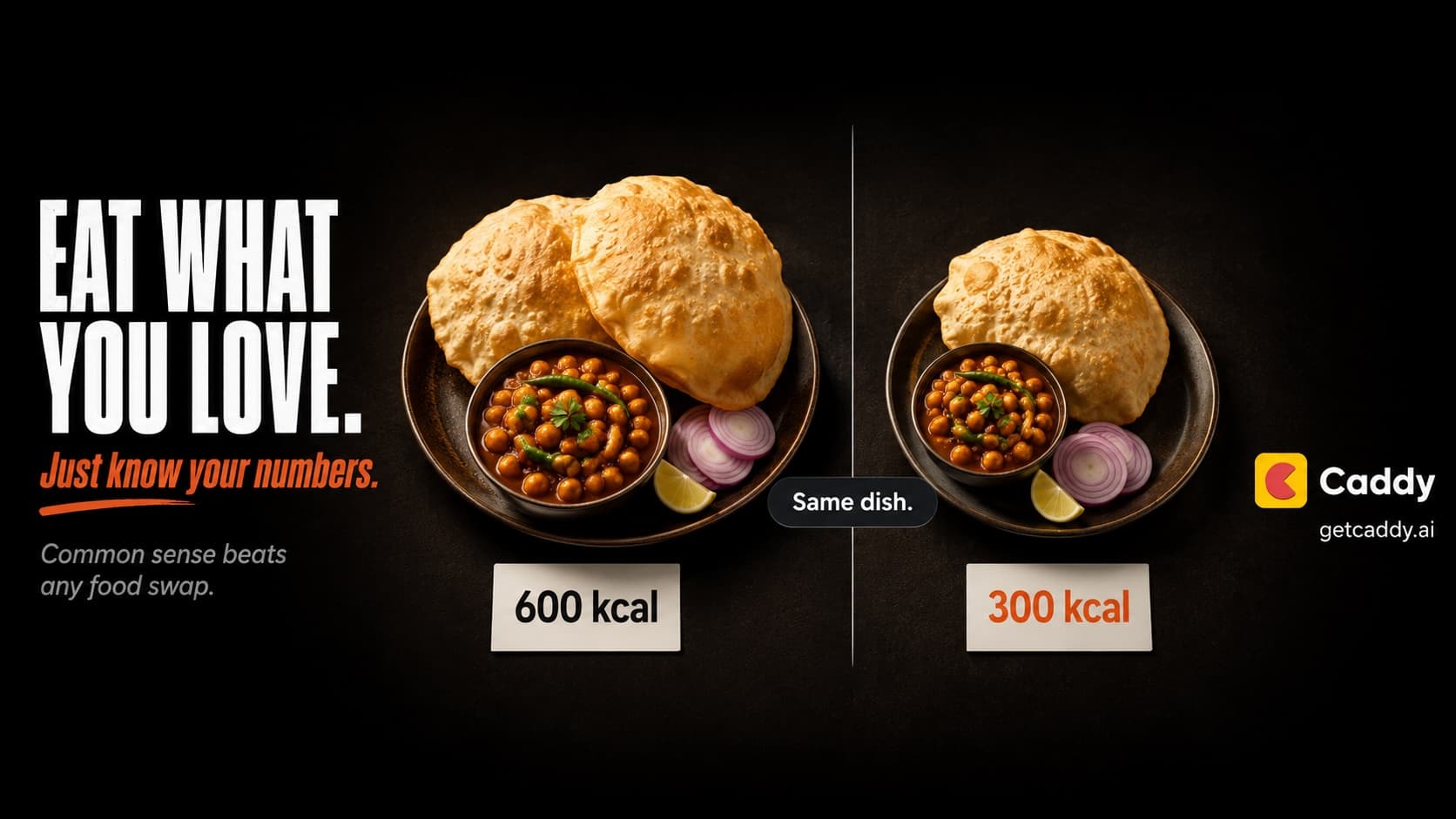
Your Brain Is Craving Chole Bhature. The Internet Says Eat Matar Kulcha. Your Brain Says No.
Written by Rishi Bhojnagarwala
Medically Reviewed by Dr. Hetal Pal, PhD in Nutrition Science
The entire healthy food swap genre is built on one assumption. That your brain is easy to fool. It is not.
The Reel You Have Definitely Seen
You are scrolling through Instagram on a Sunday morning and a craving hits. Chole bhature. The specific kind — the puffed bhature, the spicy chole, the raw onion on the side.
Your phone, which has been paying close attention to your interests, immediately serves you a reel from a health app or a certified nutritionist.
Craving chole bhature? Try matar kulcha instead! Same satisfaction, fewer calories, smarter choice!
There are colourful graphics. There is upbeat music. There is a before-and-after comparison showing 1,000 calories versus 500. There are 40,000 likes.
And somewhere in the back of your mind, something feels off — but you cannot quite articulate what.
Here is what is off.
The Brain Does Not Work Like That
The craving you are experiencing does not start in your stomach. It starts in your brain. Specifically, in the neural pathways associated with reward, pleasure, memory, and the anticipation of dopamine release.
Your brain is not asking for carbohydrates and chickpeas in general. It is asking for the specific sensory experience of chole bhature — the texture of the bhatura, the particular spice profile of the chole, the smell, the temperature, the memory of every time you have eaten it before and felt good.
Matar kulcha is a completely different sensory experience. It tastes different. It feels different. It smells different. It is made differently. And your brain — the one you are trying to satisfy — knows the difference immediately and completely.
When you eat matar kulcha because you were craving chole bhature, you do not satisfy the craving. You complete a transaction. You consumed calories. But the neural pathway that was asking for something specific did not get what it asked for. The dopamine you were expecting did not arrive at the expected intensity. The satisfaction loop does not close.
This is why you find yourself still thinking about the chole bhature an hour after finishing the matar kulcha. The craving did not go away. You just added 500 calories of matar kulcha on top of it.
The Logic Problem Nobody Addresses
Here is the argument the food swap content is actually making.
Chole bhature: approximately 1,000 calories. Matar kulcha: approximately 500 calories. Therefore eat matar kulcha to save 500 calories and get the same satisfaction.
But look at what this argument assumes. It assumes you cannot modify your consumption of the thing you actually want. It assumes the choice is binary — full plate of chole bhature or completely different food — and never considers a third option.
What if you ate half a plate of chole bhature?
Half a plate of chole bhature: approximately 500 calories. Matar kulcha full plate: approximately 500 calories.
Same calorie outcome. Completely different satisfaction experience. The craving gets answered. The brain gets what it was asking for. The dopamine arrives. You stop thinking about the food you wanted.
If you are telling a person that they should choose matar kulcha over chole bhature because the calorie count is lower — you are simultaneously telling them that they have the willpower and self-control to choose an entirely different food over the thing they are craving. You are assuming a very high level of behavioural flexibility.
And then you are not applying that same flexibility to the obviously simpler solution, which is: eat less of the thing you actually want.
If the mind is flexible enough to choose matar kulcha over chole bhature, it is flexible enough to stop at one bhatura instead of two. If it can choose thin crust over cheese burst, it can choose one slice of cheese burst instead of two. The cognitive flexibility required for portion adjustment is significantly less than the cognitive flexibility required for complete food substitution.
The simpler behaviour change always wins over the more complex one. This is not a nutrition insight. It is basic psychology.
The Cheese Burst Situation
The same logic applies perfectly to the pizza example that has become a staple of healthy eating content.
Craving cheese burst pizza? Choose thin crust instead!
Two slices of cheese burst pizza: approximately 800 calories. Two slices of thin crust pizza: approximately 400 calories.
The argument is that you save 400 calories by choosing thin crust. Correct.
But one slice of cheese burst pizza is approximately 400 calories.
You can eat one slice of the thing you actually want, achieve the identical calorie outcome, and experience the satisfaction of having eaten the thing you were craving rather than a compromise.
The person who eats one slice of cheese burst and feels satisfied has done something significantly more sustainable than the person who eats two slices of thin crust, feels vaguely unsatisfied, and thinks about cheese burst for the rest of the evening.
What Food Swaps Are Actually Selling
The healthy food swap content genre is not primarily a nutrition intervention. It is a content format.
It is visually clean and easy to produce. Two food items side by side. A calorie comparison. An arrow or VS graphic. The implication that one choice is smart and the other is weak. The viewer feels momentarily informed and possibly slightly guilty about their food preferences.
It performs well on social media because it generates engagement — people share it to demonstrate health consciousness, debate it in comments, or save it to a folder they will never open again.
What it does not do is help anyone develop a sustainable, enjoyable relationship with food. It does not address the actual mechanism of food cravings. It does not acknowledge that food is not purely fuel — it is pleasure, memory, culture, comfort, and identity. It does not solve the problem it claims to solve.
The person who successfully follows food swap advice indefinitely is a person who did not need it in the first place. Anyone with enough discipline to consistently choose matar kulcha over chole bhature has enough discipline to simply eat less chole bhature. The food swap is a complicated solution to a problem that has a simpler solution sitting right next to it.

The Actually Simple Version
Here is the framework that requires the least behavioural change and produces the most satisfaction.
Eat what you love. Eat an appropriate amount of it. Know what that amount is.
Not "eat a nutritionally approved alternative." Not "train yourself to prefer less enjoyable foods." Not "decode your cravings as mineral deficiencies and address them with superfoods." Just eat less of the thing you actually want.
This is not a revolutionary insight. It is common sense that somehow became radical in a wellness industry that profits from complexity.
A chole bhature craving answered with a half portion of chole bhature is a satisfied craving. A brain that got what it asked for. A meal that was enjoyed rather than endured. And a calorie outcome that is numerically identical to the matar kulcha alternative.
The difference is that one of these outcomes is sustainable indefinitely. You can eat half portions of things you love for your entire life. You cannot eat foods you do not want indefinitely — at some point the restriction breaks and the pendulum swings in the other direction.
What You Actually Need to Make This Work
The only tool this approach requires is awareness of what you are eating and how much.
Not a meal plan. Not a list of approved foods. Not a certified nutritionist sending you swap suggestions on WhatsApp. Just the knowledge of approximately how many calories are in the portion you are about to eat, and roughly where that sits in your daily total.
With that awareness you can eat chole bhature, cheese burst pizza, gulab jamun, biryani, or anything else you love — and make informed portion decisions that keep you on track without requiring you to eat food you do not want.
This is what Caddy is built for. Not to tell you what to eat. To tell you what you are eating, how much it contains, and whether today is a Score 8 day. The rest of the decisions stay exactly where they belong — with you.
About Caddy Caddy tracks what you actually eat — not what you were supposed to eat. Built on one of India's most comprehensive food databases with 4 million Indian dishes tracked accurately, Caddy gives you one daily score so you always know where you stand. Eat what you love. Know how much. Score 8. Visit getcaddy.ai