
Craving Chocolate? Your Body Isn't as Smart as Instagram Thinks
Written by Rishi Bhojnagarwala
Nutrition Reviewed by Dr. Hetal Pal, PhD in Nutrition Science
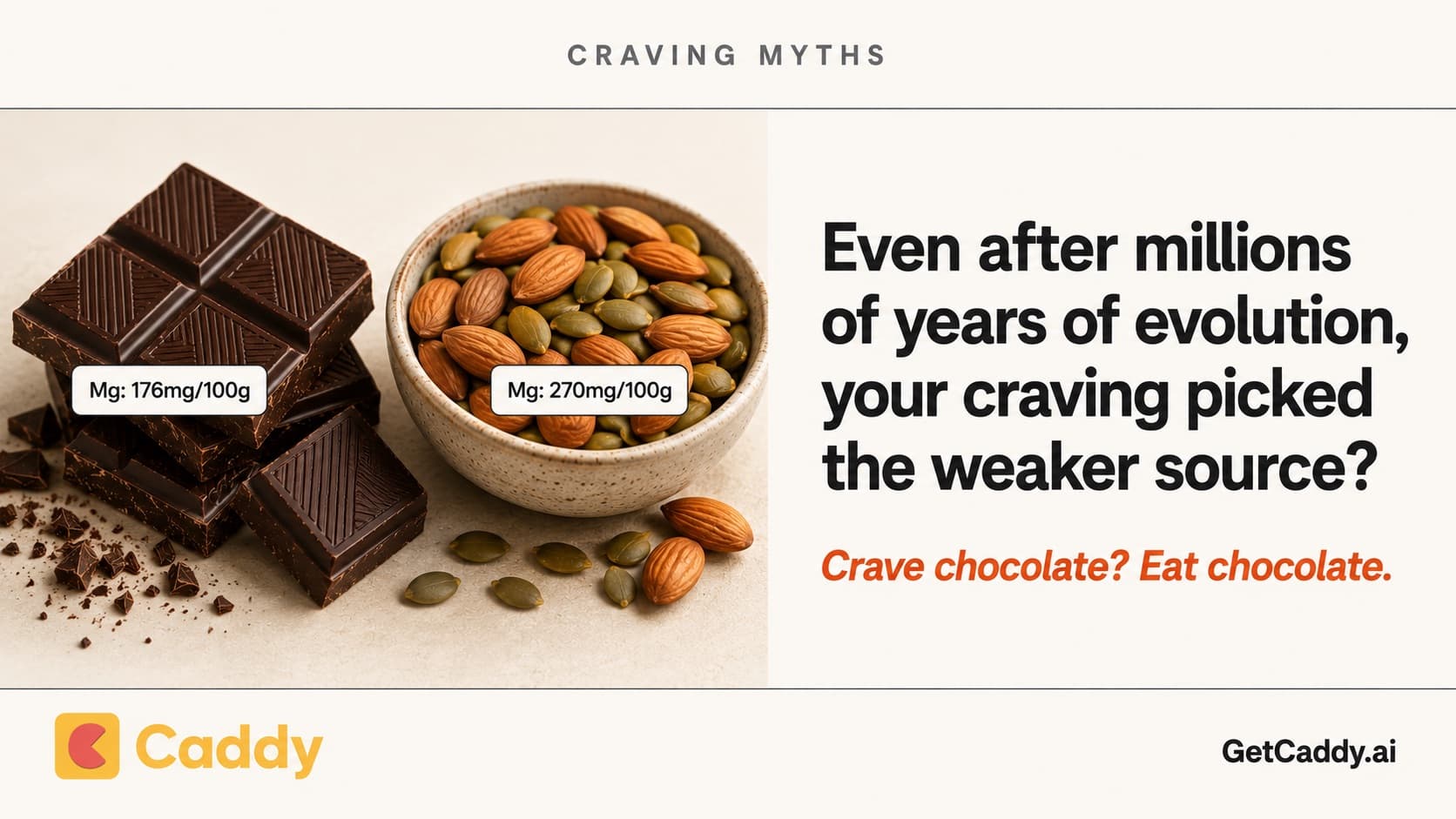
Millions of years of evolution, and this is the system we ended up with: a body that supposedly signals "I need magnesium" by making you crave chocolate — instead of the pumpkin seeds and almonds sitting right there with more magnesium in them. If that's really how deficiency signaling works, evolution owes us an explanation.
This is the promise behind a huge number of wellness reels: craving X means you're deficient in Y, and the fix is always conveniently specific. It sounds like biology. Mostly, it isn't.
The Pattern You've Probably Seen
Four versions of this claim show up constantly on wellness content:
Craving chocolate → magnesium deficiency. The most common version, and the one that's actually been tested (more on that below).
Craving sugar → protein deficiency. The logic sounds reasonable: protein slows digestion and helps stabilise blood sugar, so a protein-light meal can lead to an energy dip that triggers a sugar craving later. That's a real effect of that meal — but it gets stretched into "you have a protein deficiency," a much bigger claim the mechanism doesn't actually support.
Craving oily or fried food → calcium or essential fatty acid deficiency. There's no controlled study showing calcium or EFA supplementation reduces fried-food cravings. Fried food is craved for the same reason chocolate is: fat, salt, and crunch are intrinsically high-reward, independent of what's missing in your diet.
Craving carbs, bread, or pasta → chromium deficiency. The most exotic version. Chromium deficiency is genuinely rare in humans, and turning a narrow endocrinology finding into "your carb craving means low chromium" is a bigger leap than the science supports.
Each one is stated with total confidence online. None has been demonstrated to work the way the claim implies.

What Happens When You Actually Test It
The chocolate-magnesium claim has actually been tested directly, which is more than most viral nutrition claims can say. In a 1994 study published in Physiology & Behavior, researchers gave chocolate cravers one of several treatments the moment their craving hit: a real chocolate bar, a "white chocolate" version with the same calories and texture but none of chocolate's pharmacological compounds, cocoa powder in capsule form (all the chemistry, none of the taste), a placebo, or nothing. If the craving were really the body chasing magnesium or any other compound in chocolate, the cocoa capsules should have worked. They didn't — capsules performed no better than placebo, even 90 minutes later. Only eating actual chocolate reduced the craving.
That result lines up with a broader review of the food-craving psychology literature, which notes that the deficiency explanation for cravings seems intuitive but the supporting evidence is thin — cravings track far more consistently with conditioning, habit, and reward than with what the body is actually short on. A separate review specifically on chocolate cravings reaches the same conclusion: chocolate's hedonic appeal — its fat, sugar, texture, and aroma — is the dominant driver, not a nutrient the body is chasing.
The Logic Problem Nobody Mentions
Even where a correlation genuinely exists, these claims usually get the direction backwards. Take "craving ice cream means you're low on calcium." It's just as plausible that someone is low on calcium because their diet leans heavily on ice cream instead of calcium-rich food — not the other way around. A craving and a nutrient gap can coexist without one causing the other, and most of these reels never stop to ask which direction the arrow actually points.
The Two Cravings That Are Actually Real
Here's what makes this worth writing about instead of just mocking: the deficiency-craving idea isn't always wrong. Two examples hold up.
Salt craving and sodium deficiency is a genuine, well-mapped physiological mechanism. When the body runs low on sodium, hormonal systems — aldosterone and angiotensin II — directly activate the neural circuits that drive salt-seeking behaviour. This isn't a loose correlation; it's a documented biological pathway.
Pica, and specifically pagophagia (compulsively craving and chewing ice), is consistently associated with iron deficiency — occurring in as many as 50% of patients with iron deficiency anemia — even though doctors are still not entirely sure why. The craving frequently resolves once iron levels are corrected — a pattern documented across decades of case reports.
Both are legitimate exceptions. Neither one is "craving chocolate means low magnesium."

So Why Chocolate and Not Broccoli?
If cravings were really a precise nutrient-detection system, the foods people crave most should track with the foods that actually deliver what's supposedly missing. They don't. As Sharon Palmer, RDN, put it in Fox News' coverage of this exact myth, if cravings were genuinely related to something you need, "wouldn't you be craving kale or apples, not ice cream and French fries?"
Culture makes the case even harder to ignore. Chocolate is the most-craved food in North America, but research on Egyptian adults found only 1-6% reported craving chocolate, with savory foods far more commonly craved instead. Japanese women, meanwhile, most frequently crave rice, with chocolate a distant second. Magnesium deficiency doesn't recognise borders. Cultural food exposure does.
Nuts, seeds, and leafy greens all contain more magnesium than chocolate does. If the body were actually running a deficiency-alert system, it's sending you to the wrong aisle.

What To Actually Do With a Craving
None of this means cravings are meaningless — sodium and iron prove that some of them genuinely are the body talking. It means you can't diagnose yourself off a 30-second reel. A craving is shaped by habit, stress, sleep, hormonal cycles, and reward-seeking far more reliably than by a specific nutrient gap.
If you're actually worried about a deficiency, the fix isn't decoding your cravings — it's checking your bloodwork, or tracking what you're eating for long enough to see the real pattern. That's the whole idea behind Score 8: not guessing at what your body "must" be missing, but knowing, from what you actually ate, whether your day added up.
About Caddy
Caddy is a nutrition and weight-loss companion built for Indians who'd rather track what they actually ate than guess what their cravings mean.
Know what you ate. Know how much.
Score 8. Lose weight. That's it.
Sources
Frequently Asked Questions
- Does craving chocolate mean I'm magnesium deficient?
- Not reliably. A controlled study found cocoa capsules (all of chocolate's compounds, none of the taste) did nothing for chocolate cravings, while real chocolate did — pointing to taste and reward, not a mineral deficiency.
- Are any food cravings actually linked to real deficiencies?
- Yes, two are well documented: salt cravings linked to sodium deficiency, and pica/ice-craving (pagophagia) linked to iron deficiency. Both have identifiable physiological mechanisms.
- Why do sugar and fried food cravings get blamed on deficiencies too?
- The same pattern shows up with sugar (blamed on protein deficiency) and fried food (blamed on calcium or essential fatty acid deficiency). Neither has strong evidence behind it — both are more consistently explained by taste, habit, and stress.
- If cravings aren't about deficiencies, what are they about?
- Mostly conditioning, habit, emotional state, and reward-seeking. Research shows cravings track much more closely with these factors than with actual nutrient status.
- How can I actually check if I'm deficient in something?
- Bloodwork, not cravings. If a specific craving is persistent and unusual — especially wanting to chew ice or non-food items — it's worth mentioning to a doctor, but guessing from a viral chart isn't a diagnosis.
Score 8 to lose weight
Your simplest way to eat smarter with Indian food
Get Caddy