
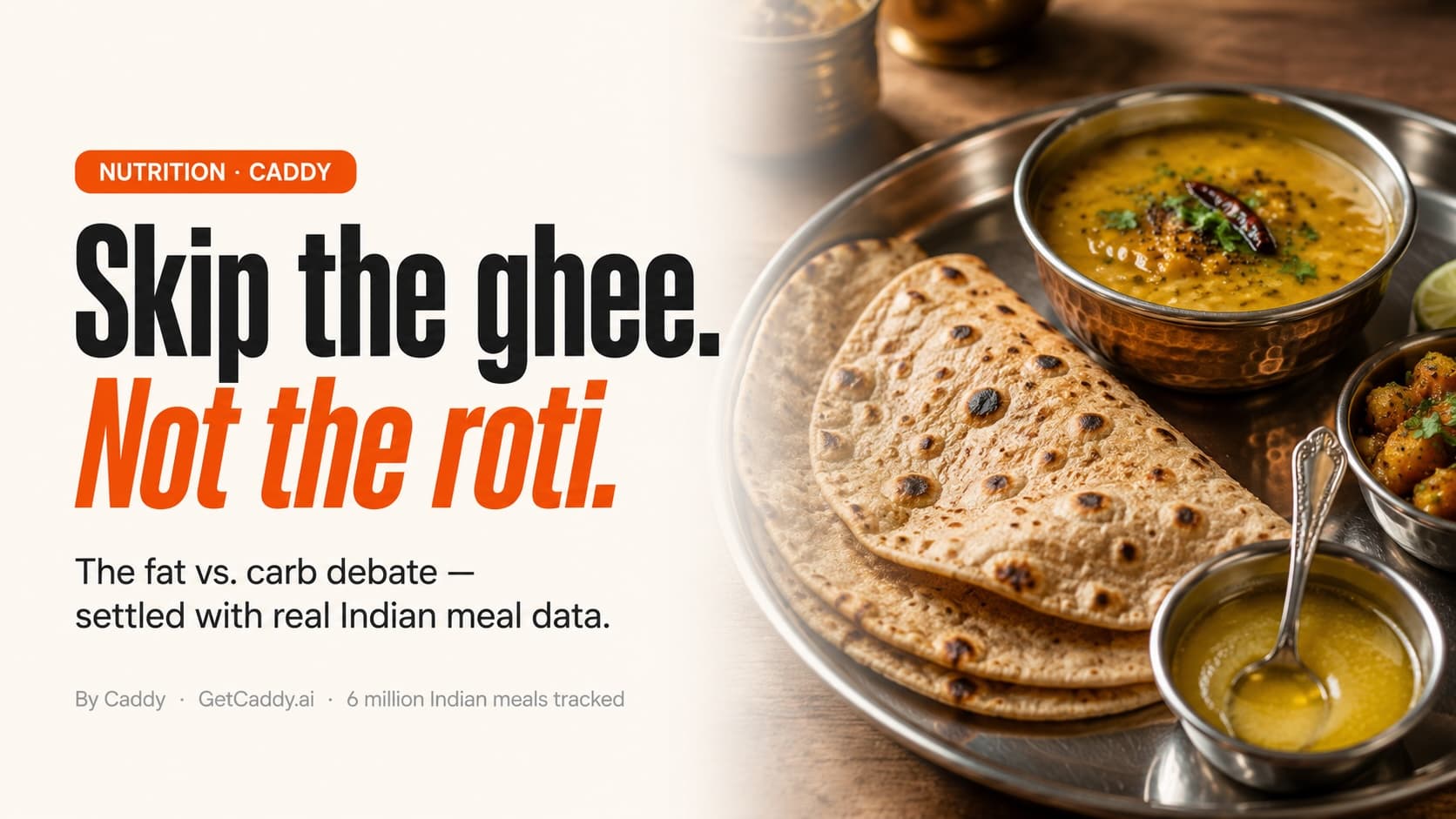
Why Cutting Ghee Gets You Further Than Cutting Roti
Written by Rishi Bhojnagarwala
Medically Reviewed by Dr. Hetal Pal, PhD in Nutrition Science
The great Indian weight loss debate has been raging in the wrong direction. Here's the math nobody is showing you.
Introduction: The Roti Is Not Your Enemy
If you have ever tried to lose weight in India, someone has told you to cut your rotis. Reduce your rice. Go low-carb. Replace your dal-chawal with a protein shake. The implicit message, repeated across gyms, Instagram reels, and well-meaning relatives, is that carbohydrates are the reason Indians struggle with weight.
The data tells a different story.
The average Indian meal is not excessively high in carbohydrates relative to global norms. What it is — consistently, invisibly, across breakfast, lunch, and dinner — is high in added fat. Cooking oil in the sabji. Ghee on the roti. Butter on the paratha. Cream in the curry. Tadka in the dal. Fat accumulates in Indian cooking the way water accumulates in a slow leak — quietly, constantly, and in quantities that most people never actually count.
This post is about the math. Simple, specific, and built on a decade of real Indian food data.
The Basic Science: Why Fat Calories Hit Differently
Before getting to rotis and ghee, one number matters more than anything else in this conversation:
1 gram of fat contains 9 calories. 1 gram of carbohydrate contains 4 calories. 1 gram of protein contains 4 calories.
This is not a diet philosophy. It is basic biochemistry. Fat is more than twice as calorie-dense as carbohydrates or protein by weight.
The practical implication is significant: a small reduction in fat intake produces a much larger calorie saving than the same reduction in carbohydrates. You do not need to eat dramatically less food. You need to eat food with less invisible fat in it.

The Roti-Ghee Calculation: A Real Indian Day
Let's run the numbers on a typical Indian eating pattern.
A person eating 4–5 rotis across the day — two at lunch, two or three at dinner — is consuming approximately 300–350 calories from the rotis themselves. This is a reasonable, moderate carbohydrate intake that also delivers fiber, B vitamins, and sustained energy.
Now add the ghee.
A typical Indian household applies ghee generously. A single roti with ghee gets approximately 3–5 grams applied — sometimes more if it is a paratha or a roti eaten at a dhaba. Across 4–5 rotis per day, this adds up to 15–25 grams of ghee daily from rotis alone. That does not count the ghee in dal tadka, the butter on bread, or the oil used in cooking.
At 9 calories per gram, 20 grams of ghee = 180 calories. At 9 calories per gram, 25 grams of ghee = 225 calories.
Now compare: removing 2 rotis from your day saves approximately 140–160 calories and also removes fiber, satiety, and a food you genuinely enjoy. Removing the ghee from your rotis — keeping every single roti on your plate — saves 150–225 calories and removes only added fat. The roti stays. The satisfaction largely stays. The calorie saving is the same or greater.
Over 30 days, reducing ghee on rotis by 15–20 grams per day produces a calorie deficit of approximately 4,500–6,000 calories. That is roughly 0.6–0.8 kg of fat lost. Without removing a single roti.
The Broader Problem: Where Fat Hides in an Indian Day
Ghee on rotis is just one source. The real picture of fat in Indian eating is considerably larger.
Cooking oil in sabji and curries: A typical Indian curry or sabji uses 2–4 tablespoons of oil per preparation. A family cooking twice daily may use 4–6 tablespoons of oil in home cooking alone. One tablespoon of oil is approximately 14 grams of fat and 120–125 calories.
Dal tadka: A proper tadka uses 1–2 teaspoons of ghee or oil with mustard seeds, garlic, and chillies. This adds 5–10 grams of fat and 45–90 calories to what is otherwise a low-fat, high-protein dish. Note — a 5-gram tadka is perfectly appropriate and worth keeping. It is the 15–20 gram tadka that adds up.
Fried snacks: 30–40 grams of sev, chakli, or namkeen — a very modest snack portion — contains 8–12 grams of fat and 140–180 calories. Much of this fat is invisible inside the snack itself, not sitting visibly on the surface.
Full-fat dairy: A 250ml glass of full-fat milk contains approximately 8–9 grams of fat. Switching to low-fat milk for two daily servings saves approximately 10 grams of fat and 90 calories.
Peanut butter and thick spreads: A 30-gram serving of peanut butter contains approximately 16 grams of fat and 180 calories. The same protein with significantly less fat is available from 50 grams of paneer at approximately 6 grams of fat and 65 calories.
None of these are foods to eliminate. They are foods where small reductions or substitutions produce meaningful calorie savings without changing the character of the meal.

The Fiber Argument: Why Cutting Carbs Backfires
Here is the part of the low-carb argument that nobody mentions: 100% of your daily dietary fiber comes from carbohydrates.
Fiber is not a minor nutritional footnote. It is fundamental to gut health, blood sugar regulation, satiety, and increasingly — to metabolic health broadly. The research on gut microbiome health has shifted fiber from a secondary concern to a primary one. Fiber is, as the nutritional conversation is beginning to acknowledge, the new protein.
When you cut rotis, rice, and dal aggressively in pursuit of a low-carb deficit, you are also cutting your primary fiber sources. The result is typically increased hunger, digestive disruption, and a deficit that is much harder to sustain than one achieved through fat reduction.
A roti contains approximately 2–3 grams of fiber. Dal contains 3–5 grams per serving. A typical Indian meal built on roti, dal, and sabji delivers 8–12 grams of fiber — a significant contribution to the recommended 25–30 grams daily. Remove those foods and you need to consciously replace that fiber from somewhere. Most people do not.
Cutting fat does not touch fiber. Your gut health stays intact. Your satiety signals stay functional. The deficit is easier to maintain because you are not fighting hunger and digestive discomfort at the same time.
The Satiety Science: Why Carbs Keep You Fuller
A calorie deficit only works if you can sustain it. Sustainability depends on hunger management. And hunger management depends substantially on fiber and volume — both of which carbohydrates provide.
A meal of 2 rotis, dal, and sabji occupies significant physical volume in the stomach, digests slowly due to its fiber content, and produces sustained satiety signals. A meal with the same calorie count but derived from higher fat, lower fiber sources digests faster, produces less physical volume, and typically results in hunger returning sooner.
This is why simply cutting carbs and replacing them with fat and protein — without careful attention to total calories — often does not produce the expected deficit. The calorie math may look correct on paper, but the hunger response changes in ways that lead to compensatory eating.
The most sustainable path to calorie deficit for most Indians is not a dramatic reduction in carbohydrates. It is a reduction in invisible, added fat — the kind that contributes significant calories without contributing equivalent satiety.

A Practical Guide: Where to Cut Fat in an Indian Day
Based on Caddy's analysis of over 6 million Indian meal data points, here are the highest-impact, lowest-sacrifice fat reductions available in a typical Indian day:
Swap 1 — Ghee on rotis: Reduce from 15–20g daily to 0–5g on most days. Saving: 90–135 kcal. Fat reduced: 10–15g. What you lose: a flavour note. What you keep: every roti.
Swap 2 — Fried snack to toast with jam: Replace 30–40g of sev or namkeen with one slice of toast and jam. Saving: 80–120 kcal. Fat reduced: 8–12g. What you lose: the crunch occasionally. What you keep: a satisfying snack.
Swap 3 — Fried egg to boiled or poached: Replace a fried egg or omelette cooked in oil with a boiled or poached egg. Saving: 80–100 kcal. Fat reduced: 8–10g. What you lose: the crispy edges occasionally. What you keep: all the protein.
Swap 4 — Peanut butter to paneer: Replace a 30g serving of peanut butter with 50g of fresh paneer. Saving: 60–80 kcal. Fat reduced: 8–10g. What you gain: more protein with less fat.
Swap 5 — Full-fat to low-fat milk: Replace full-fat milk in chai or as a glass with low-fat. Saving: 40–50 kcal per serving. Fat reduced: 5g. What you lose: nothing noticeable. What you keep: the ritual.
Pick any three of these daily. That is 240–400 calories saved. Over 30 days: 7,200–12,000 calories. Approximately 1–1.5 kg of fat per month. Without touching your roti. Without eliminating any food group. Without fighting your fiber intake.

The Ghee Bhakt Addendum
Ghee is not the villain of this post. Ghee is a traditional fat with real culinary value, a high smoke point, and a genuinely good flavour profile. 5 grams of ghee in your dal tadka is not a problem — it is appropriate and culturally meaningful.
The problem is 20–25 grams of ghee per day applied to rotis alone, on top of cooking oil in every dish, on top of butter on toast, on top of full-fat dairy. The cumulative invisible fat across a typical Indian day is where the excess lives — not in the carbohydrates.
Eat your ghee. Just know how much.
How Caddy Helps
Caddy is India's only nutrition tracking app built ground-up on Indian food data — not adapted from a Western database where idli, dal, or rajma don't exist with accurate nutritional profiles.
Built over a decade, formerly as Bon Happetee with over 1 lakh downloads, Caddy has tracked over 6 million Indian meals and helped users lose over 50,000 kgs collectively — through one simple daily mechanism: Score 8.
Score 8 means you're in calorie deficit. Lose weight. That's it.
No complicated macro tracking. No meal plans. No food restrictions. Just awareness of what you ate and how much — with the most accurate Indian food database available anywhere.
Score 8. Lose weight. That's it. GetCaddy.ai
Frequently Asked Questions
- 1. Is ghee making me gain weight, or is it the roti?
- For most people, excess ghee adds more calories than the roti itself. Ghee contains more than twice the calories per gram compared to carbohydrates, so reducing added ghee or oil often creates a bigger calorie deficit than cutting rotis or rice.
- 2. Should I stop eating roti or rice to lose weight?
- Not necessarily. Roti and rice can be part of a healthy weight loss diet if you're in an overall calorie deficit. Instead of eliminating carbohydrates, many people get better results by reducing invisible fats like excess ghee, oil, butter, and fried foods while keeping balanced Indian meals.
- 3. Why is cutting added fat often more effective than cutting carbs?
- Fat provides 9 calories per gram, while carbohydrates provide 4 calories per gram. That means small reductions in cooking oil, ghee, or butter can save more calories without removing filling, fiber-rich foods like roti, dal, and rice.
- 4. Can I eat ghee while trying to lose weight?
- Yes. Ghee doesn't need to be eliminated. Small amounts can fit into a healthy diet, but the total quantity matters. Being mindful of how much ghee and cooking oil you consume throughout the day is often more important than avoiding any single food.
- 5. What's the easiest way to create a calorie deficit on an Indian diet?
- Start by tracking what you eat and identifying hidden sources of calories such as cooking oil, ghee, fried snacks, and high-fat spreads. Small changes to these foods can help create a sustainable calorie deficit without giving up your favourite Indian meals.
Try Caddy
Your simplest way to eat smarter with Indian food
Download