
The Clean Label Permission Slip — And Why It Is Making You Eat More
Written by Rishi Bhojnagarwala
Medically Reviewed by Dr. Hetal Pal, PhD in Nutrition Science
Breaking news: eating three date-sweetened chocolate bars is not healthier than eating one regular chocolate bar. The scientists have looked into it.
The Announcement Nobody Made
The better-for-you food industry in India has achieved something genuinely impressive in the last decade.
It has convinced a large and growing number of health-conscious urban Indians that the primary problem with the food they were eating was the ingredient list — and that fixing the ingredient list fixes the eating.
It has not fixed the eating. In many cases it has made it significantly worse. And the mechanism through which this happens is so simple and so obvious that the industry's silence on the subject is itself a kind of answer.
This piece is about the overconsumption paradox — the quiet dirty secret at the heart of the clean label food revolution — and what it actually means for anyone trying to manage their weight, their health, or their relationship with food.
The Maths Nobody Does at the Shelf
Let us start with a specific, real comparison that illustrates the problem precisely.
A standard Snickers bar contains approximately 250 calories. It costs approximately ₹30 at most retail outlets. It is made with sugar, milk chocolate, caramel, peanuts, and several ingredients that a food marketing team would describe as "not clean." It has been available in India for decades and is universally understood to be a treat — a deliberate indulgence consumed with full knowledge of its nature.
A clean label, date-sweetened, no-nasties chocolate bar from one of India's premium better-for-you food brands contains approximately 220 to 240 calories. It costs approximately ₹160 to ₹200 per bar. It contains dates, nuts, dark chocolate, and ingredients that your grandmother genuinely cannot pronounce — though to be fair, most grandmothers also cannot pronounce "tigernut" or "ashwagandha" and we do not hold that against them. The packaging is beautiful. The brand story is compelling. The ingredient list is clean.
Now here is the question that the industry would prefer you did not ask.
What happens to the calories when you give the chocolate a permission slip?
The Snickers buyer, knowing they are eating a treat, typically eats one. The decision has a natural stopping point built into it — the awareness of indulgence creates a portion boundary. You ate the Snickers. You had a treat. You are done.
The clean label chocolate buyer, knowing they are eating something healthy, often eats more than one. The decision has no natural stopping point because there is no indulgence to register. You are not treating yourself. You are feeding yourself clean ingredients. Have another. It is fine. It is dates.
Three clean label bars later: 690 calories. ₹540 spent. Completely guilt-free.
The Snickers would have been 250 calories, ₹30, and one bar. The clean bar is more than twice the calories at eighteen times the price — not because of anything in the ingredients, but because the guilt that would have stopped you at one was removed by the label.

What the Clean Label Actually Removed
Here is the insight that the better-for-you food industry is structurally unable to communicate because doing so would undermine its entire marketing position.
The guilt around eating regular chocolate was not just a feeling to be fixed. It was also a portion control mechanism.
When you knew you were eating something indulgent, that knowledge created friction. It made you pause before the second one. It made you think about whether you actually wanted it or were just reaching out of habit. It created a small but real moment of conscious decision-making that moderated your consumption in ways you were not aware of.
The clean label removed that friction. It told you the food was fine — better than fine, actually, it was nutritious and honest and clean — and in doing so it removed the only speed bump between you and the fourth protein ball of the evening.
This is not speculation. It is a well-documented phenomenon in consumer behaviour research called the health halo effect — the tendency for people to consume more of foods they perceive as healthy, often overconsuming to the point where the health benefit of the cleaner ingredient profile is negated entirely by the additional quantity consumed.
The clean label food industry knows about the health halo effect. Every brand in the space has access to the same consumer psychology research. The decision not to address it in their marketing is not an oversight. It is a commercial choice.
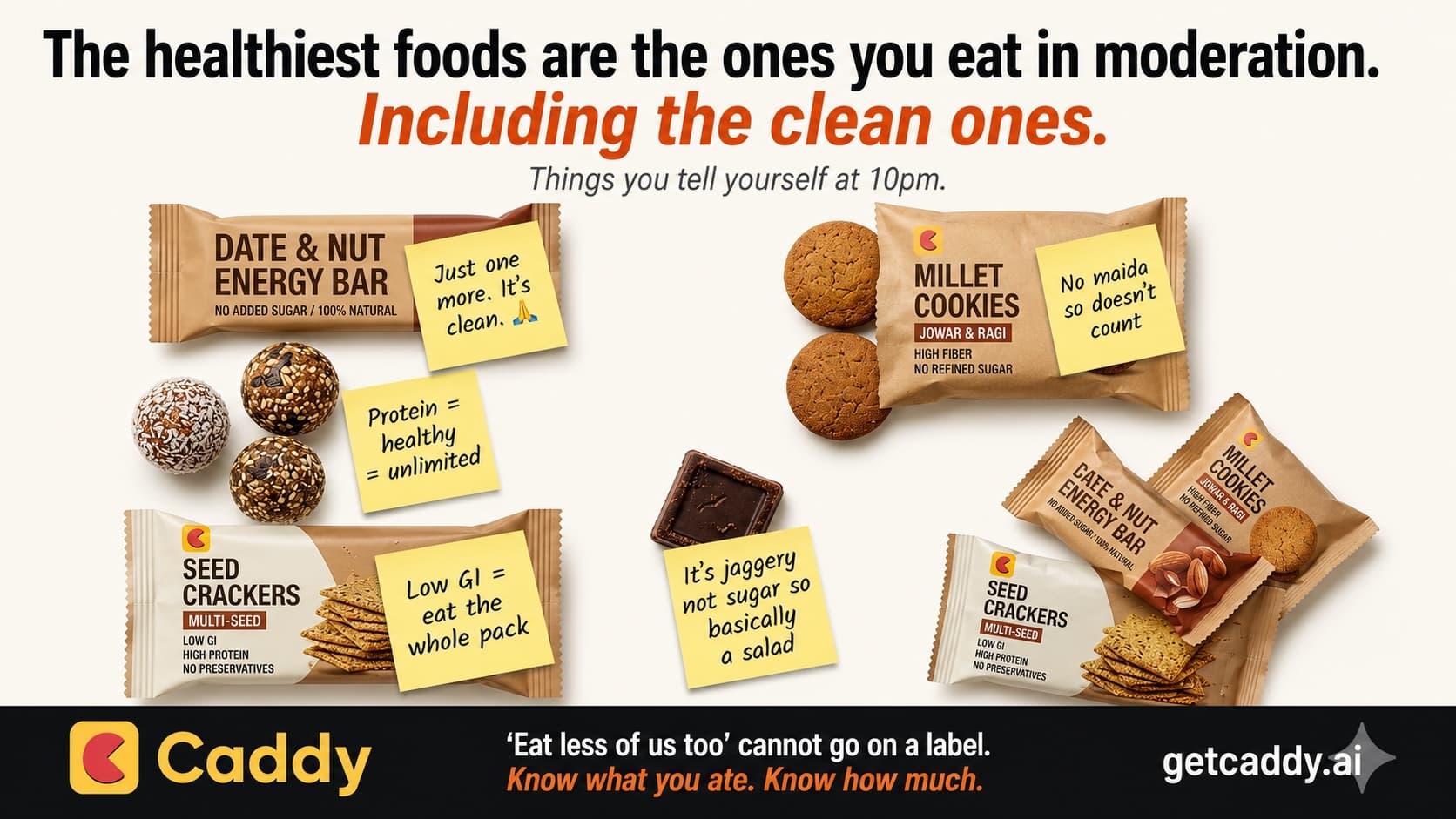
Because "eat less of us too" cannot go on a label.

The Stress-Eating Problem That Clean Ingredients Cannot Fix
Here is the most important point in this entire piece — and the one that most health food brand marketing is most carefully designed to avoid.
If you were eating six biscuits every night because of stress, boredom, habit, or the specific comfort that comes from something sweet in your hand while watching television — you were not eating six biscuits because of what was in them.
You were eating six biscuits because of the behaviour.
Switching to six date-sweetened millet cookies with no refined sugar and 4 grams of protein per cookie does not address the stress. It does not address the boredom. It does not address the habit or the comfort-seeking or the hand-to-mouth routine of late evening. It simply upgrades the ingredient list of the behaviour while leaving the behaviour entirely intact.
And in most cases it makes the behaviour worse — because the guilt that was the only natural limit on the six biscuits is now gone, replaced by the quiet satisfaction of eating something clean. You might eat eight cookies instead of six biscuits. You will almost certainly feel better about it. Your calorie intake will be higher.
This is the overconsumption paradox in its purest form. The product improved. The behaviour worsened. The caloric outcome was worse than before. And no brand in the clean label space has any financial incentive to tell you this.
The Marketing Architecture of "We Are Good Because Others Are Bad"
The clean label food movement in India has built its commercial success on a specific and remarkably effective narrative architecture.
The narrative does not, for the most part, make positive claims about what the product does to your body. It makes negative claims about what the product does not contain. No refined sugar. No artificial colours. No preservatives. No palm oil. No ingredients you cannot pronounce.
This is a carefully chosen framing because negative absence claims are almost impossible to challenge. You cannot easily argue that a product being free of artificial preservatives is not a good thing. The absence of bad ingredients becomes the presence of virtue — without requiring the brand to prove any specific health benefit.
The architecture of this narrative also requires a villain. The conventional food industry — the Snickers bars, the Oreos, the Parle-G, the aloo bhujia — becomes the implicit comparison point against which every clean label product is positioned. We are not that. We are the alternative to that. We are what you choose when you choose better.
The problem with this architecture is that it conflates ingredient quality with consumption quantity. It implies that replacing bad ingredients with good ones fixes the eating — when the evidence suggests that for a significant portion of consumers, it does the opposite.
The simplest truth in nutrition — eat everything in moderation, stop when full, move reasonably — has never built a hundred-crore food company. It never will. Because it cannot be put on packaging, it cannot be marketed to a specific lifestyle identity, and it does not require the consumer to buy anything new.
Which is exactly why nobody in the industry is saying it.

What Your Grandmother Already Knew
There is an observation that cuts through the entire clean label debate more cleanly than any nutritional argument.
Your grandmother ate white rice, full-fat dahi, homemade mithai, and plenty of food that would fail every clean label criterion currently being applied by the premium health food industry. She could not pronounce ashwagandha or tigernut or even the word protein in the way it is currently used in fitness marketing.
She also, in most cases, did not overeat. Not because she had exceptional willpower or nutritional sophistication. Because the food was just food — not a lifestyle identity, not a virtue signal, not a product that came with a permission slip to eat more of it.
When the mithai was good, she had one. When dinner was ready, she ate until she was full and stopped. The relationship with food was governed by hunger and satisfaction, not by whether the ingredient list met an externally defined standard of cleanliness.
This is not nostalgia for a simpler time. It is an observation about what happens to eating behaviour when food is not invested with moral significance. When food carries no virtue, it requires no justification. And food that requires no justification is food that gets eaten in appropriate quantities.
The clean label movement has, with the best of intentions, made food deeply morally significant — which has made certain foods feel like they warrant unlimited consumption and others feel like they require confession. Neither of these relationships with food is healthy. And neither of them is what the ingredient list actually earns.
The Number That Cuts Through Everything
The antidote to the overconsumption paradox is not a better ingredient list. It is awareness.
Specifically, awareness of quantity — knowing how much of something you actually ate, regardless of how clean its ingredient list is. A date-sweetened chocolate bar at 230 calories is 230 calories whether it is clean label or not. Three of them at 690 calories is 690 calories whether you feel virtuous about it or not.
The moment you track what you eat — actually log it, actually see the number — the permission slip the label gave you disappears. Not because the food becomes bad. But because the quantity becomes visible. And visible quantity is self-regulating in ways that invisible quantity, however cleanly labelled, never is.
This is the insight behind Caddy. Not that clean label foods are bad. Not that regular chocolate is better. But that the number is the truth — and the number is the only thing the better-for-you food industry cannot put on its packaging, because if it did, you would stop at one.
The Bottom Line
The clean label food industry has solved a real problem — ingredient quality in Indian packaged food genuinely needed to improve, and the brands that pushed in that direction deserve credit for moving the market.
But it has created a new problem in solving the old one. By building its entire marketing narrative around ingredient virtue rather than consumption moderation, it has handed a large number of health-conscious Indians a permission slip to eat more — and positioned itself commercially in a way that makes it impossible to take that permission slip back.
The overconsumption of clean label food is not a fringe phenomenon. It is the predictable consequence of telling people that the quality of what they eat matters more than the quantity — when the evidence on metabolic health, weight management, and caloric balance suggests the opposite.
Eat everything. Eat less of it. Stop when full.
No brand will put that on a label. Caddy will show you the number.

About Caddy Caddy is built on one radical idea — know what you ate and how much. Whether you are eating a Snickers bar or a clean label date chocolate, Caddy gives you the actual number so your decisions are based on reality rather than the story on the packaging. Built for Indians, powered by one of India's most comprehensive food databases, and designed to cut through the noise of nutrition marketing with one simple score. Visit getcaddy.ai
Legal note: This piece critiques a category and a marketing approach rather than specific brands. No specific brand is named as harmful or making false claims. The piece explicitly acknowledges that ingredient improvement is genuine and credit-worthy. The argument is about consumer behaviour and marketing architecture, not product safety or regulatory compliance.