
Everything You Have Been Told About Cholesterol and Food Is Probably Wrong
The science moved on in the 1990s. The food industry's marketing department did not.
The Egg on Your Plate Is Not the Problem
If you are over 35 and grew up in an Indian household, there is a reasonable chance that at some point in your life someone — a parent, a doctor, a well-meaning relative at a family gathering — told you to be careful about eggs. Or ghee. Or full-fat dairy. Because cholesterol.
You may have switched to egg whites. You may have replaced ghee with refined vegetable oil. You may have stood in a supermarket aisle and chosen the bottle that said "cholesterol-free" over the one that did not, feeling quietly virtuous about your cardiovascular responsibility.
This piece is for you.
Because the cholesterol story that shaped a generation of Indian dietary decisions is, in significant part, wrong. Not slightly wrong. Not nuanced-and-complicated wrong. Structurally, foundationally wrong in ways that have caused millions of people to fear the right foods, trust the wrong labels, and completely miss the actual driver of the cholesterol problem they were trying to solve.
Let us go through it properly.

Myth 1: Fat and Cholesterol Are the Same Thing
They are not. They are not even close to the same thing.
Fat and cholesterol are two entirely different classes of molecules that happen to coexist in some of the same foods. The fact that they are often discussed together — and that high-fat diets are sometimes associated with cholesterol problems — has created a widespread conflation that serves food marketing far better than it serves human health.
Here is the actual distinction.
Dietary fat is a macronutrient. It is a source of energy. It comes in different forms — saturated, unsaturated, trans — and these different forms have different effects on your health. Fat is found in both animal and plant foods. Olive oil is almost entirely fat. Avocados are rich in fat. Nuts are full of fat.
Dietary cholesterol is a specific sterol compound found exclusively in animal-derived foods. Meat. Eggs. Dairy. Shellfish. That is the complete list of sources. No plant food contains cholesterol. Not one. Not olive oil, not avocado, not almonds, not coconut oil regardless of how many wellness influencers have strong opinions about it.
You can consume enormous quantities of plant-based fat and consume zero dietary cholesterol. You can consume a moderate amount of eggs and consume meaningful dietary cholesterol. These are entirely different nutritional situations and treating them as equivalent — as decades of "fat is bad" messaging effectively did — produces dietary decisions that make no scientific sense.
Myth 2: The "Cholesterol-Free" Label on Vegetable Oil Means Something
It does not. It has never meant anything. It is one of the most successful pieces of nutritional misdirection in the history of food marketing.
Every bottle of vegetable oil — sunflower, canola, groundnut, rice bran, whichever variety is currently being promoted as the heart-healthy option — is cholesterol-free. Not because of special processing or superior quality. But because vegetable oil comes from plants and plants do not produce cholesterol. It is like labelling water "gluten-free." Accurate. Completely meaningless. Designed entirely to create the impression of a health benefit that does not exist relative to any comparable product.

The "cholesterol-free" label became widespread in the 1980s and 1990s when dietary cholesterol was believed to be a primary driver of cardiovascular disease. Food manufacturers with products that happened to contain no cholesterol — because they contained no animal products — slapped the label on everything they could. It was a legitimate marketing opportunity based on the prevailing science of the time.
The prevailing science changed. The labels did not.
The current scientific consensus, reflected in major dietary guidelines from the American Heart Association, the European Society of Cardiology, and nutrition bodies globally, is that dietary cholesterol — the cholesterol you eat — has a relatively modest effect on blood cholesterol levels for most people. The relationship is real but far smaller than previously believed, highly variable between individuals, and significantly less important than other dietary and lifestyle factors.
The "cholesterol-free" label on your vegetable oil is not protecting your heart. It is protecting a marketing position established four decades ago that the food industry has no financial incentive to retire.
Myth 3: Your Blood Cholesterol Is Mostly Determined by What You Eat
This is the central myth. The one that underlies all the egg anxiety, the ghee guilt, and the cholesterol-free label worship. And it is wrong in a way that is both liberating and slightly uncomfortable.
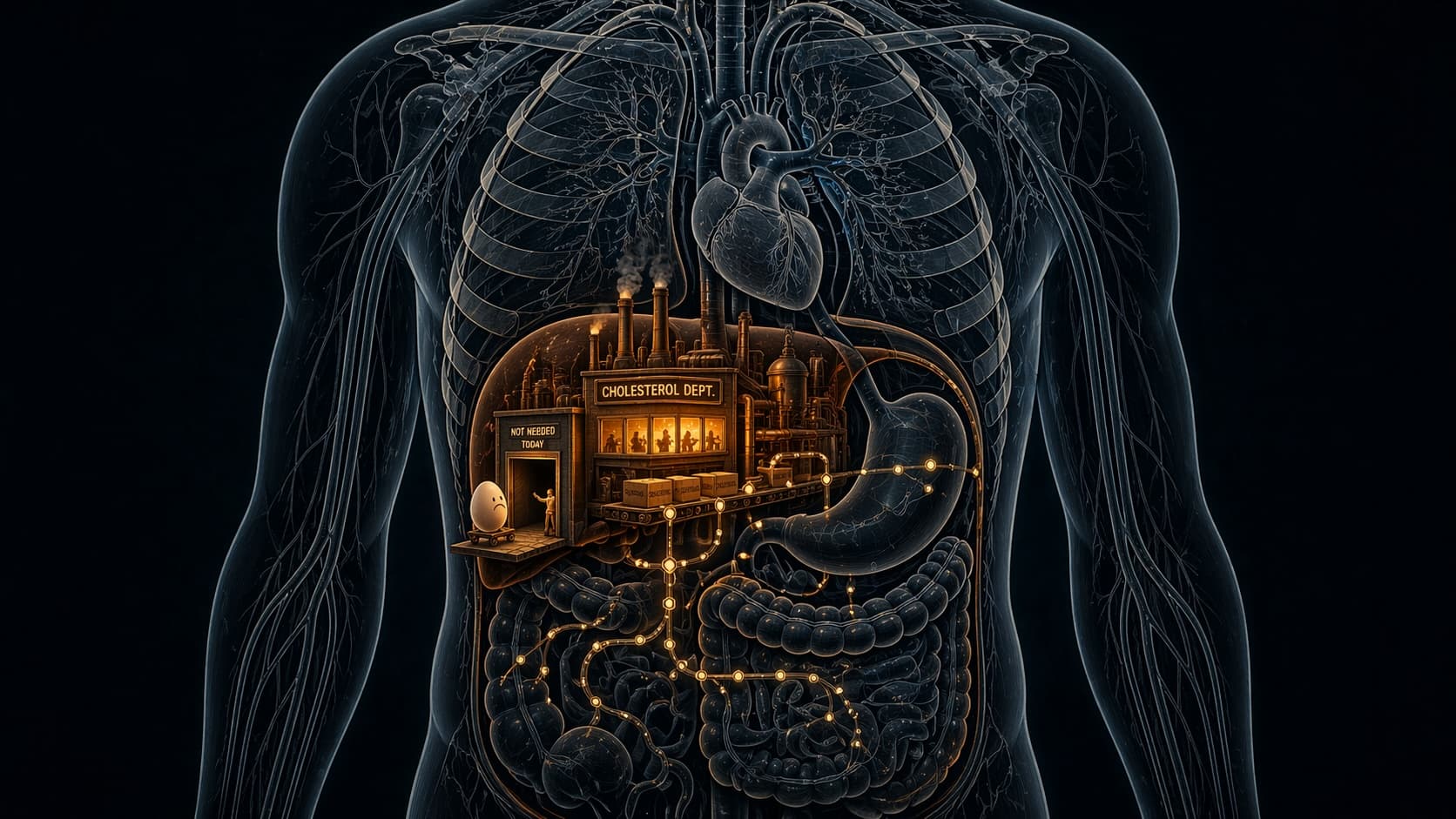
Approximately 75 to 80 percent of the cholesterol circulating in your blood was manufactured by your own liver. Not eaten. Made. Your liver produces cholesterol continuously because cholesterol is essential — it is a structural component of every cell membrane in your body, a precursor to hormones including oestrogen and testosterone, and necessary for the production of vitamin D and bile acids that enable fat digestion.

Your body needs cholesterol so much that it makes most of it itself, regardless of how much you consume. When you eat more dietary cholesterol, your liver typically produces less to compensate. When you eat less, it produces more. For most people, within normal ranges of dietary cholesterol intake, the body self-regulates with reasonable efficiency.
This is why you can eat a zero-cholesterol diet and still have high blood cholesterol. And why someone who eats eggs every day can have perfectly healthy cholesterol levels. The dietary input is one variable in a system that is primarily internally regulated.
So what actually causes the liver to overproduce cholesterol in ways the body cannot compensate for?
The Real Driver: What Actually Raises Your Cholesterol
Several factors drive elevated blood cholesterol levels more powerfully and more consistently than dietary cholesterol intake.
Chronic caloric excess — overeating — is among the most significant. When you consistently consume more energy than your body needs, the metabolic consequences include elevated triglycerides, reduced HDL cholesterol, and increased production of small dense LDL particles — the specific cholesterol profile most strongly associated with cardiovascular risk. This is not about the cholesterol you eat. It is about the total metabolic stress that overconsumption creates.
Trans fats — found in partially hydrogenated vegetable oils, many commercially produced baked goods, and fried fast food — raise LDL cholesterol and lower HDL cholesterol more aggressively than any naturally occurring food. Ironically, the vegetable oils marketed as "cholesterol-free" heart-healthy alternatives in the 1980s were frequently partially hydrogenated — meaning they contained trans fats that were doing far more cardiovascular damage than the butter or ghee they replaced.
Refined carbohydrate excess — large quantities of white rice, white flour products, added sugar — elevates triglycerides and contributes to the metabolic profile associated with cardiovascular risk. Saturated fat in excess raises LDL cholesterol in most people, though the magnitude varies significantly by individual and the specific saturated fat sources involved.
Genetics plays a substantial role. Familial hypercholesterolaemia — a genetic condition that causes the liver to overproduce LDL cholesterol regardless of diet — affects approximately 1 in 250 people and is frequently undiagnosed. People with this condition can have severely elevated cholesterol on a perfectly healthy diet and will not resolve it through dietary changes alone.
Physical inactivity, chronic stress, smoking, and excess alcohol all affect cholesterol profiles through various mechanisms. Sleep deprivation elevates cortisol in ways that drive cholesterol production. Hypothyroidism — extremely common in India, particularly among women — frequently presents with elevated cholesterol as a symptom.
The list of things that matter more than the cholesterol on your plate is long. Dietary cholesterol is on the list. It is just not at the top.
The Vegan Cholesterol Paradox
Here is a thought experiment that illustrates the point cleanly.
A vegan diet contains precisely zero dietary cholesterol. Zero. Not low. Not trace amounts. None. If dietary cholesterol were the primary driver of blood cholesterol levels, vegans should have uniformly excellent cholesterol profiles and dramatically lower rates of cardiovascular disease than omnivores.
The reality is more complicated. Vegans do, on average, tend to have lower LDL cholesterol than omnivores. But the relationship is not as clean or dramatic as the dietary cholesterol hypothesis would predict. And crucially — a vegan who chronically overeats refined carbohydrates, consumes large quantities of processed vegan foods, and lives a sedentary lifestyle can absolutely develop elevated triglycerides, reduced HDL cholesterol, and the kind of metabolic profile that increases cardiovascular risk.
No dietary cholesterol. Metabolic risk anyway. Because the dietary cholesterol was never the primary variable.
It is also worth noting, with affection, that overeating on a whole food vegan diet is genuinely difficult. Have you tried eating 3,000 calories of lentils, vegetables, and whole grains? Your digestive system will strongly discourage the attempt. This incidental caloric restriction may account for a significant portion of the health benefits associated with vegan diets — not the absence of dietary cholesterol itself.
What You Should Actually Do About Cholesterol
Having dismantled several decades of conventional wisdom, it seems fair to offer something practical in its place.
Get your cholesterol checked properly and regularly. A standard lipid panel — total cholesterol, LDL, HDL, triglycerides — gives you the actual numbers you need to make informed decisions. Do not guess based on what you eat. Test.
Understand your numbers in context. Total cholesterol as a single number is a relatively weak predictor of cardiovascular risk. The ratio of LDL to HDL, the level of triglycerides, and increasingly the level of a specific particle called Lp(a) are more informative. Ask your doctor to explain your results rather than just whether you are in or out of range.
Address the actual drivers. If your cholesterol is elevated, the intervention that will matter most is almost certainly not eliminating eggs. It is more likely to be addressing caloric excess, reducing refined carbohydrates and trans fats, increasing physical activity, managing stress, improving sleep, and — if genetics are involved — discussing medication with your doctor.
Stop fearing whole foods with long safety records. Eggs, full-fat dairy, ghee — these have been eaten by humans for thousands of years. The evidence that they cause cardiovascular disease in the context of an otherwise reasonable diet is weak. The evidence that chronic overeating, sedentary behaviour, and trans fat consumption cause cardiovascular disease is strong.
Ignore the "cholesterol-free" label entirely. It tells you nothing useful about whether a product is good for your heart.
The Uncomfortable Summary
Your cholesterol levels are mostly determined by your liver, your genetics, your overall dietary pattern, your physical activity, and your metabolic health — not by the eggs you had for breakfast or the ghee on your roti.
The food industry spent decades convincing you otherwise because it was commercially useful to do so. The science has been quietly correcting the record for thirty years. The labels have not changed because changing them would be bad for business.
Eat whole foods in reasonable quantities. Move your body. Get your blood work done. Do not buy vegetable oil because it says "cholesterol-free" on the label.
And eat the egg.
About Caddy Caddy is India's no-BS nutrition and weight loss companion — built for Indians who are tired of nutrition advice that serves marketing rather than health. Powered by one of India's most comprehensive food databases and designed around Indian eating patterns, Caddy helps you make food decisions based on evidence, not labels. Visit getcaddy.ai