
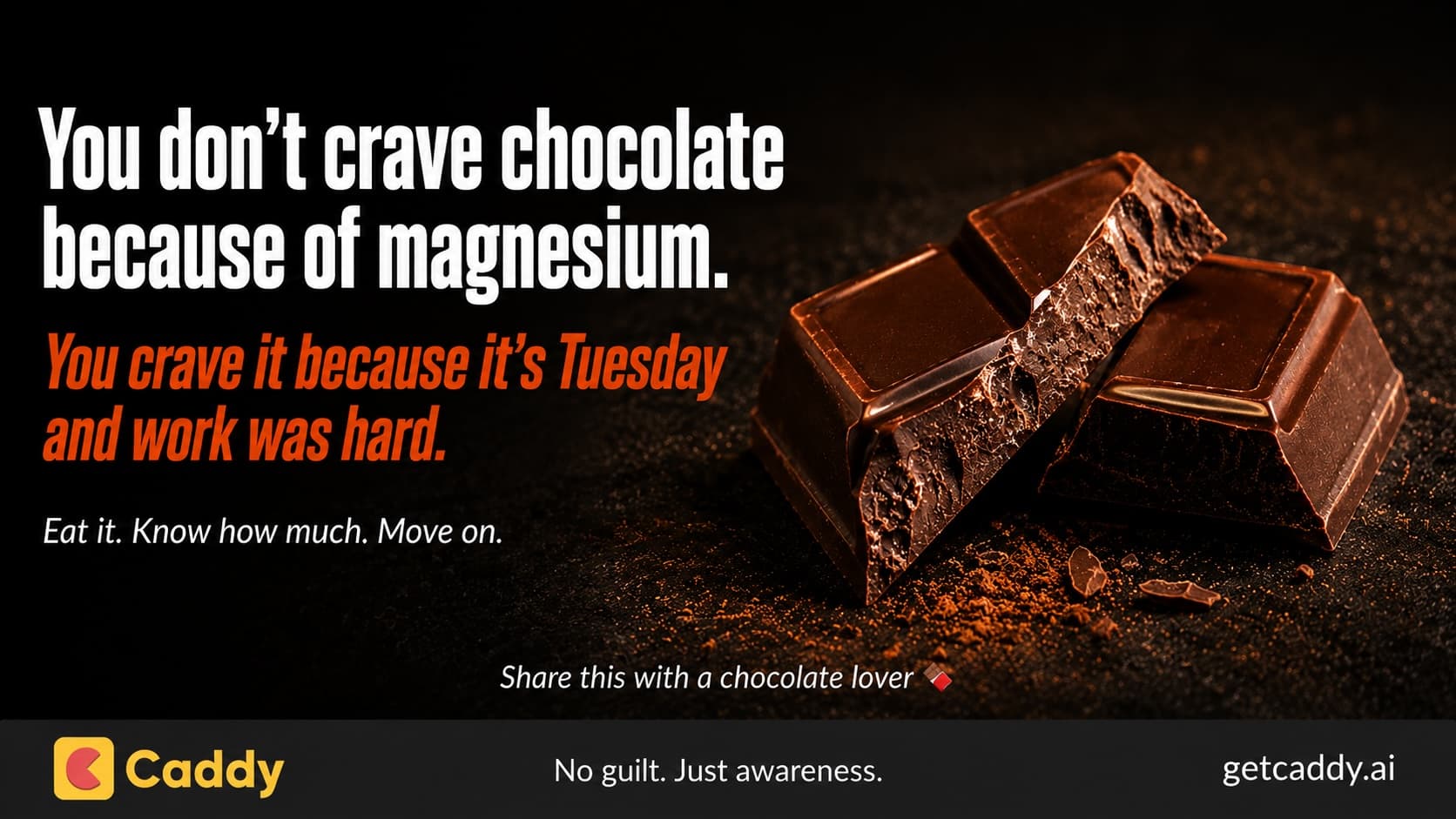
You Don't Crave Chocolate Because of Magnesium. Here Is What the Data Actually Says.
Written by Rishi Bhojnagarwala
Medically Reviewed by Dr. Hetal Pal, PhD in Nutrition Science
The internet has a theory about your chocolate cravings. The data has a different opinion. And so does every human who has ever had a difficult Tuesday.
The Theory That Sounds Like Science
You are sitting on your couch at 9pm. Work was difficult. The week has been long. And somewhere in the back of your mind — or very much in the front of it — you want chocolate.
Your phone, which has been quietly curating wellness content in your direction for the last six months, has an explanation ready.
You are magnesium deficient. Your body has detected this deficiency and is communicating it to you through the medium of a chocolate craving. The solution is simple: eat nuts, which are higher in magnesium and a healthier choice. Craving satisfied. Deficiency addressed. Problem solved.
This theory has been shared millions of times across Instagram, YouTube, and WhatsApp. It has a satisfying biological logic to it. It sounds like the kind of thing a nutritionist would say. It has a scientific-sounding mechanism — magnesium deficiency, biological signalling, nutrient-dense alternatives.
There is one problem. When you look at the actual data, the theory falls apart almost immediately.

What the Numbers Actually Show
Let us start with the foundational claim: chocolate cravings are driven by magnesium deficiency.
The Recommended Dietary Allowance for magnesium is approximately 300 to 420 milligrams per day depending on age and sex. This is the amount your body needs to function optimally.
A standard 30-gram serving of dark chocolate contains approximately 55 milligrams of magnesium.
A standard 30-gram serving of mixed nuts — the food you are supposed to eat instead — contains approximately 75 milligrams of magnesium.
The difference between the two is 20 milligrams. In a daily requirement of 300 to 420 milligrams.
Now here is the calculation that the social media food swap content never includes.
To meet your daily magnesium RDA from chocolate alone, you would need to eat approximately 200 grams of chocolate. That is 1,160 calories of chocolate — more than half the daily caloric intake of an average adult woman — in a single micronutrient-motivated eating session.
To meet the same RDA from mixed nuts, you would need approximately 200 grams of nuts. That is 1,230 calories. Essentially the same caloric cost, slightly more magnesium, and an experience that is not remotely comparable to eating chocolate when you want chocolate.
The swap saves you 20 milligrams of magnesium per 30-gram serving and costs you 10 additional calories. Neither the magnesium difference nor the calorie difference is meaningful at realistic serving sizes. Neither serving size would come close to addressing a genuine magnesium deficiency.
If magnesium deficiency were genuinely driving your chocolate craving, eating 30 grams of either chocolate or nuts would do essentially nothing to address it — and you would still want the chocolate.
The Question Nobody Asks
Here is the logical gap at the centre of the magnesium-craving theory that nobody who shares it ever addresses.
If your body is sophisticated enough to detect a magnesium deficiency and generate a specific food craving in response to it — why does it crave chocolate?
Mixed nuts have more magnesium per gram than chocolate. If the craving is genuinely a biological signal pointing you toward the most efficient source of the missing mineral, the body should be generating a nut craving. The body should be sending you to the almond jar.
Instead it sends you to the chocolate. And then the internet tells you to go to the almond jar anyway, overriding the signal the body supposedly sent.
This creates a logical situation where the body is simultaneously smart enough to detect a micronutrient deficiency, generate a targeted craving in response, and simultaneously stupid enough to point you at the wrong food for that deficiency — leaving it to a wellness influencer to correct the error.
The simpler explanation, which the data supports considerably better than the magnesium hypothesis, is that your body is not craving chocolate because of magnesium. It is craving chocolate because you like chocolate, because something triggered a comfort response, and because chocolate has been associated with pleasure and relief in your neural pathways for your entire life.
That is not a deficiency. That is being human.

The Problem With Food Swap Advice
The magnesium-and-chocolate example is one instance of a much broader pattern in social media nutrition content — the food swap recommendation.
The format is consistent and recognisable. You crave food A. This is explained by a deficiency of nutrient X. Food B contains more of nutrient X and is a healthier choice. Therefore eat food B instead of food A.
The format has several structural problems that apply almost universally regardless of the specific foods and nutrients involved.
First, food cravings are not primarily driven by micronutrient deficiencies. The research on food cravings points overwhelmingly toward psychological, emotional, contextual, and habitual drivers — stress, reward association, sensory memory, habit loops, emotional state, time of day, social context. Specific nutrient deficiencies can influence appetite broadly but they do not generate targeted cravings for specific foods with the precision the food swap theory assumes.
Second, even if nutrient deficiency were a driver of specific cravings, the substitution logic fails on the numbers. The quantities of most foods required to meaningfully address a genuine deficiency are far beyond what anyone eats in a single craving-driven serving. A 30-gram piece of chocolate is not a magnesium intervention. It is a snack.
Third, and most importantly, food is not only fuel. It is memory. It is comfort. It is pleasure. It is ritual. It is culture. It is the specific smell of your grandmother's kitchen and the texture of something you ate as a child and the particular relief of a known flavour at the end of a difficult day. None of these things can be swapped. You cannot substitute the emotional content of a food craving with a nutritionally superior alternative and expect satisfaction. The craving is not asking for magnesium. It is asking for something the magnesium in nuts cannot provide.
What Chocolate Actually Is
Dark chocolate is not a health food in the sense that its consumption should be medically justified or nutritionally defended. It does not need to be.
It contains magnesium — yes, though not enough to address a genuine deficiency in realistic serving sizes. It contains antioxidants — yes, though the clinical significance of dietary antioxidants is more complex than most health content acknowledges. It contains sugar and fat — yes, which means it contributes calories and should be consumed with awareness of that fact.
But it also tastes good. It produces measurable pleasurable responses in the brain. It has been part of human food culture for centuries. It provides genuine comfort and enjoyment to the people who eat it.
These are legitimate and sufficient reasons to eat chocolate. They do not require a biological justification. They do not need to be dressed up as a mineral absorption strategy to be valid.
The insistence that eating should always be optimised, that every food choice should serve a functional purpose, that cravings are symptoms to be decoded and corrected rather than experiences to be acknowledged — this is an impoverished relationship with food. It is also, on the evidence, not particularly effective. The people who eat chocolate when they want it and stop when they are satisfied are not doing worse nutritionally than the people who eat nuts instead and spend the evening thinking about the chocolate they did not have.
The Honest Version of This Conversation
Here is what a data-honest response to a chocolate craving actually looks like.
You want chocolate. Chocolate contains approximately 170 to 180 calories per 30-gram serving. If that fits within your daily caloric awareness — if you know what else you have eaten today and understand roughly where you stand — eat the chocolate. Enjoy it. Stop when you are satisfied.
If you are genuinely concerned about magnesium intake, the foods most meaningfully rich in magnesium in quantities you would realistically eat — pumpkin seeds, leafy greens, legumes, whole grains — are worth including in your regular diet. Not as a craving swap, but as part of eating a varied and nutritionally adequate diet over time.
If you are stressed or tired or having a difficult week, no food swap will fix that. Nuts are excellent food. They will not make Tuesday less difficult.
The goal is not to decode your cravings and correct them with nutritional substitutions. The goal is to know what you eat, eat in amounts that support your health goals, and have a relationship with food that is based on enjoyment and awareness rather than guilt and biological mythology.
The Bottom Line
Your chocolate craving is not a magnesium deficiency message. It is not a symptom requiring diagnosis. It is not a problem requiring a swap.
It is a human experience. One of many. Eat the chocolate, know how much you ate, and let that be the whole story.
And perhaps share this with the person in your life who has been eating nuts when they wanted chocolate. They deserve to know.
About Caddy Caddy is built on one radical idea — know what you ate and how much. Whether it is chocolate, biryani, or a handful of nuts, Caddy tracks it accurately using one of India's most comprehensive food databases and gives you one honest number. No guilt. No mythology. Just awareness. Visit getcaddy.ai